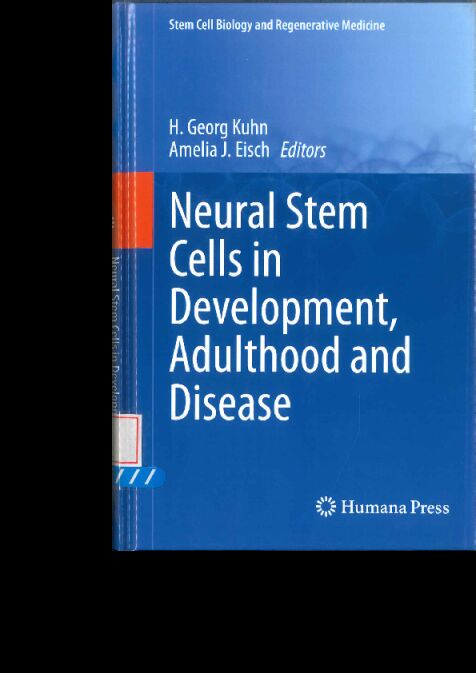
书名:Neural stem cells in development, adulthood, and disease
责任者:H. Georg Kuhn | Amelia J. Eisch
出版时间:2015
出版社:Humana Press
摘要
The previous assumption that the adult mammalian brain cannot generate new neurons has been definitively refuted with the discovery of continually ongoing neurogenesis in discrete regions of the central nervous system (CNS) in all mammalian species studied so far. The characterization of neural stem cells, their progeny and lineages, and the signaling pathways that guide these processes has fundamentally changed our view on development and repair of the CNS and even the peripheral nervous system as well.
It is in this context that we recruited prominent researchers in the field of neural stem cells and neurogenesis to provide their perspective on this rapidly changing field. The ten chapters in this book—briefly introduced below—cover a range of topics that will be of interest to both the established neurogenesis researcher as well as to readers with general interests in nervous system science. The chapters are designed to stand alone, yet even greater understanding of the field can be gained by reading the book in its entirety, following the chapters in the order they are presented.
Adult neurogenesis exists in numerous mammalian and nonmammalian species. Chapter "Adult Neurogenesis and Regeneration: Focus on Non-mammalian Vertebrates" by Ferretti and Prasongchean highlights that the contribution of adult neurogenesis to repair processes varies greatly between vertebrates. These species- specific traits provide an important opportunity to study differences in cellular and molecular mechanisms of adult neurogenesis and its contribution to neuronal cell turnover and structural repair in the CNS.
In mammals including humans, neural stem cell activity is most commonly observed in the juvenile and adult brain within the subventricular zone of the lateral ventricles and within the subgranular zone of the dentate gyrus. In chapter "Differential Intrinsic and Extrinsic Regulations of the Two Adult Neurogenic Regions," Guo and Zhao focus on comparing these regions and highlighting differential regulation of neurogenesis between these sites in order to evaluate their respective regenerative potentials.
A strong link between adult hippocampal neurogenesis and affective disorders such as depression and anxiety has been proposed because behavioral changes and neurogenesis are coregulated by alterations in serotonin neurotransmission. In chapter "The Role of Adult-Born Dentate Granule Neurons in the Regulation of Mood," Guo, Gatchel, and Sahay address whether the role of adult-born neurons in modulation of anxiety and depression-like behaviors is dependent on their proposed role in hippocampal function such as in pattern separation.
Although new neurons are continually produced in the adult human brain and may in the future serve as a replacement for dying neurons, adult neurogenesis itself could be affected by diseases. Chapter "Stem Cells and Neurogenesis in Relation to Dementia and Alzheimer's Disease Mouse Models" by Lucassen and colleagues and chapter "Hippocampal Neurogenesis in Neurodegenerative Movement Disorders" by Kohl and colleagues examine how the production of neurons is regulated by chronic neurodegenerative diseases, such as Alzheimer's, Parkinson's, and Huntington's disease. It appears that immature neurons are very vulnerable to changes in cellular milieu within the neurogenic regions in these diseases and their animal models. The resulting deterioration in neurogenesis may further reduce the ability of the adult brain to cope with pathological changes and may enhance specific cognitive and affective symptoms in these disorders.
In epilepsy, in contrast to neurodegenerative diseases, it has been speculated that new neurons could aggravate the occurrence of subsequent spontaneous seizures. In chapter "Linking Adult Neurogenesis to Epilepsy Through Epigenetics," Cho and Hsieh review the evidence for an involvement of seizure-induced neurogenesis in the onset and progression of the disease with a particularly focus on ectopic dentate gyrus granule cell production. Furthermore, epigenetic alterations, which may control behavior of hippocampal neural stem cells and their progeny after seizures, are discussed as possible contributor to epilepsy.
Increased production of neurons in the dentate gyrus is assumed to elevate hippocampal function. Chapter "Activity-Based Maintenance of Adult Hippocampal Neurogenesis: Maintaining a Potential for Lifelong Plasticity" by Kempermann explores the conditions under which it could be possible to inspire and maintain a high level of neuronal production. Maintaining a pool of recruitable progenitor cells through means of environmental stimulation and physical exercise may provide an important and natural approach to prevent the aging-related decline in hippocampal neurogenesis.
Neural stem cells in the adult brain are multipotent and the generation of oligo- dendrocytes opens the exciting possibility to respond to myelin loss by generating new myelin sheaths. Chapter "Neural Stem Cells and Demyelinating Disease" by Crawford and Franklin explores possibilities for local as well as transplanted stem cells and oligodendrocyte precursor cells to induce remyelination, reinstate rapid axonal conduction, and resolve functional deficits of demyelinating diseases.
Spinal cord injury requires reestablishment of sensory and motor connections across complex damaged neural tissue. Chapter "Stem Cell-Based Therapies for Spinal Cord Regeneration" by Sandner and colleagues provides an overview on the current status of neural stem cell transplantation in spinal cord injury and discusses future perspectives for the generation of astroglia, oligodendroglia, and neurons in spinal cord repair.
The final chapter, "Direct Reprogramming of Somatic Cells into Induced Neuronal Cells: Where We Are and Where We Want to Go," by Masserdotti and Berninger on direct reprogramming of somatic cells into neurons merges the knowledge that has accumulated on the induction of a stem cell state in somatic cells, the so-called induced pluripotency, with the more specific requirements for directed neuronal development within a neurodegenerative environment. It gives thus an outlook towards exciting future strategies of creating neurons in regions of the CNS that have no or only limited capacity for neurogenesis.
Taken together, these reviews by leading researchers emphasize the multifaceted progress made in understanding the functional role of neural stem cells in the adult nervous system. This is an extremely exciting time to study neural stem cells, and there is significant hope that the findings discussed in this book will translate into clinical advances in the near future. Dallas, TX:Amelia J. Eisch, Gothenburg, Sweden:H. Georg Kuhn
查看更多
目录
Adult Neurogenesis and Regeneration: Focus on Nonmammalian Vertebrates 1
Differential Intrinsic and Extrinsic Regulations of the Two Adult Neurogenic Regions 23
The Role of Adult-Born Dentate Granule Neurons in the Regulation of Mood 41
Stem Cells and Neurogenesis in Relation to Dementia and Alzheimer's Disease Mouse Models 53
Hippocampal Neurogenesis in Neurodegenerative Movement Disorders 79
Linking Adult Neurogenesis to Epilepsy Through Epigenetics 107
Activity-Based Maintenance of Adult Hippocampal Neurogenesis: Maintaining a Potential for Lifelong Plasticity 119
Neural Stem Cells and Demyelinating Disease 125
Stem Cell-Based Therapies for Spinal Cord Regeneration 155
Direct Reprogramming of Somatic Cells into Induced Neuronal Cells: Where We Are and Where We Want to Go 175
Index 197
查看PDF
查看更多
馆藏单位
中国医科院医学信息研究所