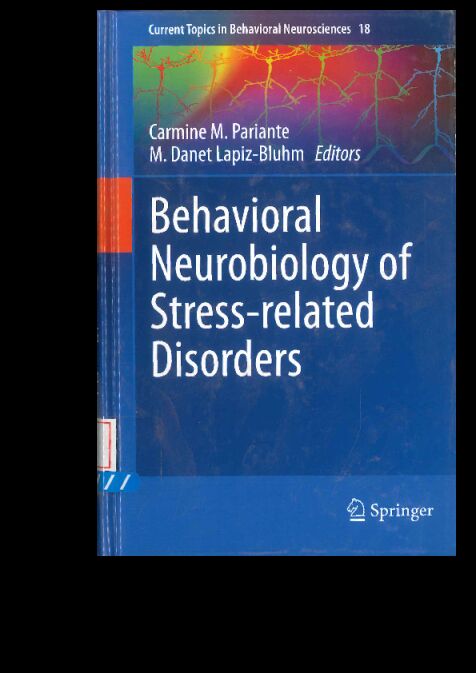
书名:Behavioral neurobiology of stress-related disorders
责任者:Carmine M. Pariante | M. Danet Lapiz-Bluhm. | Lapiz-Bluhm, M. Danet
前言
Since Selye defined stress in 1936, the field saw an exponential growth of research on the many facets of its effects. We are delighted to present this book that brings together some of the world leading experts on the neurobiology of stress at the pre-clinical and clinical level. Stress is such an over-used word that it is at times difficult to define its core features. When is an environment stressful? What does a stressful environment do to the brain and to do the body? What are the biological mechanisms by which a stressor affects us? Why some environmental conditions are stressful for some individuals and not others? How does stress contributes to the onset and the progression of mental disorders? How do the effects of stress change over the life-time of an individual? These are just some of the overarching questions that this book attempts to address, thanks to the contribution of 14 different chapters that cover a variety of topics.
In broad terms, the chapters can be grouped in three main streams. In the first stream, and over five chapters, this book present the biological pathways that are regulated by stress and that mediate the effects of stress on the brain and on the body, eventually affecting mental and physical health. These chapters cover brain-relevant mechanisms, ranging from "neurotransmitter systems" to "neuropep tides" to "neurogenesis and neuroplasticity". Moreover, they expand into mechanisms that are relevant to both the brain and the body, such as the "immune system" and the "hypothalamic-pituitary-adrenal axis" (HPA). In "Neuronal-Glial Mechanisms of Exercise-Evoked Stress Robustness", Dr. Monika Fleshner (University of Colorado, USA) and colleagues described an aspect of the interaction of stress, the immune system and behaviour. Their team presents a novel hypothesis on the role of exercise in promoting stress robustness through neuronal-glial mechanisms. Stress robustness incorporates resistance to stress and stress resilience. In "The Interface of Stress and the HPA Axis in Behavioural Phenotypes of Mental Illness", Dr. Carmine M. Pariante and Dr. David Baumeister from King's College London as well as Dr. Stafford Lightman (University of Bristol, UK) described the interface of stress and the HPA in behavioural phenotypes of mental illness. They elaborated on the clinical and molecular role of the neuroendocrine stress system in depressive, psychotic and post-traumatic stress disorders. In "Adult Hippocampal Neurogenesis in Depression: Behavioral Implications and Regulation by the Stress System", Dr. Chistoph Anacker (McGill University, Canada) addressed the interaction of stress, neurogenesis, neuroplasticity and behaviour. He reviewed some of the existing evidence for stress-and antidepressant-induced changes in adult hippo-campal neurogenesis and their effects on depression and anxiety. In "Impact of Stress on Prefrontal Glutamatergic, Monoaminergic and Cannabinoid Systems", Dr. M. Danet Lapiz-Bluhm (University of Texas Health Science Center at San Antonio, USA) presented a concise review of the effects of stress and glucocorti-coids on the glutamatergic, monoaminergic and cannabinoid signalling pathways modulating the prefrontal cortex. In "Interaction of Stress, Corticotropin-Releasing Factor, Arginine Vasopressin and Behaviour", Dr. Eleonore Beurel and Dr. Charles Nemeroff from the University of Miami (USA) focused on two peptidergic systems, i.e, corticotrophin releasing factor (CRF) and arginine vasopressin (AVP), on their roles in regulating stress response. Drugs that antagonize CRF and AVP receptors may have potential as a therapy for depression.
In the second stream, the emphasis is on psychological mechanisms that both mediate and modify the effects of stress, covering topics such as "cognition and emotional processing", the effects during "pregnancy and postnatal period" or "aging", and the important issue of "resilience". Across all chapters, the emphasis is on understanding the complex relationship between stress and behaviour, in all circumstances, leading sometimes to normal and sometimes to abnormal behavioural outcomes.
In "Long-lasting Consequences of Early Life Stress on Brain Structure, Emotion and Cognition", Dr. Harm Krugers (University of Amsterdam, Netherlands) and Dr. Marian Joels (University Medical Center Utrecht, Netherlands) reviewed how early postnatal adversity determine the structure and function of the hippocampus, amygdala and the prefrontal cortex. These areas are crucial for the normal cognitive and emotional development. Along the same line, in "Mechanisms Linking In Utero Stress to Altered Offspring Behaviour", Dr. Theresia Mina and Dr. Rebecca Reynolds from the Queen's Medical Research Institute (Edinburgh, UK) highlighted the link between maternal in utero stressors on adverse behavioural outcomes of the offspring including poorer cognitive function as well as behavioural and emotional problems.
The succeeding chapters focus on the effects of stress on different psychiatric disorders. A team from Lundbeck Research USA and Denmark led by Dr. Connie Sanchez posed the question in "Does Stress Elicit Depression?", Dr. Helle Sickmann, Dr. Yan Li, Dr. Arne Mork, Dr. Connie Sanchez, and Dr. Maria Gulinello critically reviewed clinical and pre-clinical findings that may explain how stress can cause depression. Dr. M. Danet Lapiz-Bluhm and Dr. Alan Peterson, Director of STRONG STAR (South Texas Research Organizational Network Guiding Studies on Trauma and Resilience) PTSD Consortium, and both from the University of Texas Health Science Center at San Antonio (USA) reviewed the "Neurobehavioral Mechanisms of Traumatic Stress in Posttraumatic Stress Disorder". They reviewed the neurobi-ology of the effects of traumatic stress in the development of PTSD, specifically on mechanisms that are involved in fear conditioning and fear extinction. Dr. David Baldwin and Dr. Hesham Yousry Elnazer from the University of Southampton (UK) addressed the role of stress in the development of anxiety disorders in "Investigation of Cortisol Levels in Patients with Anxiety Disorders: A Structured Review". Specifically, they reviewed HPA function across panic disorder, generalized anxiety disorder, specific phobias and social anxiety disorder.
In "Stress, Schizophrenia and Bipolar Disorder", a team from the University of New South Wales (Australia) and Schizophrenia Research Institute in Sydney (Australia) headed by Dr. Melissa Green reviewed the role of stress in the development of schizophrenia and bipolar disorder. They (Dr. Melissa Green, Dr. Leah Girshkin, Dr. Nina Teroganova and Dr. Yann Quide) highlighted on how epigenetic studies of the effects of early life stress on gene expression may hold promise for unravelling the interaction between genes and environment to inform the 'stress-vulnerability' model of psychosis.
In "Stress, Substance Abuse, and Addiction", Drs. Charles Mathias and Dr. Donald Dougherty from the University of Texas Health Science Center at San Antonio (USA) in collaboration with Dr. Tiffany Duffing and Dr. Stefanie Greiner from Fielding Graduate University (USA) addressed the role of stress in substance abuse and addiction. They reviewed the developmental and biological processes involved in the relationship of stress exposure and substance use initiation, substance use maintenance and relapse, and response to substance abuse treatment. Special emphasis was given to describing the various stress-related mechanisms involved in substance use and abuse, highlighting the differences between each of these phases of drug use and drawing upon current research to make suggestions for treatments of substance use disorder (SUD) patients.
Dr. Mak Daulatzai (University of Melbourne, Australia) addressed the role of stress, depression and aging in cognitive decline and Alzheimer's disease in "Role of Stress, Depression, and Aging in Cognitive Decline and Alzheimer's Disease". He highlighted the role of gut systemic inflammation towards the development of neuroinflammation, which may subsequently upregulate hippocampal formation of amyloid beta and neurofibrillary tangles, synaptic and neuronal degeneration, gray matter volume atrophy, and progressive cognitive decline.
Last, but certainly not least, "Role of Stress, Depression, and Aging in Cognitive Decline and Alzheimer's Disease" addressed the issue on psychological resiliency to stress. Dr. Alan Peterson, Dr. Tabatha Blount and Dr. Donald McGreary from the University of Texas Health Science Center at San Antonio (USA) described how research on psychological resiliency is at its infancy and is limited by a number of factors including: (1) the broad use of the term resiliency; (2) the lack of standardized definitions of resiliency; (3) a primary focus on descriptive, assessment, and measurement studies; (4) relatively few randomized controlled trials to evaluate the efficacy of resiliency enhancement programs; and (5) methodological challenges inherent in conducting applied resiliency research. More studies are needed to better understand the behavioural neurobiology of stress and psychological resiliency.
To both the novice and the expert, this book will provide the reader "one-stop" resource on the most current body of knowledge and advances on the neurobiology of the pervasive effects of stress on various neurobiological systems and its role in the development of various stress-related disorder and resilience. London, UK Carmine M. Pariante; San Antonio, USA M. Danet Lapiz-Bluhm
查看更多
目录
Neuronal-Glial Mechanisms of Exercise-Evoked Stress Robustness 1
The Interface of Stress and the HPA Axis in Behavioural Phenotypes of Mental Illness 13
Adult Hippocampal Neurogenesis in Depression: Behavioral Implications and Regulation by the Stress System 25
Impact of Stress on Prefrontal Glutamatergic, Monoaminergic and Cannabinoid Systems 45
Interaction of Stress, Corticotropin-Releasing Factor, Arginine Vasopressin and Behaviour 67
Long-lasting Consequences of Early Life Stress on Brain Structure, Emotion and Cognition 81
Mechanisms Linking In Utero Stress to Altered Offspring Behaviour 93
Does Stress Elicit Depression? Evidence From Clinical and Preclinical Studies 123
Neurobehavioral Mechanisms of Traumatic Stress in Post-traumatic Stress Disorder 161
Investigation of Cortisol Levels in Patients with Anxiety Disorders: A Structured Review 191
Stress, Schizophrenia and Bipolar Disorder 217
Stress, Substance Abuse, and Addiction 237
Role of Stress, Depression, and Aging in Cognitive Decline and Alzheimer's Disease 265
Stress and Psychological Resiliency 297
Index 313
查看PDF
查看更多
馆藏单位
中国医科院医学信息研究所