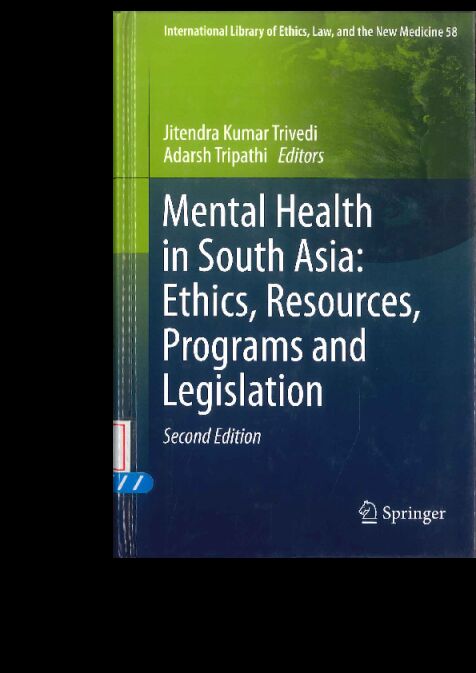
书名:Mental health in South Asia
责任者:Jitendra Kumar Trivedi | Adarsh Tripathi.
摘要
This book on "Mental Health in South Asia: Ethics, Resources, Programs and Legislation" is a readable, timely resource for the relevant mental health related issues from this socio-politically and culturally varied region of the world. The field of mental health has seen dramatic and rapid advances in the recent years, making it difficult for many regions of the world to keep abreast with relatively more developed parts of the world. Ethical and legal issues, mental health program and community psychiatry practices in this part of world are in a stage of flux with further rapid changes are expected. While sharing a number of similarities like scarcity of resources, financial limitations and increasing adversities, there is a growing consensus among the regional countries in South Asia that the delivery of mental health care can be improved with better cooperation and collaboration. This is an important time to put the mental health picture of the South Asian region in right perspective so as to enable us to grow further rapidly. This book is likely to be of great use to academic psychiatrists, educators, students of mental health professionals as well as of law and policy makers of South Asian region and others interested in the developments in this part of the world like advocacy groups etc.
Despite the great diversity in this region, a common thread of a large burden of mental and behavioural disorders, huge treatment gap due to scarcity of available mental health resources, inequities in their distribution, and inefficiencies in their use persist. It has been our guiding principle to trace the common links between these countries mental health issues pertaining to ethical, legal and community psychiatry related issues and to suggest wherever possible ways for further growth and developments. We have a galaxy of scholarly authors prominent in the South Asian region or consistently working actively in collaboration with these countries so that they have developed an authority on the topics on which they have wrote chapters and countries they worked. They are leaders in their fields and represent a broad spectrum of institutions and countries. We are indebted to these outstanding academicians and researchers who have contributed to this volume. Each chapter is written with a specific focus. There are minor repetitions in few places as may be expected from a multi-author book but each chapter can stand alone. Use of headings and subheadings make it easy to use book.
The first section starts with ethics. This is indeed most important part of the book. In the current scenario, a greater awareness and interest in the ethics is expected and this region should be discussed with even more cautiously. Psychiatry as a medical science has been under constant scrutiny. Considering the various varied dimensions of psychiatry, ethics plays a crucial role in safeguarding psychiatry as a profession. Ethics helps psychiatrists to be transparent and accountable in their practice and also helps us to protect the rights of the persons with mental illness. These ethical issues are all the more pertinent in South Asia, which consists of countries with great cultural and linguistic diversity. This section has five chapters. These chapters include important discussions on human rights related issues, ethical principles in practice, research and its implications in psychological interventions. Considerations related to spirituality and religiosity is becoming increasingly important in psychiatry. These are even more important in countries and societies where religion and spirituality play a big role and it is inevitable that these values may well carry more weight than legal frameworks. Finally, a chapter makes relevant comparisons of differences in ethical practises and standards in east and west as a whole. We have been deliberate in choices of the topics and sequence of the chapters so as to develop a smooth flow of information in a particular way.
The second section deals with the resources and opportunities pertaining to mental health services in this geographical area. Mental health care is by no means is standardised and is extremely varied in perception and practices. This section has been again divided into 2 subsections. The first subsection deals with mental health program and policies. First chapter looked into mental health programs in South Asian countries and have discussed the areas that need urgent attention both by the governments as well as by other mental health services providers. The second chapter continues the discussion with special opportunities and major obstacles faced in planning, implementation and supervision. In order to address the huge and largely unmet burden of mental health disorders in the region, it is essential to scale-up evidence-based interventions by progressively strengthening existing mental health systems. This also mentions unique endeavours made for improvement in mental health scenarios by NGOs and private sectors. The last two chapters are written with a more specific comparative approach. These discuss USA's mental health policies, programs, ethical, legal and human right related issues with the aim to examine what South Asian countries, India as an example, can learn.
The second subsection deals with status of community psychiatry in South Asia comprehensively. The chapters discuss community mental health programs and mental health resources including professionals. Public health sector has failed to deal with the huge treatment gap in South Asian countries. Private sector psychiatry has emerged as a potential service provider. Same way Non Government Organizations (NGO) has also played an active role in many countries of the region. Chapters on private sector and NGOs discuss pertinent issues related to them. Another chapter in the sequence attempt to answer the question of what is needed to correct situation of mental health care mainly community psychiatry in South Asia. Transcultural comparisons taking the differences and commonalities into consideration in the fields of mental health and ill mental health have always been a focus of scientific interest. The 'East' and 'West' comparison is one of the most widely deliberated. Beyond the inequalities and discrepancies in resources, the 'East and West' dualism has an impact on mental health theory and praxis in a many different ways. The range, content, patterns and expression of psychopathology and psychiatric symptomatology; the explanatory models of mental disorders; the diagnostic and classification systems; the psychopharmacological and psychotherapeutical interventions; the role of family and psychosocial support systems; basic conceptualizations of mental health and disease are some of the main areas of diversity. Next chapter discuss theses aspects in greater details.
The third and last section deals with the mental health legislation. Due to the common heritage and historical roots, the current scenario of mental health legislation has many commonalities in countries of the South Asian region. Many of the mental health acts in the region still have an institutional and custodial philosophy and lack human rights and community based mental health care approach. Besides ambiguities and lacunae in the acts themselves, there are major flaws in their implementation too. Therefore, mentally ill people continue to be vulnerable to various types of abuse and violation of their rights in the region. The first chapter describes a type of law governing involuntary treatment that is based on decision-making capacity and not on risk of harm to self or others. It is consistent with the legal and ethical principles followed in general medicine, and non-discriminatory against people with a mental illness. It is argued that this type of law could be adapted to the needs of many countries in South Asia without sacrificing its underlying principles and this approach could better serve need of these countries. Other chapters aims to discuss major shortcomings, difficulties faced during implementations and possible solutions for these problems. Finally comparisons between legislation of south Asian countries and western countries have been made with the intention to identify lacunae and plan comprehensive strategies for further improvements. Major areas of concern includes include poor constitutional guarantees for proper health services, inadequate attention to socioeconomic rights, civil and political rights and different cultural norms in comparison to the industrialized countries. Reform of mental health legislation will have to go hand in hand with increased trained manpower, improved resource allocation and improvement of services.
We acknowledge the help of Mr. Christopher Wilby and Prof. Weisstub for their continuous support and encouragement during this arduous journey. We would also like to acknowledge with thanks the feedback of our colleagues, trainees and students, who have been essential in the modification of the content of this volume. Finally, we also like to thank our patients and their families whose unheard voices motivated us to undertook this project and complete it so that it might help in the betterment of the mental health services in South Asia. Jiterndra Kumar Trivedi; Adarsh Tripathi
查看更多
目录
Part I Ethical Issues
1 Human Rights and Psychiatry in South Asia 3
2 Ethical Issues in Psychiatry in Southeast Asia: Research and Practice 19
3 Ethical Handling of Religious and Spiritual Issues: South Asian Perspective 35
4 Ethics and Psychiatry: East Versus West 49
5 Ethics in Counselling and Psycho-Therapy: What We Need to Learn-South Asian Perspective 63
Part II Resources and Opportunities/Mental Health Programs and Policies (their current status and future prospects)
6 Programs of Mental Health and Policies in South Asia: Origin and Current Status 81
7 Mental Health Programs and Policies in South Asia: Initiatives and Obstacles 95
8 Mental Health Services in USA: Policies and Programs-What can India Learn from Western Models? 113
9 Mental Health Services in USA: Ethical and Legal Aspects and Human Rights-What India can Learn from Western Models 133
Part III Resources and Opportunities/Community Psychiatry
10 Mental Health Programs at Community Level in South Asian Countries: Progress, Problems and Prospects 155
11 Mental Health Resources in South Asia 191
12 Allied Mental Health Professionals: Clinical Psychologists, Psychiatric Nurses and Psychiatric Social Workers: Availability and Competency 221
13 Private Sector Psychiatry: What it has to Offer to Mentally 111 Persons in South Asia? 233
14 NGOs and Mental Health: Initiatives and Progress 247
15 Roadmap for the Future: What is Needed in the Region? 263
16 Mental Health in the Context of East and West: Beyond Resources and Geographical Realities 279
Part IV Mental Health Legislation 289
17 A Mental Health Law for Low and Middle Income Countries 291
18 Mental Health Legislation in South Asian Countries: Shortcomings and Possible Solutions 319
19 Mental Health Legislation: Evolution and Implementation in South Asian Countries 333
20 Mental Health Legislation: Comparison of South Asian and Western Countries 343
查看PDF
查看更多
馆藏单位
中国医科院医学信息研究所