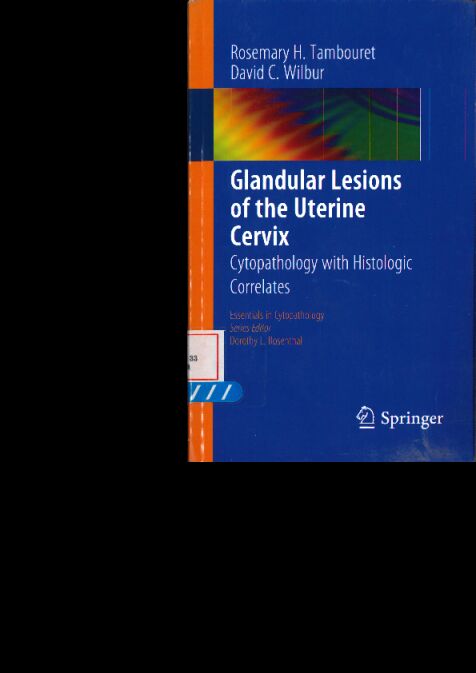
书名:Glandular lesions of the uterine cervix
责任者:Rosemary H. Tambouret | David C. Wilbur.
前言
The evaluation of glandular lesions in cervical cytology specimens can be vexing, even to the most experienced cytologist. The mere identification that a glandular lesion is present can be subtle during the screening process, and once a potential abnormality is detected, accurate classification can be even more challenging. Compared to the more prevalent squa-mous lesions, glandular lesions in cervical cytology specimens were not well recognized or fully classified until late. Endocervical adenocarcinoma in situ (AIS) was not fully described in the histopathology literature until 1953, and it was not codified as a discrete cytologic entity until the second edition of the Bethesda Manual (TBS2) in 2001. Prior to that AIS was grouped under the descriptor of "atypical glandular cells of undetermined significance, favor neopla-sia." In the 1990s, a number of detailed publications that appeared defined the morphologic characteristics of AIS and showed that when applied correctly, these criteria were actually predictive when histologic specimens were obtained. Extensive study of glandular lesions followed upon the publication of TBS2 such that a variety of conditions affecting glandular cells of the gynecologic tract became better recognized and the morphologic criteria for each became better defined.
It is fair to say that there has been an increased awareness that, although the test is not perfect, glandular lesions can indeed be reliably identified in cervical cytology specimens. As with any newly emerging discipline, the ability to detect glandular lesions has had other effects. Patients now expect that, just like squamous neoplasia, glandular neoplasia can be perfectly identified when present. Many lawsuits alleging malpractice have involved this very subject. The unfortunate truth is that the Pap test is not as sensitive for endocervical as it is for squamous neoplasias. The anatomy of endocervical cell location and the plethora of reactive mimics make accurate detection difficult from both sampling and interpretation viewpoints, respectively. That being said, there is always room for improvement and that is the idea behind the present monograph.
At the Massachusetts General Hospital, we are fortunate to have access to the material from very active gynecologic oncology, colposcopy, and general screening services. In addition, there are a large number of outside consultation cases that are received for review by our subspecialty experts in gynecologic practice, both clinical and pathologic. In the writing of the text and collection of the illustrations, we have attempted to identify the key issues in the cytology of glandular lesions, to present the important demography and clinical features associated with them, and finally to describe and to illustrate the pertinent morphology of these lesions.
The monograph begins with a background discussion and illustration of the normal histology and cytology associated with glandular epithelia in the gynecologic tract. It then describes the prototypical endocervical and endometrial neoplasia spectrums. In addition, illustrations of malignant mim-ickers, namely metastatic adenocarcinomas, which can have appearances very similar to primary lesions will be presented, with the discussion focusing on the features that should help the observer to make a correct final interpretation. The latter morphologic chapters focus on the many mimickers of glandular neoplasia. Entities such as the large number of meta-plastic processes, reactive endocervical cells caused by irritants such as polyps, intrauterine devices, prior biopsies, infectious disease, and many more will be detailed. These benign entities are common and can actually be the underlying cause of many cases of interpretations of "atypical glandular cells (AGC)." It has been a "rule of thumb" for many years that the majority of cases of AGC will turn out to be either benign/reactive or unusual presentations of squamous intraepithelial lesions, with only a small minority actually representing true glandular neoplasias. Hence recognition and correct classification of these presentations as benign can lead to significant improvements in cervical cytology specificity and can help to avoid costly and stressful follow-up clinical investigations. Therefore accuracy in both directions, detection and false negativity, as well as classification and false positivity, are addressed by this monograph.
Aids to interpretation have become very important in his-topathologic applications. When applied to cytologic preparations, the use of immunohistochemistry for markers associated with high risk HPV-associated neoplastic transformation and with types of differentiation has greatly aided again, both detection and classification. The principles behind their use and illustrations to aid in proper interpretation are presented in order to bring the reader up to speed with this newly emerging functionality.
Finally, the management of glandular lesions may seem like the clinicians' domain. But it is extremely important for laboratory professionals to be aware of the published guidelines. These lesions are rare in the general screening population and the cytologist, because of their diagnostic role, may be in the best position to advise and guide the clinician trying to determine the best course of action. Therefore the newest management algorithms are presented to assist the cytologist in this important advisory role. In addition, appropriate quality assurance practices, such as prevalence monitoring, cytology-histology correlation, and HPV testing use are included as these will be important to the laboratorian.
We certainly hope that this monograph meets the needs of the cytology community and that the format and content is displayed in a manner that allows for easy access, adaptability to clinical situations, and ease of information transfer. It has been our pleasure to "put down on paper" these subjects that we have studies and struggled over for the better parts of our careers. We hope that the knowledge and experience that we have gained will be useful to the reader.
查看更多
目录
1 Introduction to Endocervical Glandular Lesions 1
Prevalence 2
Etiology of Endocervical Adenocarcinoma and AIS 4
Clinical Features of Endocervical Adenocarcinoma and AIS 5
Diagnosis of Endocervical Neoplasia 6
References 7
2 Processing, Reporting, and Sensitivity of Cervical Cytology with an Emphasis on Glandular Lesions 11
Obtaining the Cervical Cytology S ample 11
The Requisition 15
Image Analysis-Assisted Screening 16
Specimen Reporting Format and Terminology for Reporting Glandular Lesions Identified on Cervical Cytology 17
Sensitivity of Cervical Cytology for the Presence of Glandular Abnormalities 19
References 20
3 Normal Histology and Cytology of the Endocervix and Endometrium 25
Histology of the Normal Endocervix 25
Cytology of the Normal Endocervix 29
Histology of the Normal Lower Uterine Segment and Endometrium 32
Cytology of Endometrium 34
References 40
4 Cytology of Endocervical Glandular Neoplasia........ 41
Histology and Cytology of Glandular Lesions of the Cervix: Neoplastic and Equivocal 41
Adenocarcinoma, Usual Type, Invasive and In Situ 41
The Cytologic Features of the Usual Type of In Situ and Invasive Cervical Adenocarcinoma 43
Endocervical Adenocarcinoma In Situ, Usual Type 43
Invasive Endocervical Adenocarcinoma, Usual Type 51
Other Variants of Endocervical Adenocarcinoma: Histologic and Cytologic Presentation 54
Mucinous Type 55
Villoglandular Type 58
Endometrioid Type 59
Clear Cell Type 61
Serous Type 61
Mesonephric Type 62
Adenosquamous Type 63
Endocervical Gland Dysplasia and Atypical Endocervical Cells 64
References 67
5 Cytologic Mimics of Endocervical Glandular Neoplasia 69
Histology of Benign Glandular Lesions of the Cervix 69
Histology of Metaplasias and Ectopias 69
Histology of Endocervical Glandular Hyperplasia 72
Histology of Reactive, Infectious, and Inflammatory Lesions 75
Cytology of Reactive Endocervical Cells and Repair 77
Cytology of Tubal and Tubo-Endometrioid Metaplasia 81
Cytology of Pregnancy-Induced Changes 85
Cytology of Changes Due to Intrauterine Device 87
Other Mimics of Endocervical Glandular Neoplasia 90
References 91
6 Cytology of Endometrial Cells and Lesions 95
Exfoliated Endometrium 95
Directly Sampled Endometrium 101
Atypical Exfoliated Endometrial Cells 106
Exfoliated Endometrial Adenocarcinoma 107
Post-hysterectomy Vaginal Smears Following Surgery for Malignancy 113
References 114
7 Cytology of Extracervical Adenocarcinoma 117
Cytomorphology of Metastatic Tumors 118
Work-up 124
The Future 128
References 129
8 Management of Glandular Lesions Identified on Cervical Cytology and Histology with Suggestions for Continuous Quality Improvement in the Cytology Laboratory 133
Rational for Management Guidelines 133
Management Guidelines for the Cytologic Interpretation of "Atypical Glandular Cells" or "Adenocarcinoma In Situ" 135
Management Guidelines for the Cytologic Interpretation of "Atypical Glandular Cells" or "Adenocarcinoma In Situ" in Special Populations: Pregnant Women and Women Aged 21-24 Years 137
Management of Benign Glandular Cells 137
Continuous Quality Improvement in the Cytology Laboratory 138
References 139
Index 141
查看更多
馆藏单位
中国医科院医学信息研究所