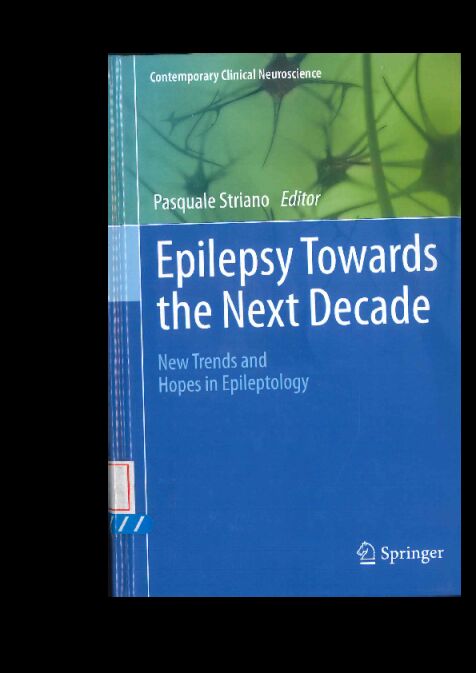
书名:Epilepsy towards the next decade
前言
Epilepsy is a common chronic neurological disorder affecting approximately 0.5—1 % of the population worldwide (~50,000,000 people) and the main goal of the treatment is to eliminate seizures without producing significant side effects. The drug therapy of epilepsy has evolved tremendously in the last twenty years and several antiepileptic drugs have been approved and marketed, offering a good number of options for treatment a large variety of seizure types and epilepsy syndromes. Nevertheless, despite optimal medical treatment, up to 30 % of patients continue to experience recurrent seizures, which may lead to a severe medically, physically, and socially disabling condition. The intent of Epilepsy Towards the Next Decade: New Trends and Hopes in Epileptology is to provide a comprehensive overview of recent advances in the field of epileptology as well as of the recent advances and current knowledge regarding epilepsy research from leading experts in the field. This book aims to provide a handy and updated reference for most recent knowledge regarding the biological basis and the modern clinical approach to epilepsy, bridging the gap between fundamental aspects and clinical implications.A\Epilepsy accounts for a variety of neurological disorders characterized by recurrent seizures. More than half of all epilepsies have some genetic basis and single gene defects in ion channels or neurotransmitter receptors are associated with inherited forms of epilepsy. In the last ten years, advances in the genetic techniques including oligonucleotide array and the following large scale studies have yielded to the identification of recurrent copy number variants associated with epilepsy. The book starts by reviewing the increasingly reported copy number variants in association with distinct epileptic phenotypes (Chap. 1), delineating emerging epileptic syndromes. Once that the features and prognosis of these conditions have been completely delineated a proposal for inclusion within the International Classification of the Epileptic Syndromes should be considered. Moreover, in the last few years, genetic research in the field of epilepsy disorders is increasing in term of testing platform for the investigation of sequence and structural variation. In particular, epileptogenic mutations have been identified in several ion channel genes, leading to the concept that several epilepsies can be considered channelopathies. Functional studies have in some cases provided significant advances in the understanding of the molecular and cellular dysfunctions caused by mutations. However, the relationships between molecular deficits and clinical phenotypes are still unclear. Moreover, mutant channels that cause a distinct epilepsy syndrome show functional heterogeneity, which is in part produced by the different experimental conditions used in the studies: cell background, cDNA from other species or isoforms, and splicing variants. This aspects are fully reviewed in Chap. 2.A\Although ion channels play an important role in genetic epilepsies, we should not overlook the fact that other pathways can lead to neuronal hyperexcitability. Mutations in the Leucine rich glioma inactivated 1 (LGI-1 or epitempin), a nonion channel gene that is implicated in autosomal dominant lateral temporal lobe epilepsy, a rare syndrome whose symptoms usually begin in adolescence. The molecular mechanisms for LGI1-mediated epilepsy are very complex and largely unknown. However, it seems that the defects in this gene can arrest the developmental maturation of excitatory circuits results in heightened seizure susceptibility. These data could also have clinical implications as pathways linked to LGI1 might become targets for epilepsy therapy (Chap. 3).A\The aetiology of epilepsy is extremely complex and heterogeneous and both genetic and acquired factors can be responsible of this condition. Symptomatic epilepsies have mainly acquired causes, including malformations of cortical development, tumours, and metabolic diseases. The cellular mechanisms underlying the epilepto-genicity of glioneuronal tumors depend on tumor histology, integrity of the blood-brain barrier, characteristics of the peritumoral environment, circuit abnormalities, or cellular and molecular defects. An evolving understanding of the mechanisms of tumor-related epileptogenicity may lead to improve surgical treatment and to identify more effective therapeutic strategies (Chap. 4). The main inborn errors of metabolism associated with epilepsy are reviewed in the Chap. 5. The diagnosis of a genetic defect or an inborn error of metabolism often results in requests for a vast array of biochemical and molecular tests leading to an expensive workup. However, a specific diagnosis of metabolic disorders in epileptic patients may provide the possibility of specific treatments that can improve seizures.A\Although the diagnosis of epilepsy remains mainly clinical, Magnetic Resonance Imaging plays a crucial role in the detection of lesions that can cause epilepsy, with high impact on the diagnostic work-up as well as on therapeutic planning (reviewed in Chap. 6). Morphologic MR imaging is still the main technique for identifying lesions responsible for the epilepsy, providing images with high spatial resolution, excellent soft-tissue contrast, and multiplanar view. Functional MR imaging is used for lateralizing language functions, and also for surgical planning predicting functional deficits following epilepsy surgery. Functional imaging and other methods have contributed to understanding how these seizures arise, as observed in patients with reflex seizures, which are provoked by specific external stimuli and that are important clues for investigating complex mechanisms of epileptogenesis (Chap. 7). Future technical progress will hopefully offer the opportunity for further investigating cortical areas and brain networks involved in cerebral functions and in epileptic discharges, thus contributing to the comprehension of mechanisms of epileptogenesis.A\A large section of the book is then dedicated to pathophysiological aspects of epilepsy and related conditions as well as the implications for the quest of new therapies. Insights into commonalities in the pathophysiology of epilepsy and other paroxysmal disorders may suggest new treatment approaches. Of special interest is the association between epilepsy and migraine (Chap. 8). The link between these conditions has been matter of debate for over many decades. However, new data have been now emerging in favour of a non-random relationship between these two entities and it has been also suggested that a headache may be sometimes the isolated ictal manifestation of an epileptic seizure, namely, "ictal epileptic headache", a new entity that has recently been quoted in the last International classification of headache disorders (ICHD-III). Another intriguing link is that between epilepsy and immune system. It is widely acknowledged that immune system influences several aspects of the central nervous system. Indeed, very recent evidences of specific antibodies found in epileptic encephalitis, the good response to immune therapy in refractory epileptic syndromes and the strong relationship between systemic autoimmune disease and epilepsy suggest a plausible role for the immune system also in paroxysmal neurological disorders (Chap. 9). This 'autoimmune hypothesis' represents a new potential approach to target antiepileptic therapy and deserves special attention the next years. In fact, still nowadays up to 30% of patients continue to present recurrent seizures and the challenge for new more efficacious and better tolerated drugs is continuing. Advances in understanding of pathophysiology of epilepsy and in the physiology of ion channels and other molecular targets provide opportunities to create new and improved therapies. Potentially interesting molecular targets include KCNQ-type K+ channels, SV2A synaptic vesicle protein, ionotropic and metabotropic glutamate receptors. The pipeline for the development of new AEDs with novel mechanisms of action is narrowing with only a few interesting compounds on the immediate horizon. Chapter 10 reviews the available information on various classes of molecules that are in the pipeline for the treatment of epilepsy. There is also increasing interested about the use of possible alternative treatments. Reproductive hormones have for years suggested for this purpose (Chap. 11). Progesterone has been reported as effective, but only in studies coming from a single research group. More recently, synthetic neurosteroids have been proposed as a possible treatment devoid of unwanted side effects associated with natural steroids. In spite of the long standing interest in this therapeutic approach, clinical experience from controlled studies is at the present tune still very limited.A\The final section of the book (Chaps. 12 and 13) discusses the role of surgical neuromodulation for epilepsy treatment, i.e., procedures involving the electrical stimulation of cortical, diencephalic, cerebellar and peripheral targets, e.g., vagus nerve. Stereotactic radiosurgery also provides a neuromodulatory approach, affecting the discharging behavior of epileptic neurons in absence of evident target necrosis. Electrical stimulation and stereotactic radiosurgery are emerging procedures for the treatment of medically refractory epilepsy in patients not amenable to resective surgery due to inability to map the focus, presence of multiple epileptogenlc foci and/or involvement of eloquent cortex.A\I warmly thank all the authors and friends for their timely and insightful contributions, the series editor Dr. Mario Manto for suggesting this book, Ms. Simina Calin and Jacob Rosati at Springer for keeping things moving along. I also thank my coworkers Maria Stella Vari, Giovanna Giudizioso, and Francesca Pinto for their input into the chapters and my beloved family for being so patient with me.A\I hope this book will serve as a helpful guide for adult and pediatric neurologists, including those beginning their careers and hone their skills, as well as for medical students and residents, and sophisticated patients and other lay persons who want to learn more about the pathophysiology, epidemiology and burden, comorbidities, treatment, research, and recourses for the management of persons with epilepsy. Pasquale Striano MD, PhD
查看更多
目录
Copy Number Variants and Epilepsy: New Emerging Syndromes 1
Mutations of Ion Channels in Genetic Epilepsies 15
LGI1 Dysfunction in Inherited and Acquired Epileptic Disorders 35
Glioneuronal Tumors and Epilepsy: Clinico-Diagnostic Features and Surgical Strategies 47
Metabolic Causes of Epilepsy 71
New Insights into Mechanisms Underlying Generalized Reflex Seizures 101
Current Status and Future Prospective of Neuroimaging for Epilepsy 109
The Complex Relationship Between Epilepsy and Headache and the Concept of Ictal Epileptic Headache 139
Epilepsy and Immune System: A Tour Around the Current Literature 163
Novel Molecular Targets for Drug-Treatment of Epilepsy 183
Reproductive Hormones in Epilepsy Therapy: From Old Promises to New Hopes 201
Neuromodulation for the Treatment of Drug-Resistant Epilepsy 213
New Radiosurgical Paradigms to Treat Epilepsy Using Synchrotron Radiation 231
Index 237
查看PDF
查看更多
馆藏单位
中国医科院医学信息研究所