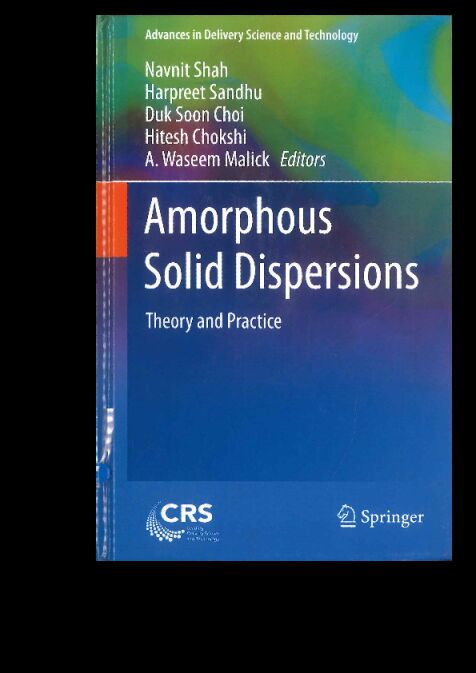
书名:Amorphous solid dispersions
责任者:Navnit Shah | Sandhu, Harpreet. | Choi, Duk Soon. | Chokshi, Hitesh. | Malick, A. Waseem.
ISBN\ISSN:1493915975,9781493915972
前言
The idea of writing this book was triggered by the development of ASD utilizing microprecipitated bulk powder (MBP) technology at Hoffmann-La Roche and the successful application of this technology to poorly soluble molecules, such as vemu-rafenib. This technology was instrumental in transforming this novel molecule into a medicine (Zelboraf®) for malignant melanoma patients. It was a gratifying and fulfilling experience for all of us when Zelboraf® became a key drug for this deadly disease and made a difference in the lives of many patients. We believe that many pharmaceutical scientists face such a challenge, and a book covering the theory and practice of amorphous solid dispersion technologies would be very useful to industrial and academic scientists as well as students in understanding and handling the challenges associated with developing such molecules.
Poorly water soluble drug molecules emerging from contemporary discovery programs often have inadequate and/or variable in vivo exposure, presenting pharmaceutical scientists with considerable challenges during development. Drugs with poor and variable oral absorption often have suboptimal therapeutic performance and significant food effect, thereby raising safety concerns, particularly for narrow therapeutic window drugs. As a result, promising molecules can be terminated prematurely if these issues are not adequately addressed. A number of formulation strategies have been developed to enhance the bio-performance of such molecules. Among these technologies, particle size reduction by micronization or nano milling improves the rate of dissolution; however, this strategy has resulted in limited success for poorly water soluble molecules having a solubility of less than 10 mcg/mL. Solubilization in lipid vehicles and self-emulsifying delivery systems have certainly added value, but their utility has been limited by drug loading, which remains a major issue. Similarly, salts of weak acids and bases have met with limited success due to precipitation of these salts in physiological fluids resulting in significant variability. Co-crystallization has been recently explored, but its utility has yet to be realized for poorly soluble molecules.
The amorphous form of a drug offers high free energy and therefore higher kinetic solubility, which provides an opportunity for overcoming solubility-related absorption and bioavailability challenges. The amorphous form, however, is ther-modynamically unstable, and stabilization of molecules in this physical state still remains a formidable task. A greater understanding of the scientific principles governing these systems and the development of amorphous solid dispersion (ASD) formulations for stabilizing amorphous molecules have created tremendous opportunities for the pharmaceutical scientist to address issues relating to the bioavailability of poorly soluble molecules. ASD technology has become one of the most powerful and versatile technology platforms in recent years. The design and development of successful ASD formulations requires the integration of scientific, technological and biopharmaceutical aspects to arrive at a robust drug product. Amorphous formulation technologies and our understanding of amorphous systems have advanced significantly in the last decade. A greater appreciation of the underlying physical science and thermodynamics, the emergence of newer technologies for the preparation of amorphous formulations, and the availability of newer excipients and polymers for stabilizing ASD have vastly expanded the opportunities for pharmaceutical scientists to establish stabilization strategies for these systems. The interest in developing amorphous formulations has increased more than ever due to the successful market introduction of such products over the last decade.
Written by experts from industry, academia and government, this book provides an excellent reference for pharmaceutical research scientists in the understanding, preparation and stabilization of ASD. In this book, we present the three primary factors for the stabilization and successful development of ASD, namely (a) the physical and chemical properties of the drug substance, (b) polymers and their impact on the stability of the final product, and (c) processing technologies to put ASD into practice. These aspects are extensively covered by the inclusion of case studies.
The first few chapters of the book cover the fundamentals and theoretical aspects of amorphous systems, an overview of ASD technologies, and details on excipients and polymers used in ASD, along with their safety aspects. "Fundamentals of Amorphous Systems" discusses the theoretical aspects of thermodynamics and kinetics with respect to the energy barrier. Also addressed are the active pharmaceutical ingredient (API) properties and polymer characteristics necessary for preparing stable ASD, involving solubility and miscibility, interaction parameters and drug loading impact. "Overview of Amorphous Solid Dispersion Technologies" provides a detailed presentation of each technology and its limitations. The chapter on excipients presents different classes of excipients, their physico-chemical properties and their interrelationship with different processes; the safety and stability of excipients are also described at length.
Later chapters present details of ASD manufacturing technologies, including spray drying, hot melt extrusion, and a breakthrough novel solvent-controlled micro-precipitation technology (MBP). Each technology is illustrated with processing fundamentals and scale up factors along with specific case studies, which provide the scientist with approaches for handling challenges presented by different types of molecules as well as building process flexibility. In addition, a dedicated section covers the miniaturization of technologies for screening polymers and processes with small amounts of API, particularly during the discovery and early development phases addressing preclinical needs. Since all of the technologies used in preparing ASD systems require downstream processing for developing viable drug products, the chapter on downstream processing covers the physical and mechanical factors impacting product performance. The analytical tools for the characterization of amorphous solid dispersions, prediction of long term stability, evolving suitable dissolution methods particularly addressing supersaturation kinetics, as well as regulatory aspects germane to amorphous solid dispersion formulations and technologies are also extensively covered.
This volume explores technologies on the horizon, such as supercritical fluid processing, mesoporous silica, KinetiSol®, and the use of non-salt forming organic acids and amino acids for the stabilization of amorphous systems. It presents a comprehensive overview of the theory and practice of amorphous solid dispersions in overcoming the challenges associated with poorly soluble drugs, and it includes practical examples based on commercially successful products using different manufacturing technologies and stabilization strategies. Amorphous Solid Dispersions provides pharmaceutical scientists with up-to-date knowledge on amorphous solid dispersions that will further enhance their ability to handle more challenging molecules and will pave the way for future innovation to bring cutting-edge therapeutics to patients in need. Sincerely Navnit Shah Harpreet Sandhu Duk Soon Choi Hitesh Chokshi A.Waseem Malick
查看更多
目录
Part I ASD Introduction
1 Fundamentals of Amorphous Systems: Thermodynamic Aspects 3
2 Theoretical Considerations in Developing Amorphous Solid Dispersions 35
3 Overview of Amorphous Solid Dispersion Technologies 91
4 Excipients for Amorphous Solid Dispersions 123
Part II Technologies
5 Miniaturized Screening Tools for Polymer and Process Evaluation 165
6 Hot-Melt Extrusion for Solid Dispersions: Composition and Design Considerations 197
7 HME for Solid Dispersions: Scale-Up and Late-Stage Development 231
8 Spray Drying: Scale-Up and Manufacturing 261
9 Design and Development of HPMCAS-Based Spray-Dried Dispersions 303
10 MBP Technology: Composition and Design Considerations 323
11 MBP Technology: Process Development and Scale-Up 351
12 Pharmaceutical Development of MBP Solid Dispersions: Case Studies 373
13 Downstream Processing Considerations 395
Part III Characterization
14 Structural Characterization of Amorphous Solid Dispersions 421
15 Dissolution of Amorphous Solid Dispersions: Theory and Practice 487
16 Stability of Amorphous Solid Dispersion 515
17 Regulatory Considerations in Development of Amorphous Solid Dispersions 545
Part IV Emerging Technologies
18 KinetiSol®-Based Amorphous Solid Dispersions 567
19 Amorphous Solid Dispersion Using Supercritical Fluid Technology 579
Part V Material Advances
20 Supersolubilization by Using Nonsalt-Forming Acid-Base Interaction 595
21 Stabilized Amorphous Solid Dispersions with Small Molecule Excipients 613
22 Mesoporous ASD: Fundamentals 637
23 Mesoporous Silica Drug Delivery Systems 665
Index 695
查看PDF
查看更多
馆藏单位
中国医科院医学信息研究所