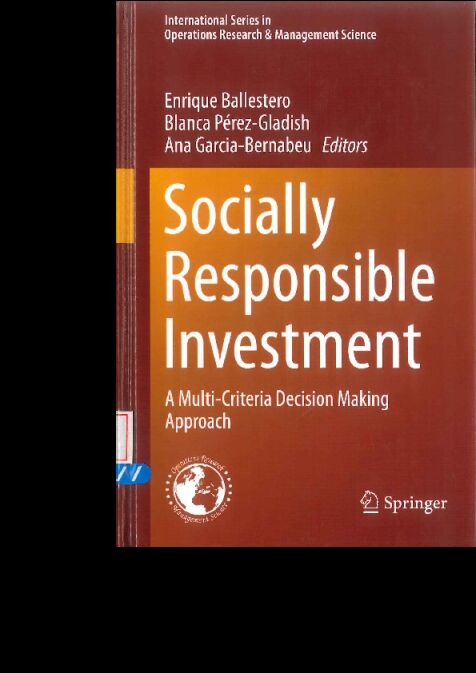
书名:Socially responsible investment
责任者:Enrique Ballestero | Blanca Perez-Cladish | Ana Garcia-Bernabeu. | Garcia-Bernabeu, Ana.
前言
In the last 40 years, multicriteria methods have emerged as a branch of decision science. At the beginning of this period, the multicriteria tools did not seem convincing to those reviewers educated in the traditional paradigm, but years later the usefulness of multicriteria tools was undeniable. This intruding and welcome perception of their importance has caused some change in the decision-making map as well as in the optimization methods. For centuries, mathematicians have been interested in optimizing a single variable depending on other variables under constraints. This problem, elegantly solved by Lagrange in the eighteenth century, has a unique criterion character. Classic financial theory has insistently assumed this unique criterion of investing: to maximize the investor's wealth, or more precisely, to maximize the expected utility of wealth under uncertainty. Normative portfolio management models based on this assumption have been fertile in the past and are helpful for managers today, although psychologists and sociologists have commented their unrealism. One can argue that fund managers consider multiple criteria such as historical returns, market trends, conjectures about companies in the near future and in the long term, historical volatilities, downside risk, liquidity, expected changes in macromagnitudes, probability or likelihood of these changes, unpredictable events, appropriate size of portfolios and attractive image of portfolios to investors. Reducing all these criteria to a single variable seems quite impossible.
This book attempts to articulate socially responsible investments (SRI) into modern portfolio theory from the multicriteria perspective. Socially responsible Investment is a new deal defended by sectors of institutional investors and banks. These agents, which influence mutual funds and other collective investment schemes, think that financial strategies without ethical constraints can damage sustainable growth and welfare. To avoid this threat, they think that financial criteria such as profitability and risk should be combined with ethical criteria such as ecosystem protection, responsible consumption of energy, health care campaigns, no monopoly, no cartel agreements, and others. An increasing flow of financial resources should be invested in companies with ethical projects and a decreasing flow invested in companies with anti-ethical activities. Freedom but not government interventionismis a widely accepted principle of efficiency in Economics today, and therefore ethical investment is viewed as a private initiative.
As the title of this book suggests, the multiple criteria decision making methods play a visible role in this work. Some aspects should be highlighted. First, the overall approach of the book, except for some chapters at the beginning, is normative rather than descriptive. We emphasize the use of goal programming and compromise programming models to select ethical financial portfolios and evaluate fund performance. Second, applicability is a friendly purpose in the book. In every part of the book illustrative examples and actual cases are numerically developed. We think that theory alone is insufficient, not only to implement the methods, but also to get insight into them in a variety of details. Going from practice to theory is more natural and didactic than going from theory to practice. Third, we would be happy if the book is useful to graduates, researchers and practitioners as well as undergraduate students.
Thanks are given to Ignacio Gonzalez for reviewing the English style and grammar.
Finally, we would like to follow properly the path left by Prof. Ballestero, especially because of his interest in the increment and effective implementation of social responsibility in our society.
Thanks, Prof. Ballestero, for all you have taught us. Alcoy, Spain Enrique Ballestero; Oviedo, Spain Blanca Perez-Gladish; Alcoy, Spain Ana Garcia-Bernabeu July 2014
查看更多
目录
Part I Critical Issues in Ethical Investment
1 The Ethical Financial Question and the MCDM Framework 3
Enrique Ballestero, Blanca Perez-Gladish, and Ana Garcia-Bernabeu
1.1 What SRI Means 3
1.2 Historical Outline 8
1.3 Why SRI? Sustainability Constraints in the Classical Economic Model 11
1.4 Multiple Criteria Decision Making (MCDM) Framework 12
1.4.1 A Brief MCDM History 13
1.4.2 MCDM and Portfolio Selection 14
1.4.3 MCDM Applications to SRI 16
Conclusions 16
References 17
2 Profiling Ethical Investors 23
Paz Mendez-Rodrfguez, Laura Galguera, Mila Bravo, Karen Benson, Robert Faff, and Blanca Perez-Gladish
2.1 Introduction 23
2.1.1 The Australian SRI Market 24
2.1.2 The Spanish SRI Market 25
2.2 Literature Review 27
2.3 Research Design and Results 30
2.4 Case Studies for the Spanish and the Australian Investors 32
2.4.1 Spanish Investors 33
2.4.2 Australian Investors 42
Conclusions 49
References 51
3 Social Performance and Financial Performance: A Controversial Relationship 53
Hajer Tebini, Bouchra M'Zali, Pascal Lang, and Paz Mendez-Rodriguez
3.1 Introduction 54
3.2 Research Hypothesis 56
3.3 Research Method 57
3.3.1 Description of Data and Sample 57
3.3.2 Methodological Approach 58
3.3.3 Measures 59
3.3.4 Model Specification 61
3.4 Results 62
3.4.1 The Impact of SP on FP Depends on the Period of Study 63
3.4.2 The Impact of SP on FP Depends on the Extent of SP 65
3.4.3 The Impact of SP on FP Depends on the Extent of FP 65
3.4.4 The Impact of SP on FP Depends on the Selected Sample 66
3.4.5 The Impact of SP on FP Depends on the Model Used 67
Conclusions 69
References 70
4 Measurement of Assets' Social Responsibility Degree 75
Mila Bravo, Ana B. Ruiz, David Pla-Santamaria, and Paz Mendez-Rodriguez
4.1 Introduction 75
4.2 The Role and Practice of Social Rating Agencies 76
4.2.1 KLD 80
4.2.2 VIGEO 81
4.2.3 EIRIS 86
4.3 Academic Literature Review on the Measurement of Mutual Funds' Social Responsibility Degree 87
4.4 A First Proposal for the Measurement of Assets' Social Responsibility Degree 97
4.4.1 Aggregated Social Responsibility Indicator 97
4.4.2 Applying SRD Indicator to a Real World Case Study 99
Conclusions 106
References 107
Part II Goal Programming and SRI Funds
5 Portfolio Selection by Goal Programming Techniques 111
Enrique Ballestero, Ana Garcia-Bernabeu, and Adolfo Hilario
5.1 Deterministic Weighted Goal Programming 111
5.2 An Example of SRI Decisions 115
5.3 Risk Aversion and Statistical Risk 117
5.3.1 Risk Aversion as Depending on the Investor's Utility 117
5.3.2 Eliciting ARA in Arrow's Utility Scenarios 120
5.4 Risk Aversion for Portfolio Random Returns: How to Elicit ARA Coefficients 121
5.4.1 Mean-Variance Stochastic Goal Programming (MV-SGP) Model 123
5.4.2 Markowitz E-V Model 124
5.4.3 A Multiobjective Extension: The MV-SGP Model 124
5.4.4 Two Objective Case 127
5.5 Selecting SRI-Financial Portfolios: Stages in the Process 127
Conclusions 128
References 129
6 Selecting SRI Financial Portfolios Applying MV-SGP Model 131
Enrique Ballestero and Ana Garcia-Bernabeu
6.1 Goal Statement Under Uncertainty from Financial and SRI Perspectives 131
6.2 Analytic Statement for the Financial-Ethical Bicriteria Model 133
6.3 ModelTargets 134
6.4 Estimating ARA Coefficients 135
6.5 Meaning of the Model in Terms of Risk and Risk Aversion 139
Conclusions 140
References 140
7 An Actual Case of SRI Financial Portfolio Choice by MV-SGP 143
Enrique Ballestero, Ana Garcia-Bernabeu, David Pla-Santamaria, and Mila Bravo
7.1 Introduction 143
7.2 Defining Investor's Profiles 145
7.3 Specifying and Solving the Model 146
7.4 Results 147
7.4.1 Achievement in Terms of Expected Return and Risk 148
7.4.2 Portfolio Weights: A Comparison from the Green Perspective 150
7.5 Sensitivity Analysis 150
Conclusions 151
References 151
Part III Compromise Programming and SRI Funds
8 Compromise Programming and Utility Functions 155
Enrique Ballestero and Ana Garcia-Bernabeu
8.1 Introduction to CP Modelling 155
8.2 Choice Problems and the Decision Maker's Utility 157
8.3 Reviewing the CP Model 158
8.3.1 An Example of CP Setting from Economic and Ethical Objectives 159
8.3.2 CP Proxy for the Decision Maker's Utility Function 162
8.3.3 SRI Example: Carbon Pollution from a Power Plant 162
8.4 Linear-Quadratic Composite Metric: Advanced Approaches 165
8.4.1 Utility Function: An Extended Approach 166
8.4.2 Normalizing the Xj Criteria 167
8.4.3 Normalizing the Objective Function 168
8.4.4 Linear Quadratic CP Achievement Function 168
8.4.5 A Case of Polymer Industry 169
Conclusions 173
References 174
9 Portfolio Selection by Compromise Programming 177
Enrique Ballestero, David Pla-Santamaria, Ana Garcia-Bernabeu, and Adolfo Hilario
9.1 Using CP to Select Securities Portfolios 177
9.2 A Real World Case of Stock Market Investment 181
9.3 First Stage: Basic Statements 185
9.4 Second Stage: Bounding the Investor's Utility Optimum 186
Conclusions 194
References 195
10 Ethically Constrained Portfolio Selection of Funds by CP Modelling: A Real World Environmental Case 197
Ana Garcia-Bernabeu, Blanca Perez-Gladish, and Adolfo Hilario
10.1 Motivating the Problem 197
10.2 The CP Model 199
10.3 Actual Environmental Case 201
10.3.1 Empirical Information 202
10.3.2 Applying CP to the Portfolio Selection Process 203
Conclusions 208
References 209
11 Evaluating Fund Performance from Financial and SRI Criteria 211
Ana Garcia-Bernabeu, Blanca Perez-Gladish, and Adolfo Hilario
11.1 Performance Composite Measures in Classic Financial Analysis 211
11.2 Purely Financial Performance Analysis Regardless of the Investor's Preferences 212
11.3 Purely Financial Performance and Combined SRI-Financial Performance from the Investor's Preferences 213
11.3.1 Purely Financial Performance 214
11.3.2 Combined SRI-Financial Performance 216
11.4 Numerical Examples 216
11.4.1 An Actual Case of Purely Financial Performance 217
11.4.2 An Example of Combined SRI-Financial Performance 220
Conclusions 223
References 224
Part IV Other Decision-Making Support Methods
12 Ranking Socially Responsible Mutual Funds Based on the Particular Preferences of the Decision Maker 227
Ana B. Ruiz, Bouchra M'Zali, and Paz Mendez-Rodriguez
12.1 Introduction 228
12.2 Ranking SRI Mutual Funds Based on the Analytical Hierarchy Process (AHP) 229
12.2.1 Socially Responsible Criteria 229
12.2.2 Ranking Mutual Funds Based on Socially Responsible Criteria 238
12.3 Ranking SRI Mutual Funds Based on Macbeth 243
12.3.1 Evaluation of Mutual Funds' Socially Responsible Performance 244
12.3.2 Weighting the Evaluation Criteria 251
12.4 Discussion 258
Conclusions 260
References 260
13 Portfolio Selection with SRI Synthetic Indicators: A Reference Point Method Approach 263
Paz Mendez-Rodriguez, Blanca Perez-Gladish, Jose Manuel Cabello, and Francisco Ruiz
13.1 Introduction 263
13.2 The Reference Point Based Approach 264
13.3 Synthetic Indicators of Stocks' Social Responsibility 269
13.4 Portfolio Selection Model 271
13.4.1 Banks and Financial Services 272
13.4.2 Broadcasting, Advertising and Publishing 273
13.4.3 Electric, Gas Utility andEnergy 273
13.4.4 Heavy Construction and Logistics 273
13.4.5 Rest of Stocks 274
Conclusions 280
References 281
14 Soft Computing Techniques for Portfolio Selection: Combining SRI with Mean-Variance Goals 283
Clara Calvo, Carlos Ivorra, and Vicente Liern
14.1 Introduction 283
14.2 Elements of Fuzzy Set Theory 284
14.3 Fuzzy Measurement of Social Responsibility 286
14.4 Portfolio Selection Under Cardinality and Semicontinuous Variable Constraints 289
14.5 A Soft Computing Approach to SRI 292
Conclusions 300
References 300
查看PDF
查看更多
馆藏单位
中国医科院医学信息研究所