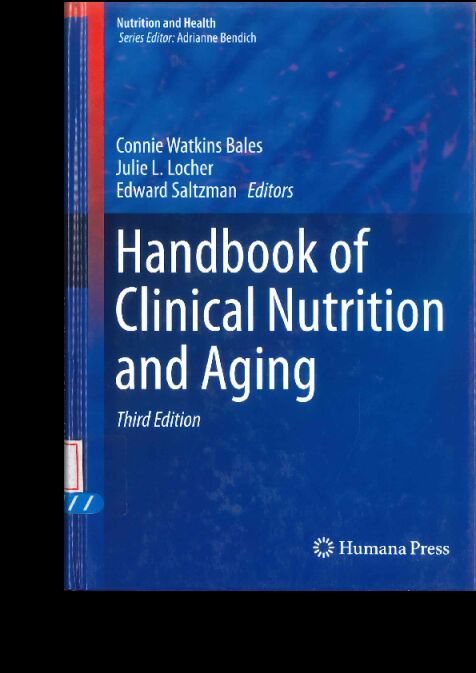
书名:Handbook of clinical nutrition and aging
责任者:Connie Watkins Bales | Julie L. Locher | Edward Saltzman
出版时间:2015
出版社:Humana Press
分类号:医药、卫生
版次:Third edition.
前言
It has been a decade since the first edition of this Handbook was created. The intervening time has indeed brought a mixture of blessings and concerns. Rapid scientific progress and advances in information transfer have fostered medical discoveries and dissemination of health-related information at an unprecedented rate. Consumers are more aware of the value of health-promoting behaviors than ever before, and older adults are paying close attention. For example, older persons are the greatest consumers of dietary supplements. Many employers have introduced wellness in the workplace initiatives, including to their retirees. Yet, the stark economic difficulties of the past few years have added unanticipated challenges for many individuals and families, often making it difficult to take advantage of these advances. The stress of limited time and resources and the confusion resulting from mixed messages in the media can be particularly challenging for older adults. Many are living on a fixed income and coping with a number of comorbidities as they make choices about health-related behaviors, including nutrition. As a result, they may not rank nutrition highly amongst the complex array of health-related recommendations they are offered, but we believe that they should!A\In later life, as at any age, a poor diet and related factors like inactivity and obesity increase the risk of developing a long list of chronic conditions, such as cardiovascular disease, type 2 diabetes, metabolic syndrome, gallbladder disease, and cancer. Conversely, adherence to medical nutrition therapies for age-associated conditions such as renal disease and chronic heart failure can foster important improvements in health-related quality of life by preserving organ function and reducing problematic symptoms. With this in mind, we sought in this third edition of the Handbook to emphasize newer topics that have received limited attention heretofore, as well as mainstay topics for which assessment and therapies have continued to evolve and improve. For example, the increased recognition of physical function as a determinant of independence and well-being in later life is supported by three relevant chapters (Chaps. 6, 7, and 22). Two chapters (Chaps. 8 and 18) deal with aspects of diet and cognition, a current "hot topic" in geriatric nutrition. Chapters on food insecurity (Chap. 9), pressure ulcers (Chap. 14), feeding in late dementia (again, Chap. 18), and end of life issues (Chap. 19) highlight nutritional concerns in highly vulnerable populations. As in past editions, our "menu" of chapters on clinical conditions includes obesity, diabetes, heart failure, cancer, kidney disease, and osteoporosis. We are also pleased to include a new chapter on nutrition and anti-aging (Chap. 20) and the latest information on the ever-challenging topic of dietary supplements (Chap. 22), as well as a number of additional chapters relating to new knowledge about the role of nutrition in aging on a broader scope. The contents of these chapters reflect an optimistic outlook. Clearly, the authors contributing chapters to the Handbook support the idea that optimal nutrition benefits all older adults and they offer specific suggestions for accomplishing these benefits.A\As with the first two editions, this book is a uniquely comprehensive and current resource on the topic of secondary disease prevention and medical nutrition therapy for older adults. We hope that it will be a valuable guide to clinical nutritionists/dietitians, physicians, nurses, and therapists in speech- language and occupational therapy, as well as many other health professionals, including social workers and case managers, who provide care for this high-risk population. We are indebted to many individuals who contributed as we put together this edition of the Handbook, In particular, we sincerely thank Diane Lamsback, Developmental Editor at Springer. With the consuming demands on the time of both editors and authors, her ongoing support was invaluable and truly helped to make this edition become a reality. CWB thanks Sarah B. Rose, MS, RD, who assisted with all the initial chapter reviews and supported the Duke Center for Aging work on the Handbook. CWB also thanks Amanda Quinn, who was with Springer until recently, for support and guidance as three editions of this Handbook have come together. We all as editors especially acknowledge the encouragement from our series editor, Dr. Adrianne Bendich, to explore the critical clinical issues in geriatric nutrition through this collaboration with the gifted and dedicated scientists who study them. It is these scientist-authors who ultimately made the book a successfully reality and we thank them all. Durham, NC, USA:Connie Watkins Bales, Ph.D., R.D.,Birmingham, AL, USA:Julie L. Locher, Ph.D.,Boston, MA, USA:Edward Saltzman, M.D.
查看更多
目录
Part I Overarching Issues for Nutritional Well-Being in Later Life
1 Nutrition Interventions for Aging Populations 3
2 Systematic Reviews in the Field of Nutrition 21
3 Nutrition Assessment 35
Part II Fundamentals of Nutrition and Geriatric Syndromes
4 Nutrition and the Aging Eye 57
5 Nutrition and Oral Health: A Two-Way Relationship 81
6 Loss of Muscle Mass and Muscle Strength in Obese and Nonobese Older Adults 99
7 Muscle Metabolism, Nutrition, and Functional Status in Older Adults 113
8 Nutrition in the Prevention and Treatment of Cognitive Decline 125
9 Food Insecurity and Hunger Among Older Adults 147
Part III Common Clinical Conditions
10 Obesity in Older Adults and Strategies for Weight Management 163
11 Nutrition and Lifestyle Change in Older Adults with Diabetes Mellitus and Metabolic Syndrome 179
12 Preventive Cardiology: Counseling Older At-Risk Adults on Nutrition 203
13 Chronic Heart Failure 215
14 The Relationship of Nutrition and Pressure Ulcers 237
15 Nutrition Support in Solid l\imor Cancer Patients 253
16 Nutrition and Chronic Kidney Disease 261
17 Nutritional Concerns in Osteoporosis 273
18 Dementia-Related Mealtime Difficulties: Assessment and Management in the Long-Term Care Setting 287
19 Nutrition at the End of Life 303
Part IV Contemporary Diet-Focused Concerns
20 Anti-aging Effects of Nutritional Modification: The State of the Science on Calorie Restriction 315
21 High-Risk Nutrients in the Aging Population 335
22 Physical Activity and Exercise: Important Complements to Nutrition in Older Adults 355
23 Dietary Supplements in Older Adults 375
Index 425
查看PDF
查看更多
馆藏单位
中国医科院医学信息研究所