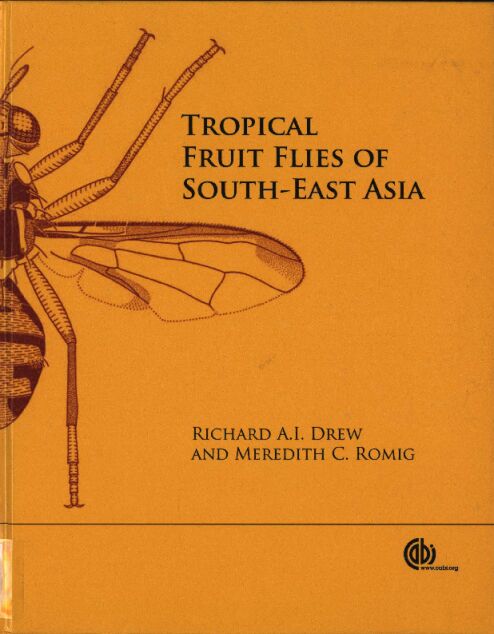
书名:Tropical fruit flies (Tephritidae
责任者:Richard A.I. Drew and Meredith C. Romig. | Romig, Meredith C.
前言
The research presented herein covers studies undertaken on the dacine fauna of Indomalaya, Wallacea and north-west Australasia.
Taxonomic studies in the tephritid subfamily Dacinae have their origins in the early research of Fabricius (1794; 1805), followed by Wiedemann (1819; 1830) and Macquart (1835; 1843). The voyage of Alfred Russel Wallace to the Malay Archipelago (1854-1862), the area now known as Maluku (formerly Moluccas), and New Guinea resulted in pioneering biological collections, including some valuable dacines, that are still preserved in The Natural History Museum (BMNH). This fruit fly material was studied by Francis Walker who published a large number of new species (Walker, 1856a, b; 1859; 1860a, b; 1861a, b, c; 1864), the types of which are still in good condition. Hardy (1959) designated Lectotypes for some of these species and this new publication records and describes, for the first time, some of the Walker species collected in recent surveys within the region now called Wallacea. Other early researchers were Saunders (1842), Doleschall (1856; 1858), Schiner (1868) and Weyenbergh (1869).
The realisation that the Tephritidae, particularly the subfamily Dacinae, included a number of pest species that damaged important food crops, led to a large number of taxonomists collecting and describing species during the 20th century. Across the region from the Indian subcontinent to South-East Asia, a large number of species were described by some 50 workers. Some researchers have been working on fauna within confined geographic areas and have thus published a number of synonyms. During the first decade of the 21st century, at least ten workers have published taxonomic papers on the Dacinae of the Indomalayan region.
Some workers have concentrated on fauna within their regions, notably China, Japan and the Indian subcontinent. In China, Zia(1936; 1937; 1939; 1955; 1963), Chen (1940) and Wang (1988; 1990; 1996) have described most of the known Chinese dacine fauna. In the Indian subcontinent, Senior-White (1922), Kapoor (1971; 1993), Hardy (1964), Munro (1935), Kapoor et al. (1980), Tsuruta & White (2001), Agarwal et al. (1989) and Agarwal & Sueyoshi (2005) described and listed the bulk of species. The fauna of the Andaman Islands was recorded by Ranganath & Veenakumari (1995; 1996). In the Japanese islands, Matsumura (1916), Miyake (1919), Shiraki (1933; 1968) and Ito (1983) made the major contributions to our knowledge of species in that region. For the remainder of the region covered in this publication, the majority of known species have been described by Bezzi (1908a; 1909; 1913; 1914a, b; 1916; 1919), de Meijere (1911; 1914), Hendel(1912; 1927a, b; 1928), Enderlein (1920), Hering (1938; 1939; 1941; 1942; 1952a, b; 1953; 1956), Perkins (1938a, b; 1939), Hardy (1954; 1955a, b; 1959; 1964; 1968; 1969a, b; 1970; 1973; 1974; 1981; 1982; 1983; 1984), Hardy & Adachi (1954), Drew (1979), Drew & Hancock (1994a, b), Drew & Raghu (2002), Drew et al. (1998; 2007) and White & Evenhuis (1999).
Some large tephritid monographic works have been produced by Hardy (1973; 1974), Shiraki (1933; 1968) and Wang (1996) but these have had only small sections on the Dacinae. The largest overview of the dacines is in the White & Hancock (1997) CABIKEY which has been extremely valuable in listing species and their main morphological features and in the collation of taxonomic literature.
Some additional studies have been published that enhance our understanding of the taxonomy of the Dacinae. Drew (2004) discussed aspects of biogeography and speciation of the subfamily, Clarke et al. (2005) produced a comprehensive overview of the dorsalis complex with additional discussion of this group by Drew et al. (2008). Hancock & Drew (2006) presented a revised classification of the genus Dacus and Allwood et al. (1999) published a comprehensive list of host records.
In carrying out this comprehensive revision of the Asian and South-East Asian Dacinae, the species listings of Hardy (1977), White & Hancock (1997) in CABIKEY and Norrbom et al. (1998) have been valuable.
The history of taxonomic research on the Tephritidae of the Australasian and Oceanian regions was discussed by Drew (1989).
In discussions on the biogeography and speciation of the Dacini, Drew & Hancock (2000) and Drew (2004) proposed that the parental stock originated in the Indian block of Gondwana as it drifted northwards. At this point the genera Ichneumonopsis and Monacrostichus evolved, the Dacus dispersed to Africa while the Bactrocera entered a long period of speciation in the rainforests of southern and eastern Asia. Prolific speciation in these rainforest habitats, across the many islands, has resulted in the largest number of endemic dacine species occurring in South-East Asia and Papua New Guinea (Drew, 2004), many of which occur within complexes based on morphological similarity. These complexes present great challenges for taxonomists, and accurate diagnosis of species will depend on data collated from research into the behaviour, ecology and molecular aspects in addition to morphological features.
There are four identifiable species complexes within the genus Bactrocera, i.e. B. (Bactrocera) dorsalis complex, B. (Bactrocera) nigrotibialis complex, B. (Zeugodacus) scutellaris complex and the B. (Zeugodacus) tau complex. The speciation processes within the genus Bactrocera, in particular, have led to reasonably rapid morphological changes (Clarke et al., 2005) resulting in complex taxonomic difficulties for researchers attempting to define species. As a consequence, a large number of synonyms have been described by taxonomists working in isolation, attempting to diagnose and describe species without studying the more widely distributed regional fauna.
The supraspecific classification within the Dacinae has always been in a state of flux and open to change as a result of differing opinions on the value of morphological characters at this level. Early taxonomists, namely Perkins (1937; 1939), Hering (1941a, b, c, d, e) and May (1963), chose to place all species within genera and not use subgenera. However, Hardy (1951) and subsequent workers placed species within subgenera, particularly within the genera Bactrocera and Dacus, based on their opinion that the available character states were not worthy of generic level status. The generic classification of Drew (1989) where Bactrocera and Dacus were divided on the basis of fused abdominal terga (genus Dacus) and free terga (genus Bactrocera) has been widely accepted, as this morphological feature is supported with biogeographical distribution data and host plant specificity. That is, the Dacus appear to have originated and speciated in the African continent where they utilize host plants in the dry savannah environment, and Bactrocera in Indomalaya and Australasia where their endemic host plants are associated with the subtropical and tropical rainforests. The African fauna has been revised by White (2006).
The subgeneric classifications of Drew (1972a; 1989) have generally been found satisfactory in the studies on South-East Asian fauna by Hardy (1973; 1974) and the South Pacific fauna by Drew (1989) but not consistent with available molecular data. While in this publication we have further refined the subgeneric classification of the genus Bactrocera, more improvements can be made, especially in combining data from in-depth molecular research and host plant associations. For the genus Dacus, we have followed the subgeneric classification of Hancock & Drew (2006). For the region, we recognize only five subgenera within Dacus.
The research presented in this publication has resulted from extensive field surveys of fruit flies in Bhutan, India, Sri Lanka, Thailand, Vietnam, Peninsular Malaysia, East Malaysia, the Philippines and all provinces of Indonesia. All surveys were conducted by teams organized by, and funded by projects from, the International Centre for Management of Pest Fruit Flies, Griffith University, Brisbane, except for that in Sri Lanka which was conducted by Mr Kenji Tsuruta, Quarantine Service, Japan. Within each country, field sites representing a range of ecosystems were chosen. At each site, male lure traps (cue lure and methyl eugenol) were set and serviced for 1-2 years on a 2-3 week cycle. Also, host fruits, commercial/edible and wild, were sampled and fruit flies reared from those infested. This programme resulted in extensive collections of flies, now curated and held within each coxintry and the Queensland Primary Industries Insect Collection (QDPC), Brisbane. Also, the surveys were so comprehensive that the host records have been published in Allwood et al. (1999). In this publication, we are presenting full descriptions of all known species, previously undescribed species, updated distribution records, male lure records and an evaluation of the eco・ nomic pest status of those species reared from commercial/edible host fruits. New host records since Allwood et al. (1999) are also presented.
The research presented herein is the first holistic taxonomic review of the Dacinae covering the region from Indomalaya to north-west Australasia. Seven species, considered as belonging to the Australasian region, are included because they were collected in the Indonesian provinces of Papua and West Papua (originally part of Irian Jaya). These species are Bactrocera (Bactrocera) bryoniae (Tryon), Bactrocera (Bactrocera) fulvicauda (Perkins), Bactrocera (Bactrocera) musae (Tryon), Bactrocera (Bactrocera) neocheesmanae Drew, Bactrocera (Bactrocera) paramusae Drew, Bactrocera (Bactrocera) speculif-era (Walker) and Bactrocera (Zeugodacus) abdoangusta (Drew).
White and Evenhuis (1999) published complete known records of dacines from the Indonesian territory of Papua.
查看更多
目录
Acknowledgements vii
Abstract 1
Introduction 5
Methods and Abbreviations 7
Generic and Subgeneric Classification 11
Definitions of Genera 11
Definitions of Subgenera 12
Species Listed Under Genera and Subgenera 17
Species Complexes 23
Bactrocera (Badrocera) dorsalis complex 23
Bactrocera (Bactrocera) nigrotibialis complex 24
Bactrocera (Zeugodacus) scuteliar is complex 24
Bactrocera (Zeugodacus) tau complex 24
Identification of Cryptic Species 25
Description of Species Under Genera and Subgenera 27
Genus Bactrocera Macquart 29
Subgenus Afrodacus Bezzi 29
Asiadacus Perkins 29
Bactrocera Macquart 36
Bulladacus Drew &Hancock 195
Daculus Speiser 199
Gymnodacus Munro 201
Hemigymnodacus Hardy 205
Javadacus Hardy 208
Nesodacus Perkins 214
Papuodacus Drew 215
Paradacus Perkins 219
Parasinodacus new subgenus 225
Paratridacus Shiraki 237
Parazeugodacus Shiraki 243
Semicallantra Drew 249
Sinodacus Zia 251
Tetradacus Miyake 259
Zeugodacus Hendel 263
Genus Dacus Fabricius 373
Subgenus Callantra Walker 373
Didacus Collart 374
Leptoxyda Macquart 375
Mellesis Bezzi 376
Neodacus Perkins 401
Genus Ichneumonopsis Hardy 403
Genus Monacrostichus Bezzi 405
Pest Species in the Genera Bactrocera and Dacus 408
Figures 411
References 639
Taxonomic Index 647
查看PDF
查看更多
馆藏单位
中科院文献情报中心 中国农科院农业信息研究所