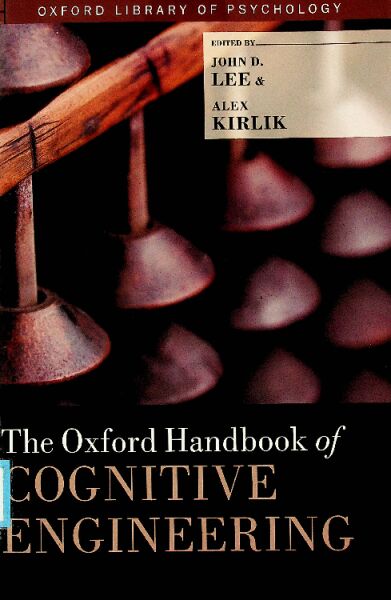
书名:The Oxford handbook of cognitive engineering
责任者:John D. Lee | Alex Kirlik ; consultaing : Marvin J. Dainoff | Peter A. Hancock | Neville Moray. Donald A. Norman | Richard W. Pew | Eduardo Salas | Thomas B. Sheridan.
ISBN\ISSN:9780199757183,0199757186
出版时间:2013
出版社:Oxford University Press
摘要
This handbook is the first to provide comprehensive coverage of original state-of-the-science research, analysis, and design of integrated, human-technology systems.
Cognitive engineering is an interdisciplinary approach to the analysis, modeling, and design of engineered systems or workplaces in which humans and technologies jointly operate to achieve system goals. As individuals, teams, and organizations become increasingly reliant on information technology and automation, it is more important than ever for system and workplace design to be maximally informed by state-of-the-art cognitive engineering research.
This volume is the first authoritative handbook to cover this recent and rapidly growing field. The handbook collects and organizes contemporary cognitive engineering research, drawing on the original research of more than 60 contributing experts. Coverage of human factors, human-computer interaction, and the conceptual foundations of cognitive engineering is extensive, addressing not only cognitive engineering in broader organizations and communities, but also focusing on individual cognition,addressing topics of attention, decision making, and multi-tasking. This thorough approach speaks to the broad scope of cognitive engineering, spanning the individual operator to teams and organizations, with a focus on how systems of people and technology, often in the form of automation,influences performance.
By collecting the best of cognitive engineering research in one volume, this book serves as both a convenient reference guide and as a useful entry point to the large and diverse research literature. As such, this handbook will be a valuable resource for researchers, students, and practitioners in cognitive engineering and a variety of related fields in need of guidance for how to put their products, systems, and services into the hands of human users, performers, and customers.
查看更多
目录
Oxford Library of Psychology vii
About the Editors ix
Contributors xi
Table of Contents xv
Chapters 1-622
Index 623
Part One Cognitive Engineering: History and Foundations
Introduction to the Handbook 03
John D. Lee and Alex Kirlik
Part Two Cognition in Engineered Systems
1. The Closed-Loop Dynamics of Cognitive Work 19
Jobn M. Flach, Kevin B. Bennett Richard J. Jagacinski, Max Mulder,and Rene van Paassen
2. Attention 36
Christopher D. Wickens
3. Multitasking 57
Dario D. Salvucci
4. Judgment and Prediction 68
Kathleen L. Mosier
5. Situation Awareness 88
Mica R. Endsley
6. Trust, Reliance, and Compliance 109
Joachim Meyer and Jokn D. Lee
7. Learning and Retention 125
Frank E. Ritter, Gordon D. Baxter, Jong W. Kin, and Sowmyalatha Srinivasmurthy
8. Expertise 143
Walter R. Boot and K. Anders Ericsson
9. Neuroergonomics: Brain-Inspired Cognitive Engineering 159
Raja Parasuraman
10. Communication in Socio-Technical Systems 178
Daniel G. Morrow and Ute M. Fischer
11. Team Cognition: Coordination across Individuals and Machines 200
Patricia Bockelman Morrow and Stephen M. Fiore
12. Organizational Design and Cognitive Work 216
Pascale Carayon and Peter Hoonakker
Part Three Cognitive Engineering Methods
13. Cognitive Task Analysis 229
Beth W. Crandall and Robert R. Hoffman
14. Cognitive Work Analysis 240
Emilie M. Roth and Ann M. Bisantz
15. Decision-Centered Design 261
Laura G. Militello and Gary Klein
16. Situation Awareness-Oriented Design 272
Mica R. Endsley
17. Cognitive Engineering to Support Successful Aging 286
Wendy A. Rogers, Marita A. O'Brien, and Arthur D. Fisk
18. Artifact Analysis as a Way to Understand Cognition 302
Christopher P. Nemeth and Richard I. Cook
19. Evaluation: Does the Cognitive Engineering Effort Do What It Was Envisioned to Do? 315
Leonard Adelman
20. Microworld Experimentation with Teams 327
Nancy J. Cooke and Jamie C. Gorman
21. Simulation to Assess Human Responses to Critical Events 336
L. Jane Easdown, Arna Banerjee, and Matthew B. Weinger
22. Simulation to Assess Safety in Complex Work Environments 352
Amy R. Pritchett
23. Metrics for Supervisory Control System Evaluation 367
Mary L. Cummings and Birsen Donmez
24. Multitasking and Multi-Robot Management 379
Michael A. Goodrich
25. Human-Machine Cooperation 395
Jean-Michel Hoc
26. Learning from Failure 404
Daniel Hummerdal, Alexander Wilhelmsson, and Sidney Dekker
Part Four Cognitive Engineering Models
27. Computational Cognitive Modeling of Interactive Performance 415
Michael D. Byrne
28. Computational Process Modeling and Cognitive Stressors: Background and Prospects for Application in Cognitive Engineering 424
Kevin A. Gluck and Glenn Gunzelmann
29. Modeling and Formal Analysis of Human-Machine Interaction 433
Asaf Degani, Michael Heymann, and Michael Shafto
30. Queuing and Network Models 449
Yili Liu
31. Bayesian and Signal Detection Models 465
Jason S. McCarley and Aaron S. Benjamin
32. Judgment Analysis 476
Alex Kirlik
33. Modeling Decision Heuristics 490
Konstantinos V. Katsikopoulos and Gerd Gigerenzer
34. Establishing the Micro-to-Macro Linkin Cognitive Engineering: Multilevel Models of Socio-Computer Interaction 501
Wai-Tat Fu and Peter Pirolli
Part Five Cognitive Technologies in Engineered Systems
35. Configural and Pictorial Displays 517
Kevin B. Bennett and Jokn M. Flach
36. Emergence in Organizations and Human Collective Intelligence 534
Stephen J. Guastello
37. Multimodal Displays:Conceptual Basis, Design Guidance, and Research Needs 556
Nadine B. Sarter
38. Ecological Interfaces 566
Catherine M. Burns
39. Uncertainty Visualization and Related Techniques 579
Ann M. Bisantz
40. Adaptive Automation 594
David B. Kaber
41. Distributed Communities of Practice 610
Anna T. Cianciolo and Karen M. Evans
Index 623
查看更多
作者简介
Alex Kirlik PA\Alex Kirlik is professor in the Departments of Computer Science, Psychology, and Systems Engineering and a member of the Beckman Institute at the University of Illinois at Urbana-Champaign. He previously served as Coordinator of Cognitive Science Academic Programs at Georgia Institute of Technology and as Head of Human Factors at Illinois. He is the editor of Adaptive Perspectives on Human-Technology Interaction (Oxford, 2006) , co-editor of Attention: From Theory to Practice (Oxford, 2008), and editor of Human-Tech (Oxford,2011) . His engineering research focuses on the design of collaborative human-technology systems to leverage mathematical models and human expertise in cognitive tasks such as judgment, prediction, diagnosis, and dec ii on making. He is a member of the editorial boards of the journals Human Factors and Cognitive Engineering and Decision Making and has served as editor of the Oxford Series in Human-Technology Interaction since it since p-tion in 2006.
查看更多
馆藏单位
中科院文献情报中心