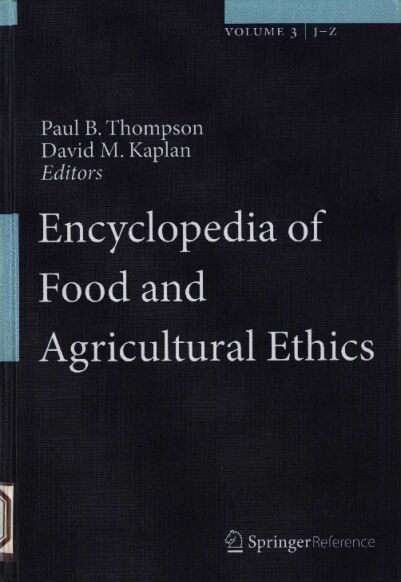
书名:Encyclopedia of food and agricultural ethics
责任者:ed Paul B. Thompson | David M. Kaplan.
前言
When we met with our coeditors and representatives of Springer in May 2010 to begin conceptualizing the Encyclopedia of Food and Agricultural Ethics, we were thinking along the lines of something that would be a cross between a traditional general-interest encyclopedia and a “handbook.” We envisioned a work that would help scholars and relatively advanced students obtain a quick introduction to the issues and the published literature that was most relevant to a broad range of issues in the ethics of food and agriculture. We took “ethics” to imply thoughtful and scholarly studies on the normative dimension of topics rather than rubrics or remonstrations on right action. We wanted to create a resource for those interested in learning more about the ethical dimension of food and agriculture rather than a collection of arguments for particular ethical positions.
All areas in practical ethics suffer from a deep ambiguity of this kind. On the one hand, for many people, ethics simply implies an uncomplicated matter of doing the right thing. “Being ethical” would be understood in contrast to blatantly unethical actions such as the intentional contamination of Chinese milk products (including infant formula) with melamine in 2008. No one needs scholarly research to understand why this action was unethical, just as no one needs philosophy to explain why it is wrong to leave farm animals to suffer and die from a lack of feed and water. On the other hand, the circumstances that lead to these blatantly unethical actions can be better understood (and hopefully prevented) through careful research on the institutions and incentives faced by human actors. Ethical analysis can shed light on how ethical situations come about and what we might do in response.
In addition, there are some topics whose ethical dimensions are less obvious such as biofuel production and international trade regulations. These topics require careful research and analysis to reveal the ethical issues. Sometimes, they are beset with contradictory and conflicting views on why and even whether issues of right and wrong are involved at all. It is these case examples that give rise to scholarship by philosophers, social scientists, and agricultural specialists. The Encyclopedia of Food and Agricultural Ethics was conceived to provide overviews of the work that had already been done on key areas of practice in food and agricultural systems of production, distribution, and consumption. The aim was to facilitate more and better scholarship in all aspects of the field.
And so, we entered the project with the expectation that it would be a long and arduous process to recruit authors and to compile a volume of the scope that the subject deserved. The volume that emerged has met our expectations in many respects; yet, there are two ways in which the original vision has been significantly altered.
First, many of the topics that we placed on the original list had far less existing scholarship than we expected. There is still a lack of scholarly maturity in the field of food and agricultural ethics. The problem we faced is that an encyclopedia is a work of tertiary literature. It should contain neither research (primary literature) nor review articles summarizing original papers (secondary literature). It should instead summarize established information in the field. As editors, we found ourselves in the unfortunate position of too little to edit. Worse, we had to exclude fine works of original ethics scholarship more appropriate for a journal such as Springer’s Journal of Agricultural and Environmental Ethics than for a reference work. It is our hope that today’s original scholarship on food and agricultural ethics will soon develop a secondary literature that deserves its own encyclopedia entry.
Second, the continued growth of digital publishing has shaped our editorial practice in ways that we did not fully anticipate. While electronic access was a crucial aspect of the original design, we did not fully appreciate the impact of this format on the timeliness of content. As the first entries began to trickle in during 2011 and 2012, we began to realize that the pace of scholarship (and of the issues themselves) threatened to date some very fine entries by the time that the entire edition would be done. It became clear that the cutoff date for declaring the encyclopedia to be “complete” and ready for publication was becoming increasingly arbitrary. At the end of the day, we decided that it was more important to go to press than to cause further delay in making the fine work that we had already compiled available. Entries will continue to be added, and existing entries will be updated in the online edition. The Encyclopedia of Food and Agricultural Ethics will be a living document.
查看更多
目录
Preface v
About the Editors vii
Contributors xxiii
J 1297
K 1317
L 1325
M 1359
N 1409
O 1447
P 1471
R 1573
S 1631
T 1719
U 1775
V 1783
W 1817
Y 1845
List of Entries 1857
查看更多
馆藏单位
中国农科院农业信息研究所