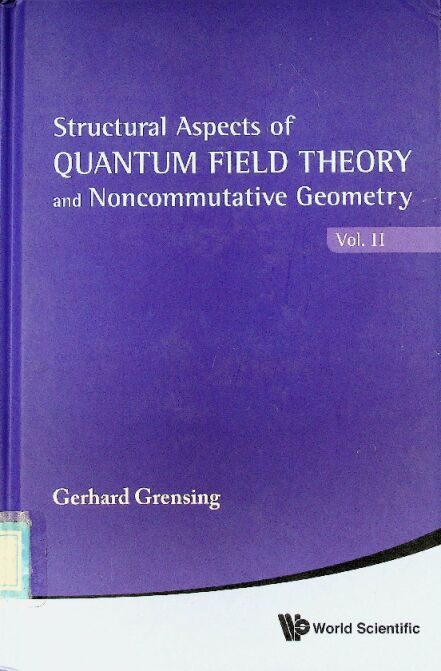
书名:Structural aspects of quantum field theory and noncommutative geometry. Vol. II
责任者:Gerhard Grensing | University of Kiel | Germany.
ISBN\ISSN:9789814472739,9814472735,9789814472692,9814472697
出版时间:2013
出版社:World Scientific
摘要
The book is devoted to the subject of quantum field theory. It is divided into two volumes. The first volume can serve as a textbook on main techniques and results of quantum field theory, while the second treats more recent developments, in particular the subject of quantum groups and noncommutative geometry, and their interrelation.The second edition is extended by additional material, mostly concerning the impact of noncommutative geometry on theories beyond the standard model of particle physics, especially the possible role of torsion in the context of the dark matter problem. Furthermore, the text includes a discussion of the Randall-Sundrum model and the Seiberg-Witten equations.
查看更多
前言
This is the second volume of a book on quantum field theory; it can be read rather independently of the first. A survey of the contents has already been given in the preface to the first volume. Here we restrict ourselves to a synopsis on the internal logic of the present text.
One of its aims is to provide a solid background for some ad hoc approaches that have been made use of in the first volume. The Faddeev-Popov device for the quantization of nonabelian gauge theories belongs to these. We give a sound justification, which requires techniques from classical reduction of constrained systems `a la Marsden and Weinstein. But the resulting reduced system is difficult to quantize directly. The way out consists in extending the system by ghost degrees of freedom, giving rise to the Becchi-Rouet-Stora invariance of the gauge theory. Another issue that has been left open is the ordering problem in quantum mechanics; it is treated here by means of Weyl quantization, for both fermions and bosons. Beyond this, Weyl techniques are also needed for the construction of coherent states and their associated path integrals.
The main topic, underlying all the various subjects treated in this second volume, is the role of symmetries in both classical and quantum physics. Usually a classically valid symmetry is also present in the corresponding quantum mechanical system. But sometimes the classical symmetry is deformed by quantum effects, leading to the so-called quantum groups invented by Faddeev, Drin'feld, and others. It can even happen, however, that the quantization gives rise to an anomaly; we have already met such a phenomenon in the context of Virasoro and Kac-Moody symmetries. A related observation is made for gauged chiral symmetries, which are severely broken in the quantum theory so that renormalizability is ruined; but it can be saved if certain anomaly cancellations happen to occur, as it is the case in the standard model of particle physics.
Another instance of a violated symmetry is realized in the spontaneous symmetry breaking mechanism of particle physics. Usually this is introduced by hand on following the guide of Bose-Einstein condensation and superconductivity in statistical physics. In these cases one knows the underlying microscopic origin, but not so in particle physics. Nothing is known about the deeper foundation of the Higgs sector — beyond its mere existence. The situation has changed dramatically, however, with the advent of noncommutative geometry. The first indication that noncommutative geometry has to tell us something profound about this theme was given by its founder A. Connes and J. Lott 1990; they realized that the HiggsKibble potential comes from a gauge connexion living on a discrete space made of two points. This essential insight was further substantiated by the so-called spectral action of Chamseddine and Connes 1997, which unavoidably shows that the quadratic term in the Higgs-Kibble potential indeed carries the 'wrong' sign, as is required for spontaneous symmetry breaking, and also endows the Higgs field with dynamics. Hence, the geometric origin of the Higgs field is revealed; it is a gauge field of spin zero, living on a discrete space consisting of two points.
We have already mentioned the subject of deformed symmetries, the quantum groups. Since we try to keep the text self-contained, a thorough introduction to this subject is given so that the reader does not need to refer to outside sources. Our aim is twofold; on the one hand, we show that a main series of quantum numbers observed in the fractional quantum Hall effect is due to an underlying suq(2) quantum symmetry with deformation parameter q = exp 2πi/p with p an odd integer, which explains the degeneracy of the quantum system. On the other hand, it is shown that quantum groups and noncommutative geometry are intimately related. We do this on the example of the quantum group suq(n) and the n-dimensional noncommutative torus with the same deformation parameter by demonstrating that the generators of the quantum group can be expressed in terms of those of the noncommutative torus.
查看更多
目录
Volume I
Preface V
I CLASSICAL RELATIVISTIC FIELD THEORY: KINEMATICAL ASPECTS 1
1. Relativistic Free Fields: Bosons 3
1.1 Maxwell's Equations in Relativistic Notation 3
1.2 Klein-Gordon Equation 9
1.3 Group Velocity and Special Relativity 11
1.4 Nonrelativistic Limit and the Schrödinger Equation 13
1.5 Classical Interpretation of Fields 14
1.6 Normal Coordinates 16
1.7 Quantized Harmonic Oscillator* 18
1.8 Quantization of the Klein-Gordon Field* 22
2. Lagrange Formalism for Fields 25
2.1 Functionals 25
2.2 Euler-Lagrange Equations for Fields 27
2.3 Variational Principle 29
2.3.1 Nonrelativistic classical mechanics 30
2.3.2 Relativistic classical mechanics 31
2.3.3 Reparametrization invariance* 33
2.3.4 Relativistic field theory 36
2.4 Appendix: Improper Bases* 37
3. Relativistic Invariance 45
3.1 Minkowski Space and its Symmetry Group 45
3.2 Transformation Law of Fields 54
3.3 Appendix: Lie Groups and Lie Algebras* 56
3.3.1 Fundamentals of group theory 56
3.3.2 Lie groups and their algebras 61
4. Special Relativity 75
4.1 Inertial Frames and Causality 75
4.2 Lengths and Time Intervals 77
4.3 Addition Theorem for Velocities 77
4.4 Rotating Frames 79
4.5 Accelerated Inertial Frames 81
4.6 Appendix: Product Integral 85
5. Relativistic Free Fields: Fermions 89
5.1 Dirac's Equation 89
5.2 Relativistic Invariance of Dirac's Equation 93
5.3 Variational Principle for the Dirac Equation 97
5.4 On the Origin of Gauge Invariance. 99
5.5 Nonrelativistic Limit 100
5.6 'Classical' Interpretation of Fermions 102
5.6.1 Fermions on a lattice 103
5.6.2 Canonical quantization of fermions* 105
5.6.3 The doubling problem 108
5.6.4 Resolution of the doubling problem 109
5.7 Clifford Algebras and Spin Groups* 110
6. Relativistic Free Fields and Spin 119
6.1 Scalar Field 119
6.2 Dirac Field 120
6.3 Maxwell Field 122
6.4 Spin 124
6.4.1 Representations of rotations 125
6.4.2 Fields and their spin 128
6.5 Transformation Law of Fields and Induced Representations* 131
7. Neutral Fermions 133
7.1 Charge Conjugation 133
7.2 Majorana Spinors 135
7.3 Neutrinos 136
8. Symmetries and Conservation Laws 141
9. Differential and Integral Calculus for Anticommuting Variables 151
9.1 Real Grassmann Variables 151
9.2 Fourier Transformation 158
9.3 Complex Grassmann Variables 161
9.4 Appendix: Pfaffians* 164
II CLASSICAL RELATIVISTIC FIELD THEORY: DYNAMICAL ASPECTS 167
10. Dynamical Principles: Internal Symmetries 169
10.1 Internal Gauge Theories 169
10.1.1 Gauge invariance in quantum mechanics 170
10.1.2 Weyl's principle 172
10.2 Yang-Mills Theory 174
10.2.1 Field equations 180
10.2.2 Covariant current conservation 181
10.2.3 Chern-Simons theory 185
10.3 Gauge Theories and Elementary Particle Physics 186
10.3.1 Higgs-Kibble mechanism. 187
10.3.2 Glashow-Salam-Weinberg model 202
10.3.3 Standard model 205
10.3.4 Majorana neutrinos 210
10.3.5 Appendix: SU(N) 214
11. Dynamical Principles: External Symmetries 223
11.1 Introduction 224
11.2 Dynamics of a Relativistic Point Particle in a Gravitational Field 226
11.2.1 Geodesic equation 228
11.2.2 Gravity and gauge invariance 231
11.2.3 Newtonian limit 232
11.2.4 Energy-momentum tensor of a relativistic point particle 234
11.3 Differential Geometry: A First Course 236
11.3.1 Covariant differentiation 237
11.3.2 Metric postulate 240
11.3.3 Riemann's curvature tensor 242
11.3.4 Bianchi identities and symmetry properties of the curvature tensor 243
11.3.5 Parallel displacement 245
11.3.6 Normal coordinates and the principle of equivalence 248
11.3.7 Riemann normal coordinates 251
11.3.8 Jacobi operator 253
11.3.9 Vector analysis and integration 255
11.4 Einstein's Theory of Gravity 257
11.4.1 Hilbert action 258
11.4.2 Coupling of matter fields to gravity 263
11.4.3 Gravity as a special relativistic field theory 267
11.4.4 Linear approximation and gravitational waves 272
11.4.5 Schwarzschild solution 274
11.5 Differential Geometry: A Second Course 279
11.5.1 Coordinate transformations and the general linear group 279
11.5.2 Geodetic function 283
11.5.3 Geodetic parallel transport 286
11.5.4 Coincidence limits* 287
11.5.5 Riemann normal coordinates revisited 289
11.6 Differential Geometry: A Third Course 290
11.6.1 Orthonormal frames 291
11.6.2 Spin connexions 292
11.6.3 Differential geometry as a gauge theory: Cartan connexions 298
11.7 Accelerated Observers and Inertial Systems** 301
11.8 Gravity as a Gauge Theory of the Poincaré Group 307
12. Supergravity 315
12.1 Super Poincaré Group 315
12.2 Supersymmetry and Differential Geometry: Cartan Connexions 319
12.3 Rarita-Schwinger Fermions 323
12.4 Supergravity as a Gauge Theory of the Super Poincaré Group 327
12.5 Summary 333
12.6 Appendix: Majorana Spinors in Higher Dimensions 333
12.6.1 Properties of gamma matrices in four dimensions 335
12.6.2 Fierz identities 335
12.6.3 Properties of Majorana spinors in four dimensions 336
12.6.4 Majorana spinors in higher dimensions 337
13. Cosmology 341
13.1 Gauss' Normal Coordinates 341
13.2 Symmetric Spaces 342
13.3 Realization of Maximally Symmetric Spaces 345
13.4 Robertson-Walker Metric 347
13.5 General Relativistic Hydrodynamics 348
13.6 Friedmann Equations 350
13.7 Models of the Universe 352
13.8 Present Status of the Universe 356
13.9 Observational Astronomy and Cosmological Parameters 359
13.10 Cosmological Constant Problem 360
13.11 Quintessence 362
13.12 Appendix: Geometric Optics in the Presence of Gravity 363
13.13 Appendix: Local Scale Invariance and Weyl Geometry* 366
13.13.1 Weyl geometry 366
13.13.2 Conformally invariant matter fields 371
III RELATIVISTIC QUANTUM FIELD THEORY: OPERATOR METHODS 377
14. Quantization of Free Fields 379
14.1 Scalar Field 379
14.1.1 Canonical quantization 379
14.1.2 Feynman propagator 381
14.2 Dirac Field 386
14.2.1 'Canonical' quantization 386
14.2.2 Feynman propagator 390
14.3 Maxwell Field 391
14.3.1 'Canonical' quantization 391
14.3.2 Feynman propagator 394
14.3.3 Maxwell's theory as a constrained system* 395
15. Quantum Mechanical Perturbation Theory 397
15.1 Interaction Picture 397
15.2 Time Independent Perturbation Theory* 404
15.3 Formal Theory of Scattering* 412
15.4 In and Out Picture* 419
15.5 Gell-Mann & Low Formula* 421
15.6 Transcription to Quantum Field Theory* 423
15.7 Reduction Formulae* 425
15.7.1 Scalar field 425
15.7.2 Dirac field 429
15.7.3 Maxwell field 430
16. Perturbative Quantum Electrodynamics 433
16.1 QED Hamiltonian in the Coulomb Gauge 433
16.2 QED Scattering Operator and States 436
16.3 Wick's Theorem 437
16.4 Scattering Matrix Elements 440
16.5 Feynman Rules for QED 445
16.6 Cross Sections 447
16.7 Elementary Processes 453
16.7.1 Compton scattering 453
16.7.2 Pair annihilation 457
16.7.3 Moller scattering 458
16.7.4 Electron-positron scattering 462
16.8 Appendix: Gamma 'Gymnastics' 462
IV NONRELATIVISTIC QUANTUM MECHANICS: FUNCTIONAL INTEGRAL METHODS 465
17. Path Integral Quantization 467
17.1 Feynman Path Integral 467
17.2 Gauge Invariance and the Midpoint Rule 477
17.3 Canonical Transformations and the Path Integral* 479
18. Path Integral Quantization of the Harmonic Oscillator 483
18.1 Harmonic Oscillator 483
18.2 Driven Harmonic Oscillator 487
19. Expectation Values of Operators 491
19.1 Expectation Values for a Finite Time Interval 491
19.2 Expectation Values for an Infinite Time Interval 494
19.3 Driven Harmonic Oscillator Revisited 497
20. Perturbative Methods 503
20.1 Perturbation Theory 503
20.2 Imaginary Time and Quantum Statistical Mechanics 504
20.3 Ground State Energy of the Quartic Anharmonic Oscillator 507
21. Nonperturbative Methods 511
21.1 Expansion in Terms of Planck's Constant 511
21.2 Small Deviations 513
21.3 Stationary Phase Approximation: Particle in an External Potential 516
21.4 Wentzel-Kramers-Brillouin and Stationary Phase Approximation: Compatibility 518
21.5 Stationary Phase Approximation: Charged Particle in an External Magnetic Field 521
21.6 Particle in an External Gravitational Field and Heat Kernel Expansion 526
21.7 Partition Functions and Functional Determinants 532
21.7.1 Second order operators and the zeta function method 532
21.7.2 First order operators and the zeta function method: Preliminary version 535
21.7.3 First order operators and the zeta function method: Improved version 542
21.7.4 First order operators and the zeta function method: Final version 545
22. Holomorphic Quantization 549
22.1 Coherent States: Bosons 549
22.2 Coherent State Path Integral: Bosons 553
22.3 Coherent States: Fermions 557
22.4 Path Integral for Fermions 562
22.5 Driven Harmonic Oscillator: Bosonic and Fermionic 565
23. Ghost Fermions 571
23.1 Schrödinger Representation 572
23.2 Vector Space Realization 575
23.3 Dirac States and Their Duals 576
23.4 Feynman Type Path Integral 580
23.5 Poisson Structures for Fermions 581
V RELATIVISTIC QUANTUM FIELD THEORY: FUNCTIONAL INTEGRAL METHODS 585
24. Quantum Fields on a Lattice 587
24.1 Lattice Bosons 587
24.2 Lattice Fermions 593
24.2.1 Lattice fermions and the doubling problem 594
24.2.2 Dirac-Kähler fermions 602
24.2.3 Lattice fermions and the path integral 610
24.3 Lattice Gauge Fields 614
24.3.1 Gauge theories on an infinite lattice 614
24.3.2 Gauge theories on a finite lattice and the 't Hooft algebra 618
25. Self Interacting Bosonic Quantum Field 621
25.1 Partition Function and Perturbation Theory 621
25.2 Effective Action 625
25.3 Effective Action and Perturbation Theory 629
25.4 Dimensional Regularization 632
25.5 Renormalization 644
25.6 'Cosmological' Constant 648
25.7 Renormalization Group Equations 652
25.8 Asymptotia 657
25.9 Coleman-Weinberg Effective Potential 659
25.9.1 Stationary phase approximation 660
25.9.2 Zeta-function evaluation 662
26. Quantum Electrodynamics 665
26.1 Path Integral for the Free Dirac Field 665
26.2 Path Integral for the Free Electromagnetic Field 666
26.3 Path Integral Representation of Quantum Electrodynamics 668
26.4 Ward's Identity 671
26.5 Regularization 674
26.5.1 Regularization of the self-energy 676
26.5.2 Regularization of the vacuum polarization 677
26.5.3 Regularization of the vertex part 678
26.5.4 Conclusion 679
26.6 Renormalization and the Callan-Symanzik Function 680
26.7 Application: Anomalous Magnetic Moment 682
26.8 Structure of the Physical Vacuum 684
26.8.1 Ground state wave functional of the free electromagnetic field 684
26.8.2 Casimir effect 688
26.8.3 Euler-Heisenberg effective field theory 691
27. Quantum Chromodynamics 697
27.1 Faddeev-Popov Device 697
27.2 Becchi-Rouet-Stora Transformation 700
27.3 Zinn-Justin Equations 703
27.4 Feynman Rules 705
27.5 Regularization 708
27.6 Asymptotic Freedom 714
27.7 Conclusion 715
VI QUANTUM FIELD THEORY AT NONZERO TEMPERATURE 719
28. Nonrelativistic Second Quantization 721
28.1 Field Operators and the Fock Space Construction 723
28.2 Multilinear Algebra and the Fock Space Construction * 727
28.3 Second Quantized Form of the N-Particle Hamiltonian 729
29. Quantum Statistical Mechanics 733
29.1 Thermodynamics and the Partition Function 733
29.2 Canonical Ensemble 736
29.3 Constant Mode Expansion of the Canonical Partition Function 738
30. Grand Canonical Ensemble 741
30.1 Path Integral Representation of Second Quantized Fields 741
30.2 Grand Canonical Partition Function as a Functional Integral 743
30.3 Perturbation Theory in Direct Space 745
30.4 Perturbation Theory in Fourier Space 747
30.5 Connection with Thermodynamic Quantities 749
30.6 Noninteracting Case 750
31. Bose-Einstein Condensation 753
31.1 Spontaneous Symmetry Breaking and Condensation 753
31.2 Condensation and Feynman Rules 756
31.3 Schwinger-Dyson-Beliaev equations 760
31.4 Hugenholtz-Pines Relation 761
31.5 Nonperturbative Approach 763
31.6 Superfluidity 767
32. Superconductivity 771
32.1 Introduction 771
32.2 Effective Action 772
33. Relativistic Quantum Field Theory at Nonzero Temperature 781
33.1 Relativistic Ideal Gas 781
33.1.1 Bosons 781
33.1.2 Fermions 782
33.1.3 Gauge bosons 785
33.2 Symmetry Restoration 786
34. Fractional Quantum Hall Effect 789
34.1 Classical Hall Effect 790
34.2 Landau Problem 791
34.3 Second Quantization and the Integer Effect 794
34.4 Chern-Simons Theory and Ginzburg-Landau Effective Theory 797
34.5 Laughlin Theory 798
34.6 Excitations 804
34.7 Braid Statistics 808
34.7.1 Path integral quantization in a non-simply connected space 808
34.7.2 Artin's braid group 811
34.8 Chern-Simons Theory and Braid Statistics 814
34.9 Edge Excitations 816
34.10 Virasoro and Kac-Moody Algebras 817
34.11 Laughlin Ground State and Vertex Operators 827
34.12 Laughlin's Trial Wave Function as an Exact Ground State 832
34.12.1 Canonical properties of Chern-Simons theory 834
34.12.2 Quantization 838
34.12.3 Regularization 845
34.12.4 Excitations 847
Index I-1
Volume II
Preface V
VII SYMMETRIES AND CANONICAL FORMALISM 851
35. Hamiltonian Formalism and Symplectic Geometry 853
35.1 Introduction 853
35.2 Canonical Transformations 858
35.3 Generating Functions 864
35.4 Vector Fields as Generators of Diffeomorphisms 866
35.5 One Parameter Subgroups of Canonical Transformations 869
36. Conventional Symmetries 875
36.1 Symmetries and Conservation Laws: Lagrange Formalism 875
36.2 Symmetries and Conservation Laws: Hamilton Formalism 881
36.3 Gauge Invariance 887
37. Accidental Symmetries 891
37.1 Hydrogen Atom or Quantum Mechanical Kepler Problem 891
37.2 Three-Dimensional Harmonic Oscillator 895
38. Anomalous Symmetries 901
38.1 Generalized Noether Charges and Anomalies 901
38.2 Cochains and Boundaries 904
38.3 BRS Operator 907
38.4 Landau Problem: 1. Variation 909
38.5 Cohomology of Lie Groups and Algebras* 920
38.5.1 Cohomology of Lie groups 920
38.5.2 Cohomology of Lie algebras 925
38.5.3 Heisenberg-Weyl group 929
VIII GAUGE SYMMETRIES AND CONSTRAINED SYSTEMS 933
39. Constrained Systems and Symplectic Reduction 935
39.1 Linear Reduction 935
39.2 Nonlinear Reduction 937
39.3 Constraints and Reduction 940
39.4 Symmetry and Marsden-Weinstein Reduction 942
39.5 Dirac Brackets 945
39.6 Dirac Brackets and Poisson Structures 947
40. Quantum Reduction of Constrained Systems 949
40.1 Gauge Theories as Constrained Systems 949
40.2 Finite Dimensional Analogue of Gauge Theories 953
40.3 Quantum Mechanical Time Evolution of Constrained Systems 957
40.4 Quantization of Constrained Systems 959
40.5 Geometry of Systems with First Class Constraints 961
40.6 Geometry of Yang-Mills Fields 965
40.7 Yang-Mills Theory and Poisson-Dirac Brackets 969
40.8 Faddeev's Path Integral Formula for Constrained Systems 975
41. BRS Quantization of Constrained Systems 981
41.1 BRS Invariance 981
41.2 Extended BRS Formalism 984
41.3 Fradkin-Vilkovisky Theorem 987
41.4 Zinn-Justin Equations 990
IX WEYL QUANTIZATION 993
42. Weyl Quantization of Bosons 995
42.1 Weyl Order: Real Representation 995
42.2 Weyl Order: Complex Representation 1000
42.3 Groenewold-Moyal Bracket 1003
42.4 Generalized Weyl Formalism 1006
42.5 Berezin's Path Integral 1008
42.6 Other Ordering Schemes and Symbols: Real Representation 1016
42.7 Other Ordering Schemes and Symbols: Complex Representation 1019
42.8 Generating Functions and Their Quantum Counterparts 1022
42.9 Weyl Ordering and the Path Integral 1025
42.10 Appendix: Pseudodifferential Operators and Weyl Quantization 1026
42.10.1 Introduction 1027
42.10.2 Symbol calculus 1028
42.10.3 Symbol classes 1031
42.10.4 Elliptic pseudodifferential operators 1036
42.10.5 Elliptic pseudodifferential operators on manifolds 1037
43. Weyl Quantization of Bosons and Canonical Transformations 1039
43.1 Symplectic Vector Spaces and Symplectic Transformations 1039
43.2 Complex Structures and Complexifications 1041
43.3 Complex Realization of the Symplectic Group 1046
43.4 Heisenberg-Weyl Group and Quantization 1049
43.5 Metaplectic Operator 1051
43.6 Bargmann Transform 1057
43.7 Symplectic Transformations and Quantum Mechanics 1058
44. Geometric Quantization and Spin 1067
44.1 Generalized Coherent States: SU(2) 1067
44.2 Coherent States: Noncompact Picture 1075
44.3 Coherent State Path Integral: Noncompact Picture 1077
44.4 Coherent States: Compact Picture 1079
44.5 Coherent State Path Integral: Compact Picture 1080
44.6 Spin Models 1085
44.6.1 Ferromagnets 1086
44.6.2 Antiferromagnets: Ground state 1087
44.6.3 Antiferromagnets: Quadratic approximation 1090
44.6.4 Antiferromagnets and Chern-Simons term 1093
44.6.5 Topological solitons 1096
44.6.6 Topological solitons and Hopf fibration 1098
44.6.7 Hopf invariant 1101
44.6.8 Hopf invariant and Chern-Simons term 1102
45. Weyl Quantization of Fermions 1107
45.1 Canonical Symmetry: Weyl and Spinorial Operator 1107
45.2 Weyl Ordered Operators 1110
45.3 Fermionic Heisenberg-Weyl Transformation of Wave Functions 1111
45.4 Antiholomorphic Representation 1112
45.5 Complex Realization of Rotations 1114
45.6 Quantum Mechanical Representation of Canonical Transformations 1116
45.7 Fermionic Weyl Formalism 1118
45.8 Groenewold-Moyal Bracket for Fermions 1120
45.9 Generalized Weyl Formalism 1122
45.10 Berezin's Path Integral for Fermions 1124
45.11 Partition Function in the Weyl Approach 1130
X ANOMALIES IN QUANTUM FIELD THEORY 1137
46. Anomalies and Index Theorems 1139
46.1 Axial Anomaly 1139
46.1.1 Chiral fermions 1139
46.1.2 Quantization of chiral fermions 1141
46.1.3 Computation of the axial anomaly: Heat kernel regularization 1143
46.1.4 Computation of the axial anomaly: Zeta-function regularization 1147
46.1.5 Physical origin of the axial anomaly 1151
46.1.6 Axial anomaly and the supersymmetric proof of the index theorem 1160
46.2 Axial Gauge Anomaly 1169
46.3 Physical Consequences of Anomalies 1173
46.4 Anomalies and Geometry 1174
46.4.1 Chern-Weil theory 1174
46.4.2 Algebraic approach to anomalies 1184
46.4.3 Anomalies and cohomology 1186
46.5 Gravitational Anomalies 1193
46.5.1 Supersymmetric proof of the index theorem: External case 1194
46.5.2 Index theorems for the classical complexes 1199
46.6 Supersymmetric Relativistic Point Particle with Spin 1210
46.7 Appendix: Spin and Spinc Structures 1214
46.7.1 Orientations 1215
46.7.2 Spin structures 1216
46.7.3 Spinc structures 1217
46.8 Appendix: Geometric Gauge Fixing Conditions 1219
47. Integrated Anomalies 1227
47.1 Pure Non-Abelian Chern-Simons Theory 1227
47.1.1 Classical properties 1228
47.1.2 Quantization 1231
47.2 Nonabelian Schwinger Model 1236
47.3 Chiral Nonabelian Schwinger Model 1245
XI NONCOMMUTATIVE GEOMETRY 1251
48. Noncommutative Geometry: Algebraic Tools 1253
48.1 Basic Algebraic Tools 1254
48.1.1 Modules 1254
48.1.2 Algebras 1259
48.2 Noncommutative Differential Geometry 1268
48.2.1 Universal differential graded algebras 1268
48.2.2 Universal connexions 1273
48.2.3 Hermitian connexions 1275
48.2.4 Gauge transformations 1276
48.3 Cyclic Cohomology 1277
48.3.1 Elements of homological algebra 1277
48.3.2 Noncommutative integral calculus 1281
48.4 Graded Cyclic Cohomology 1285
48.4.1 Z/2-graded modules and algebras 1285
48.4.2 Cyclic cohomology for Z/2-graded algebras 1290
48.5 Berezin Integration and Graded Cyclic Cohomology* 1296
49. Noncommutative Geometry: Analytic Tools 1321
49.1 Spectral Triples 1321
49.2 Spectral Triples and Universal Differential Calculus 1325
49.3 Dixmier Trace 1329
49.4 Wodzicki Residue 1335
49.5 Real Structures 1342
49.5.1 Classification of Clifford algebras 1342
49.5.2 Charge conjugation in four dimensions 1346
49.5.3 Real structure in arbitrary dimension 1348
49.5.4 Spectral triples with a real structure 1349
49.6 Order One and Orientation 1349
49.7 Regularity and Finiteness 1352
49.8 Axiomatic Foundation 1353
49.9 Internal Symmetries 1354
49.10 Appendix: Review of C*-Algebra Basics 1358
49.10.1 Banach spaces 1358
49.10.2 Continuous linear operators 1361
49.10.3 Banach algebras 1362
49.10.4 C*-algebras 1364
50. Noncommutative Geometry: Particle Physics 1367
50.1 Fermionic Action 1368
50.2 Bosonic Action 1369
50.2.1 Spectral action 1370
50.2.2 Spectral action for Yang-Mills fields coupled to gravity 1373
50.2.3 Spectral action for a Higgs field coupled to gravity 1376
50.2.4 Spectral action and cosmology 1382
50.2.5 Spectral action and nonzero torsion 1386
50.3 Outlook 1389
51. A Glance at Noncommutative Quantum Field Theory 1391
51.1 Noncommutative Spaces 1391
51.1.1 Noncommutative spacetime 1391
51.1.2 Noncommutative 2-dimensional torus 1393
51.2 Landau Problem: 2. Variation 1397
51.3 Noncommutative Quantum Field Theory 1399
51.3.1 Scalar field theory on noncommutative spacetime 1399
51.3.2 Gauge theory on noncommutative spacetime 1402
51.3.3 Scalar field theory on a noncommutative torus 1404
51.3.4 Gauge theory on a noncommutative torus 1407
XII QUANTUM GROUPS 1413
52. Hopf Algebras 1415
52.1 Motivation 1415
52.2 Algebras 1417
52.3 Coalgebras 1422
52.4 Bialgebras 1427
52.5 Hopf Algebras 1430
52.6 Hopf *-Algebras 1441
53.Quasitriangular Hopf Algebras 1447
53.1 Almost Cocommutative Hopf Algebras 1447
53.2 Quasitriangular Hopf Algebras 1451
53.3 Ribbon Hopf Algebras 1456
53.4 Matrix Realizations of the Universal R-Operator and Artin's Braid Group 1462
53.5 Quasitriangular Hopf Algebras and *-Structures 1465
54. Quantum Groups: Basic Example 1467
54.1 Motivation 1467
54.2 Uq(sl2) as an Algebra 1469
54.3 Uq(sl2) as a Hopf Algebra 1470
54.4 Uq(sl2) as a Quasitriangular Hopf Algebra 1473
54.5 Uq(sl2) as a Quasitriangular Ribbon Hopf Algebra a 1475
54.6 Elements of q-Analysis 1476
54.7 Real Forms of Ug(sl2) 1479
54.8 Representation Theory of Uq(sl2) 1483
54.8.1 Deformation parameter not a root of unity 1483
54.8.2 Deformation parameter a primitive root of unity .1485
54.8.3 Unitarity 1488
54.8.4 Quasitriangularity 1491
54.8.5 Example: Deformed harmonic oscillator 1495
XII NONCOMMUTATIVE GEOMETRY AND QUANTUM GROUPS 1497
55. Quantum Groups and the Noncommutative Torus 1499
55.1 Landau Problem: 3. Variation 1500
55.2 Weyl Quantization and Quantum Groups 1501
56. Quantum Hall Effect with Realistic Boundary Conditions 1505
Index I-1
查看PDF
查看更多
馆藏单位
中科院文献情报中心