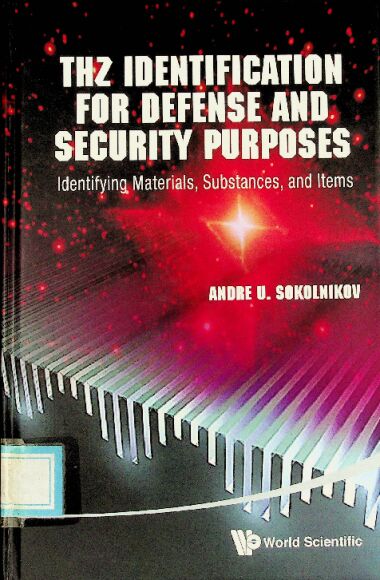
书名:THz identification for defense and security purposes
责任者:Andre U. Sokolnikov | president | Visual Solutions & Applications | USA.
ISBN\ISSN:9789814452380,9814452386
出版时间:2013
出版社:World Scientific
摘要
The principal aim of this book is to provide the reader with the understanding of the possibilities and features of THz identification as opposed to more traditional techniques such as X-rays, microwaves, etc. by elucidating and illustrating the principles of THz identification and its applications in a systematical way. Its scope includes a description of the physical principles of THz generation, transmission and detection, as well as of the applications of THz identification.
The inherent advantages and potential benefits of the terahertz (THz) phenomenon, potential that encompasses various aspects such as THz sensing, imaging and material properties investigation with THz radiation for Defense (military) and security applications serve as an important stimulus for the interest in emerging THz science and technology, in particular, the very rapid growth of this new field.
This text presents some of the leading fundamental research efforts towards the realization of practical THz devices applications for military and security applications. Relevant chapters contain fundamentals and/or measurements of THz radiation in solid-state materials such as high explosives (e.g. HMX, PETN, RDX, etc.), biological tissues and organic-semiconductor nanostructures. Individual chapters also address the present capabilities of THz equipment for the effective utilization of screening packages and personnel.
This book contains descriptions and analyses of the most innovative research in the field; the presented material introduces novel devices and/or concepts that enhance THz source and detector performance enabling completely new types of sensor performance at THz frequency (e.g. detection at molecular and nanoscale levels), and defining innovative sensing modalities (e.g. remote object and personnel identification) for defense and security.
查看更多
前言
This book came from real life.
I started working with electronic applications for defense back in the70's. In the 80's, my senior project was about fiber-optics. It was mostly focused on optical measurements but implied a military intercom usage. In the early 90's, microwave range was widely used for surveillance and identification purposes. The first surveillance system I designed worked at1 GHz. It was still three orders of magnitude lower than a typical terahertz (THz) frequency. Ever since then, the frequency has been increasing, filling the gap between microwaves and infrared. THz range became popular in the middle of the 90's. A lot of effort has been invested in making this range workable but there are still many challenges (mostly of technological nature). However, in a number of aspects, the scope of the scientific and engineering approaches has remained the same as it was for the microwave identification.
As we have been doing for 20 years, now, it is important to continue to use mathematical, statistical and probabilistic methods to determine what the identifiable object is (which is especially critical for automatic systems). Long gone are the days when the only reliable detector and analyzer was the human eye. Now, it is usually a microprocessor or a more elaborate computer system that makes a decision. In addition, the basic physics of the electromagnetic processes (since THz waves are part of the electromagnetic spectrum) are the same as they were for microwaves, visible light and X-rays -traditional means of identification and control. Bearing in mind the above, I tried to present succinctly the approaches applicable to the well-established means of identification. Such are the chapters concerning the electromagnetic theory and mathematical methods.
I have met many people with B.S. and advanced degrees who, for example, asked me to remind them of some electromagnetism laws even though they had taken corresponding courses in the past. Also, mathematical approaches were something that we would discuss. At the same time, I discovered that many specialists would collaborate with other experts (in the fields that they did not know) in order to make an electronic system such as a THz detection or surveillance device. I met professors from e.g. mechanical engineering departments who knew quite well how to build a mathematical model of a process, had some knowledge of electronics but needed other professors (say from Electrical Engineering) to work with image or signal processing. Thus, I would expect many potential readers to use certain chapters only as a reference or to acquire some idea of how, for example, a typical mathematical model is built and then use this knowledge to collaborate with specialists in this field who know the subject in more detail. Researchers who know the physics of THz sources and detectors might skip the corresponding chapters or just browse them. However, Ch.7 on "THz Applications" is meant for everyone and could be useful even for those who are not directly involved with Defense and Security technology.
Having spent almost a decade working for a federal organization dealing with organized crime and terrorism, I have adopted their perspective and approaches. Since the book is devoted to defense and security issues, I have tried to render, wherever it was possible, views of the law enforcement and military agencies and their understanding of the problem. For the most part, Ch. 7 contains a number of requirements emphasized by the military agencies. There are several examples in the chapter that illustrate the common approaches and achieved level of the THz technology as well as practical implementations (some of them of my own design).
In many ways, this book is written for the readers with engineering and scientific degrees who would be interested to get involved with the design and practical exploitation of THz equipment and work with representatives of the law enforcement and defense agencies and companies. Also, I can envision an opportunity for a college or university student to get a flavor of the possibilities of THz range and make it their field of study as a result of reading this book. Lastly, I had in mind businessmen who sell, buy, and service or market THz technology and want to know something about the products that they are dealing with.
On the whole, I would expect from the readers some technical and scientific background, university-level in physics, mathematics, material science and even biology, but not necessarily a thorough grasp of every subject in question.
Andre Sokolnikov
查看更多
目录
Preface
1. Introduction 1
2. Basics of Electromagnetism 3
2.1. Nature of electromagnetism 3
2.2. Electric fields 4
2.3. Magnetic fields 8
2.4. Static and dynamic fields 11
2.5. Maxwell's equations 12
2.6. Coulomb's law 13
2.7. Gauss's law 15
2.8. Poisson's equation 17
2.9. Electrical properties of materials 18
2.10. Conductors 19
2.11. Resistance 21
2.12. Dielectrics 22
2.13. Magnetostatics 26
2.14. Dynamic fields 31
References 37
3. Mathematical Methods of Identification 39
3.1. Process modeling 49
3.1.1. General approach 49
3.1.2. Nonlinear Least Squares Regression (NLSR)'s definition 54
3.2. Developing a model: Example 55
3.3. Validation of the created model 57
3.4. Spectrum analysis 60
3.4.1. General structure model 60
3.5. Signal processing implementation 62
3.5.1. General description 62
3.5.2. Process simulation and identification 62
3.6. Conclusions 64
References 64
4. Physics of Producing and Detecting THz Waves 67
4.1. Interaction of THz radiation with matter 68
4.1.1. Photoconductive THz generation: Photoconductive emitters 71
4.1.1.1. Example 75
4.1.2. Photoconductive detectors 76
4.2. Nonlinear optical pulse generation and detection 77
4.2.1. Semiconductor materials 83
4.2.2. Inorganic electro-optical compounds 84
4.2.3. Organic electro-optical compounds 85
4.2.4. Terahertz electro-optical detection 88
4.2.5. Semiconductors and inorganic compounds for detectors 88
4.2.6. Organic crystals 95
References 96
5. Methods and Technology for THz Sources, Detectors and Processing Electronics 97
5.1. THz sources 97
5.1.1. Pulsed THz sources 101
5.1.1.1. Example: Electron beam THz source 101
5.1.1.2. Background of electron beam sources 102
5.1.1.3. Source of radiation 102
5.1.1.4. Undulator emission 103
5.1.1.5. Results 103
5.1.2. Semiconductor sources of THz radiation 104
5.1.2.1. Example: Electrically pumped photonic-crystal THz laser 105
5.1.3. Continuous wave sources 108
5.1.3.1. Example: Photomixer as Cw, design features 109
5.2. THz detectors 112
5.2.1. Quantum superlattice as a THz detector 115
5.2.1.1. Example: THz detector based on layered superlattice 119
5.2.1.2. Resonant detector based on lateral superlattice 120
5.2.1.3. Responsivity of the resonant detector 122
5.2.1.4. Conclusion for example "THz detector based on layered superlattice" 124
5.3. Processing electronics 124
5.3.1. Example: THz source/frequency multiplier 125
5.3.1.1. The active multiplier chain 125
5.3.1.2. Terahertz source evaluation 128
5.4. Imaging using THz radiation 129
5.4.1. Imaging considerations, measurement time and pulse signal-to-noise ratio 130
5.4.2. Parametric images 132
5.4.3. Image spatial resolution capabilities 133
5.4.4. Safety measures for THz radiation 140
5.5. Conclusions 141
References 141
6. Electronics for Portable THz Devices 143
6.1. Example: Resonance Amplification - Power Source Based on Resonance Amplification 146
References 146
7. THz Applications 147
7.1. THz imaging of nonmetallic structures 148
7.1.1. Identification of tablet structure 149
7.1.2. Interferometry for Terahertz imaging - a possible solution 150
7.1.3. Results for the example 159
7.2. Mobile THz systems 163
7.2.1. Example: Mobile security surveillance system 164
7.2.2. Example: Compact THz system 167
7.3. THz identification of explosives 169
7.3.1. Example: Detection of explosives 171
7.3.1.1. THz spectral signatures of high explosives 171
7.3.1.2. Sensor set-up and operation 171
7.3.2. Recent improvements of explosives identification 176
7.4. THz identification of concealed weapons 177
7.4.1. Image construction 180
7.4.2. Additional improvements for identification of metal objects 182
7.5. THz identification of illicit substances 186
7.6. Prospects and conclusions 188
References 190
8. Medical and Other Applications of THz Radiation 193
8.1. Data analysis-Example: Wavelet analysis 196
8.1.1. Calculation of refractive index (for the Example) 197
8.1.2. Calculation of absorption coefficient (for the Example) 198
8.1.3. Results for the Example 199
8.2. Dermatology 201
8.3. Hard tissues diagnostics (dentistry, surgery, etc.) 204
8.4. THz characterization of biological and inorganic material (hydrated and anhydrous) 207
8.4.1. Modeling of water intermolecular structure 208
8.4.1.1. THz spectroscopy of hydrated and anhydrous substances 211
8.4.1.2. Conclusions for the examples and theory 215
References 216
Index 217
查看PDF
查看更多
作者简介
Dr Andre U. Sokolnikov is currently president of Visual Solutions and Applications.
查看更多
馆藏单位
中科院文献情报中心