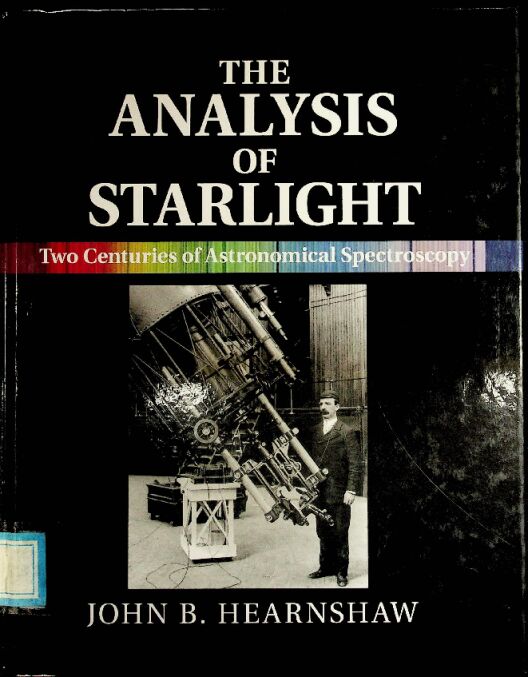
书名:The analysis of starlight
责任者:John B. Hearnshaw | University of Canterbury | Christchurch | New Zealand.
ISBN\ISSN:9781107031746,1107031745
出版时间:2014
出版社:Cambridge University Press
分类号:天文学、地球科学
版次:Second edition.
前言
First published in 1986, this is the story of the analysis of starlight by astronomical spectroscopy. Beginning with Joseph Fraunhofer's discovery of spectral lines in the early nineteenth century, this new edition continues the story through to the year 2000. In addition to the key discoveries, it presents the cultural and social history of stellar astrophysics by introducing the leading astronomers and their struggles, triumphs and disagreements. Basic concepts in spectroscopy and spectral analysis are included, so both observational and theoretical aspects are described, in a non-mathematical framework. This new edition covers the final decades of the twentieth century, with its major advances in stellar astrophysics: the discovery of extrasolar planets, new classes of stars and the observation of the ultraviolet spectra of stars from satellites. The in-depth coverage makes it essential reading for graduate students working in stellar spectroscopy, professional and amateur astronomers, and historians of science.
查看更多
目录
Preface to the second edition xi
Preface to the first edition, 1986 xiii
Acknowledgements xv
Acknowledgements for the second edition xv
Acknowledgements for the first edition (1986) xv
1 Introduction to spectroscopy, spectroscopes and spectrographs 1
1.1 Introduction 1
1.2 Basic concepts in spectroscopy 1
1.2.1 Terminology 1
1.2.2 Wavelength and colour 2
1.2.3 Continuous, emission and absorption spectra 2
1.2.4 Resolution and resolving power of spectroscopes 3
1.3 The development of the spectrograph and spectroscope design 3
1.3.1 Prism instruments in the nineteenth and early twentieth centuries 3
1.3.2 Early objective prism instruments 5
1.3.3 Early grating spectroscopes and spectrographs 5
1.3.4 The development of coudé spectrographs 6
1.3.5 The development of the échelle spectrograph 9
1.3.6 The CCD as a detector for astronomical spectroscopy 11
2 The analysis of sunlight: the earliest pioneers 15
2.1 Isaac Newton and the composition of sunlight 15
2.2 Invisible rays in the solar spectrum: Thomas Young and the measurement of wavelength 16
2.3 William Wollaston and the discovery of the solar line spectrum 16
2.4 Joseph Fraunhofer and the solar line spectrum 17
2.5 Planetary and stellar spectra observed by Fraunhofer 19
3 The foundations of spectral analysis: from Fraunhofer to Kirchhoff 21
3.1 The beginnings of spectral analysis: the work of Sir John Herschel 21
3.2 Sir David Brewster and spectral analysis 21
3.3 Fox Talbot and the spectra of flames 22
3.4 Further progress in studying the solar infrared by J. Herschel, Fizeau and Foucault 22
3.5 Edmond Becquerel and solar spectrum photography 23
3.6 The photographic solar spectrum of J.W. Draper 24
3.7 Sir George Stokes and the fluorescent ultraviolet solar spectrum 25
3.8 The relationship between heat, light and 'chemical rays' 25
3.9 The origin of the Fraunhofer lines 26
3.10 A key observation by Foucault as a step towards understanding the Fraunhofer spectrum 27
3.11 Kirchhoff announces the presence of sodium in the Sun 27
3.12 The emission and absorption of radiation: the theoretical work of Balfour Stewart and Kirchhoff 28
3.13 Further laboratory work in the analysis of flame, arc and spark spectra 28
3.14 Bunsen and Kirchhoff: chemical analysis of the solar spectrum 28
3.15 Reactions to the work of Kirchhoff and Bunsen 29
4 Early pioneers in stellar spectroscopy 33
4.1 Stellar spectroscopy before 1860 33
4.2 Stellar spectroscopy: a new beginning 33
4.3 Lewis Rutherfurd 35
4.4 Early spectroscopy at Greenwich 35
4.5 Angelo Secchi and spectral classification 36
4.6 William Huggins and stellar composition 41
4.7 Wolf and Rayet and their emission-line stars 44
4.8 Huggins' later work: comets and the Doppler effect 44
4.9 Henry Draper, Wm Huggins and spectrum photography 45
4.10 Hermann Carl Vogel 47
4.11 The discovery of helium 50
4.12 Vogel's second classification 52
4.13 Vogel and photographic radial-velocity determinations 52
4.14 Norman Lockyer and the meteoritic hypothesis 53
4.15 New southern emission-line stars: Herschel, Ellery, Pechüle, Copeland 56
4.16 The spectra of red stars: d'Arrest, Dunér, Espin 57
4.17 Nicholas von Konkoly, Eugen von Gothard and the first supernova spectrum 58
4.18 Spectrum photography in the 1890s: McClean, Scheiner, Sidgreaves 59
5 Spectral classification at Harvard 63
5.1 Edward Pickering at Harvard College Observatory 63
5.2 Mrs Draper and the Henry Draper Memorial 63
5.3 Williamina Fleming and the Draper Memorial Catalogue 64
5.4 Establishment of the Boyden Station at Arequipa, Peru 66
5.5 The Maury classification 66
5.6 Antonia Maury's 'collateral divisions' based on line width 68
5.7 Ionized helium lines and the Pickering series 70
5.8 Annie Cannon and the Harvard classification of 1901 71
5.9 Annie Cannon's classifications of 1912 73
5.10 The 1910 meeting of the International Solar Union and the spectral classification questionnaire 74
5.11 Williamina Fleming's work on stars with peculiar spectra 75
5.12 Emission-line stars catalogued by Annie Cannon 78
5.13 The Henry Draper Catalogue: programme initiated by Pickering and Cannon 78
5.14 Publication of the HD Catalogue 79
5.15 The Henry Draper Extension 82
5.16 Statistical analysis of the HD data: Shapley and galactic structure 83
6 The Doppler effect 86
6.1 Early history of the Doppler effect 86
6.2 Fizeau and Mach and the concept of line displacements 86
6.3 First attempts to observe Doppler shifts by Secchi and Huggins 87
6.4 Visual Doppler shift programmes of Maunder and Christie (Greenwich) and Seabroke (Rugby) 88
6.5 The Doppler effect and solar rotation 89
6.6 Visual radial-velocity measurements by Keeler at Lick 89
6.7 Photographic radial-velocity work by Vogel and Scheiner at Potsdam 90
6.8 Radial-velocity work of Belopolsky at Pulkova 91
6.9 Radial-velocity programmes in the United States, France and Britain in the 1890s 92
6.10 William W. Campbell 94
6.11 The D.O. Mills expedition to Chile 95
6.12 Campbell, Wright and Moore at Lick 97
6.13 Campbell's analysis of solar motion 99
6.14 New radial-velocity programmes established early in the twentieth century 99
6.15 The Mt Wilson radial-velocity programme 100
6.16 High-velocity stars and the discovery of galactic rotation 100
6.17 John Plaskett at the Dominion Astrophysical Observatory, Victoria 101
6.18 Edwin Frost at Yerkes Observatory 102
6.19 Cepheid variables and the pulsation theory 104
6.20 The International Astronomical Union and radial-velocity programmes 106
6.21 Standard wavelengths and standard stars 106
6.22 Radial-velocity catalogues 107
6.23 Radial-velocity programmes in the 1930s: David Dunlap and McDonald observatories 108
6.24 Radial-velocity work in the Soviet Union and in the southern hemisphere, 1930–1950 108
6.25 The Wilson General Catalogue 109
6.26 Changing trends in radial-velocity research from the 1950s 110
6.27 Empirical confirmation of Doppler and gravitational shifts 111
6.28 Objective prism radial velocities 111
6.29 Photoelectric radial velocities 114
6.30 New radial-velocity catalogues of the late twentieth century 116
6.31 Stellar rotation 116
6.32 Rotation in binary stars 117
6.33 Rotation in single stars and the correlation with spectral type 118
6.34 The discovery of extrasolar planets 120
7 The interpretation of stellar spectra and the birth of astrophysics 127
7.1 Some early theories of stellar evolution 127
7.2 Hertzsprung's analysis of the Maury c-type stars 127
7.3 Monck's analysis of proper motion and luminosity 129
7.4 Russell's work on luminosity and spectral type, and his relationship to Hertzsprung 129
7.5 Adams and Kohlschütter's work on luminosity effects in stellar spectra 132
7.6 New developments in atomic physics and their influence on astrophysics 133
7.7 The first stellar temperatures measured by Wilsing and Scheiner 133
7.8 Photographically determined stellar energy distributions 134
7.9 Further visual spectrophotometry at Potsdam 135
7.10 Saha and the theory of ionization 135
7.11 Saha's analysis of the sequence of Harvard spectral types 136
7.12 Fowler and Milne and the method of line strength maxima 137
7.13 Ionization theory and luminosity effects in stellar spectra 138
7.14 Cecilia Payne and the empirical confirmation of ionization theory 138
7.15 The Russell–Adams–Moore analysis of the solar spectrum 140
7.16 Russell and Adams on stellar composition 140
7.17 Unsöld and Russell on the composition of the Sun 141
7.18 The first curve of growth 142
7.19 The curve of growth applied to interstellar and stellar lines 144
7.20 The gradient effect and stellar atmospheric turbulence 146
7.21 Subsequent work in solar spectral analysis and the Utrecht Solar Atlas 148
7.22 Kenneth Wright and the solar curve of growth 149
8 Spectral classification: From the Henry Draper Catalogue to the MK system and beyond 152
8.1 The first International Astronomical Union meeting in Rome, May 1922 152
8.2 The classification of O stars 153
8.3 Spectral classification of nebulae 155
8.4 The spectroscopy of normal B stars 158
8.4.1 Line strengths, spectral types and the singlet-triplet anomaly 158
8.4.2 The Stark effect, luminosity criteria and spectroscopic parallaxes 160
8.5 Spectral classification programmes in the 1920s and 1930s 162
8.6 Bertil Lindblad and the spectrophotometry of late-type stars 165
8.7 Barbier, Chalonge and the Balmer jump 165
8.8 To the MKK classification and beyond 168
8.8.1 The origins of the MKK two-dimensional classification 168
8.8.2 The MKK Atlas of Stellar Spectra 170
8.8.3 Some commentaries on the MKK system 170
8.8.4 Spectral classification at Yerkes after the MKK 171
8.8.5 The MK system 173
8.9 The classification of the carbon stars 173
8.9.1 Introduction and summary of principal band systems 173
8.9.2 Classification of carbon stars after the HD Catalogue 175
8.9.3 Other proposed carbon star classifications 177
8.9.4 Carbon isotope ratios and the J-type stars 178
8.9.5 Carbon star catalogues 179
8.10 The classification and spectra of S stars 179
8.10.1 S stars, 1922–1970 179
8.10.2 A new understanding of the S spectral type, from 1970 182
8.11 Vanadium oxide and metallic hydrides in the M-type stars 182
8.12 Spectral classification 1970–2000 184
8.13 The discovery of brown dwarfs and the introduction of the L and T spectral types 185
8.13.1 The discovery of brown dwarfs 185
8.13.2 The lithium test for brown dwarfs 185
8.13.3 New spectral classes L and T 186
9 Spectroscopy of peculiar stars 193
9.1 Introduction to peculiar stars 193
9.2 Carlyle Beals and the Wolf–Rayet classification 193
9.3 Spectral classification of novae 196
9.3.1 Nova spectral classification by Williams 199
9.4 Emission line B stars: the Be stars 201
9.4.1 Herbig Ae and Be stars 204
9.5 The peculiar A-type stars: an astrophysical enigma 205
9.5.1 Discovery of peculiar A stars and early progress up to 1930 205
9.5.2 W.W. Morgan and Ap stars, 1931–1935 206
9.5.3 Horace Babcock and magnetic fields in the Ap stars 207
9.5.4 The oblique rotator model for magnetic stars 208
9.5.5 Spectral classification of Ap stars 209
9.5.6 The manganese stars and other early-type peculiar stars 209
9.5.7 Chemically peculiar stars 210
9.6 The λ Boötis stars 212
9.7 The metallic-line stars (Am) 215
9.7.1 Early history to 1960 of Am stars 215
9.7.2 Clarification of some of the metallic-line problems 216
9.7.3 Am stars from 1970 217
9.8 White dwarf spectra 218
9.8.1 Discovery of three white dwarfs 218
9.8.2 The Einstein redshift 220
9.8.3 New white dwarfs in the 1930s 221
9.8.4 Luyten's white dwarf discoveries and spectral classification scheme 222
9.8.5 Classification and analysis of white dwarf spectra, 1957–1967 223
9.8.6 The 1983 Sion spectral classification 224
9.9 The hydrogen-deficient stars 224
9.10 The T Tauri variable stars 227
9.11 The barium stars 231
9.12 The discovery of CH stars 233
9.13 Symbiotic stars 234
9.14 The spectra of supernovae 237
9.14.1 A note on the paucity of bright supernovae 237
9.14.2 S Andromedae and Z Centauri 237
9.14.3 Supernova spectroscopy to 1937 238
9.14.4 The classification of supernova spectra 239
9.14.5 Further refinements in supernova spectral classification 240
9.14.6 The supernova SN1987A in the Large Magellanic Cloud 242
10 Quantitative analysis of stellar spectra 253
10.1 Introduction 253
10.2 Stellar colour temperatures from 1925 254
10.3 Early model stellar atmospheres 256
10.4 Rupert Wildt and the negative hydrogen ion 258
10.5 Early model atmospheres in the 1940s after Wildt’s discovery 260
10.6 Empirical and theoretical solar models and the line-blanketing problem 262
10.7 Successive refinements to stellar model atmospheres from 1940 264
10.7.1 Convection and line blanketing in early model atmospheres 264
10.7.2 The great debate: LTE versus non-LTE models 266
10.8 The analysis of stellar spectra: four basic prerequisites 268
10.8.1 The effect of adopted temperature on derived abundances 268
10.8.2 Equivalent widths of lines by microdensitometry 268
10.8.3 Line identification in standard stars 269
10.8.4 The need for absolute oscillator strengths 271
10.8.5 Blackwell's precise Oxford oscillator strengths, and the great solar iron abundance controversy 273
10.9 Four pioneers in stellar abundance analysis: Unsöld, Greenstein, Aller, Wright 274
10.9.1 Unsöld and τ Sco: the method of 'Grobanalyse' 274
10.9.2 Greenstein and the differential analysis of F stars 275
10.9.3 Aller's abundance analyses 277
10.9.4 Kenneth Wright and the analysis of four solar-type stars 279
10.9.5 Concluding remarks on abundance analyses in the 1940s 280
10.10 Abundance analyses from 1950 281
10.10.1 Overview 1950–1970: who analysed which stars when, where and how? 281
10.10.2 Abundance analyses of stars of the halo population 284
10.10.3 G dwarfs analysed by Wallerstein and others 287
10.10.4 Lithium in the Sun and other stars 288
10.10.5 HD 33579 and the first spectral analysis of an extragalactic star 291
10.11 Stellar element abundances in the late twentieth century 292
10.11.1 New determinations of iron-to-hydrogen ratios [Fe/H] 292
10.11.2 Uranium and thorium lines and their use in cosmochronology 293
10.11.3 The great Population III treasure hunt 293
10.11.4 The age–metallicity relationship in the galactic disk 295
11 Some miscellaneous topics in stellar spectroscopy: individual stars of note, stellar chromospheres, interstellar lines and ultraviolet spectroscopy from space 304
11.1 Introduction 304
11.2 Some individual stars of note 304
11.2.1 The spectrum of P Cygni 304
11.2.2 η Carinae 306
11.2.3 He~3 in 3 CenA 309
11.2.4 Przybylski's star, HD 101065 309
11.2.5 The amazing Doppler shifts of SS 433 310
11.2.6 The remarkable spectra of the post-AGB stars, FG Sagittae and Sakurai's object 311
11.3 Emission lines at H and K and the Wilson–Bappu effect 313
11.4 Interstellar absorption lines and the dawn of ultraviolet spectroscopy from space 315
11.4.1 The discovery of interstellar absorption lines 315
11.4.2 New interstellar lines and bands and later research 317
11.4.3 The dawn of ultraviolet spectroscopy from space 319
11.5 Ultraviolet stellar spectroscopy from satellites 321
11.5.1 The Orbiting Astronomical Observatories 321
11.5.2 Ultraviolet spectroscopy with Europe's TD-1 satellite 322
11.5.3 The International Ultraviolet Explorer 322
11.5.4 The Goddard High Resolution Spectrograph on Hubble 323
Figure sources and acknowledgements 329
Appendix A: List of solar lines designated by letters by Fraunhofer and others 337
Appendix B: Vogel's first spectral classification scheme of 1874 339
Index of names 341
Index of star names 349
Index of spectral lines 353
Index of subjects 355
查看PDF
查看更多
馆藏单位
中科院文献情报中心