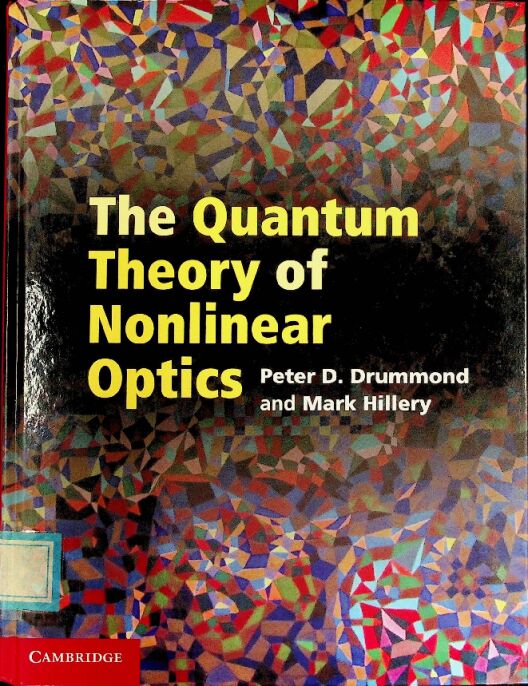
书名:The quantum theory of nonlinear optics
责任者:Peter D. Drummond | Swinburne University of Technology | Melbourne | Mark Hillery | Hunter College | City University of New York.
出版时间:2014
出版社:Cambridge University Press
前言
This book grew out of our work in the field of the quantum theory of nonlinear optics. Some of this work we have done together and some following our own paths. One major emphasis of this work has been the quantization of electrodynamics in the presence of dielectric media. This is a subject that is often given short shrift in many treatments, and we felt that a book in which it receives a more extensive discussion was warranted.
M.H. would like to thank his thesis advisor, Eyvind Wichmann, for an excellent education in quantum mechanics and quantum field theory, and M. Suhail Zubairy for introducing him to the field of nonlinear optics with quantized fields. Others who played a major role are Leonard Mlodinow, with whom the initial work on quantization in nonlinear media was done, and Janos Bergou and Vladimir Buzek, long-time collaborators with whom it has been a pleasure to work. He also thanks Carol Hutchins for many things.
P.D.D. wishes to acknowledge his parents and family for their invaluable support. The many colleagues who helped form his approach include Crispin Gardiner and the late Dan Walls, who pioneered quantum optics in New Zealand. Subhash Chaturvedi, Howard Carmichael, Steve Carter, Paul Kinsler, Joel Corney, Piotr Deuar and Kaled Dechoum have contributed greatly to this field. He also thanks Margaret Reid, who has played a leading role in some of the developments outlined in the quantum information section, and Qiongyi He, who provided illustrations.
查看更多
目录
Preface page ix
Introduction 1
1 Classical nonlinear optics 4
1.1 Linear polarizability 4
1.2 Nonlinear polarizability 7
1.3 Frequency dependence and dispersion 10
1.4 Power and energy 12
1.5 Order-of-magnitude estimates 16
1.6 The two-level atom 17
1.7 Local-field corrections 24
1.8 Propagation in a nonlinear medium 29
1.9 Raman processes 32
Additional reading 34
Problems 35
2 Field quantization 37
2.1 Quantum theory 37
2.2 Fock space for bosons 41
2.3 Many-body operators 44
2.4 Fock space for fermions 48
2.5 Canonical quantization 50
2.6 One-dimensional string 53
2.7 Scattering matrix 57
2.8 Quantized free electromagnetic field 66
2.9 Constrained quantization 73
2.10 Exponential complexity 78
Additional reading 81
Problems 81
3 Quantized fields in dielectric media 83
3.1 Dispersionless linear quantization 83
3.2 Scattering in linear media 89
3.3 Quantizing a nonlinear dielectric 92
3.4 Homogeneous nonlinear dielectric 94
3.5 Inhomogeneous nonlinear dielectric 96
3.6 Dispersion 103
3.7 One-dimensional waveguide 108
Additional reading 113
Problems 113
4 Microscopic description of media 116
4.1 The Coulomb gauge 116
4.2 The multipolar gauge 119
4.3 Hamiltonian for a polarizable medium 123
4.4 Dipole-coupling approximation 127
4.5 Linear medium 129
4.6 Quantization of the linear model 134
4.7 Two-level atomic medium 136
4.8 Polaritonic limit 139
Additional reading 142
Problems 142
5 Coherence and quantum dynamics in simple systems 144
5.1 Photon counting and quantum coherence 144
5.2 Quadratures and beam-splitters 149
5.3 Coherent states and P-representations 151
5.4 Nonclassical states 154
5.5 Two-mode states 157
5.6 Mode entanglement 160
5.7 Parametric interactions 163
5.8 Anharmonic oscillator and Schrodinger’s cat 170 ¨
5.9 Jaynes–Cummings dynamics 175
5.10 Parametric approximation 177
Additional reading 181
Problems 182
6 Decoherence and reservoirs 184
6.1 Reservoir Hamiltonians 184
6.2 Absorption 187
6.3 Gain 191
6.4 Phase decoherence 195
6.5 Input–output relations 198
6.6 Photon flux and density 201
6.7 Two-time correlation functions 206
6.8 Master equations 207
6.9 Gain and damping rates 211
6.10 Driven linear cavity example 212
Additional reading 214
Problems 215
7 Phase-space distributions 217
7.1 Diffusion processes 217
7.2 Fokker–Planck equations 220
7.3 Stochastic differential equations 223
7.4 Phase-space representations 228
7.5 Wigner and Q-representations 231
7.6 Nonclassical representations 235
7.7 Operator identities and quantum dynamics 241
7.8 Quasi-probability Fokker–Planck equation 245
7.9 Linearized fluctuation theory 250
7.10 Functional phase-space representations 251
Additional reading 253
Problems 254
8 Single-mode devices 256
8.1 Linear cavity 256
8.2 Phase-space representation methods 257
8.3 Driven nonlinear absorber 262
8.4 Squeezing and photon anti-bunching 264
8.5 High-Q laser 268
8.6 Laser linewidth 272
8.7 Laser quantum state: number or coherent? 274
8.8 Open nonlinear interferometer 276
Additional reading 280
Problems 280
9 Degenerate parametric oscillator 283
9.1 Hamiltonian and stochastic equations 283
9.2 Classical results 285
9.3 Fokker–Planck and stochastic equations 287
9.4 Adiabatic approximation 290
9.5 Multi-mode treatment of parametric down-conversion in a cavity 291
Additional reading 296
Problems 296
10 Quantum field dynamics 298
10.1 Kerr medium 299
10.2 Quantum solitons 301
10.3 Time-dependent Hartree approximation 304
10.4 Quantum solitons in phase space 307
10.5 Parametric down-conversion 308
10.6 Maxwell–Bloch equations 312
Additional reading 317
Problems 318
11 Quantum propagation in fibers and waveguides 319
11.1 Order-of-magnitude estimates 319
11.2 Waveguide modes 321
11.3 Dispersive energy 323
11.4 Nonlinear Hamiltonian 326
11.5 Fiber optic Hamiltonian 328
11.6 Raman Hamiltonian 330
11.7 Gain and absorption 333
11.8 Combined Heisenberg equations 336
11.9 Phase-space methods 337
11.10 Polarization squeezing 341
Additional reading 344
Problems 345
12 Quantum information 346
12.1 The Einstein–Podolsky–Rosen paradox 347
12.2 Bell inequality 350
12.3 Schrödinger cat paradoxes 355
12.4 Probabilistic simulations of Bell violations 358
12.5 Quantum cloning 360
12.6 Teleportation 363
Additional reading 366
Problems 367
List of symbols 369
Index 371
查看PDF
查看更多
馆藏单位
中科院文献情报中心