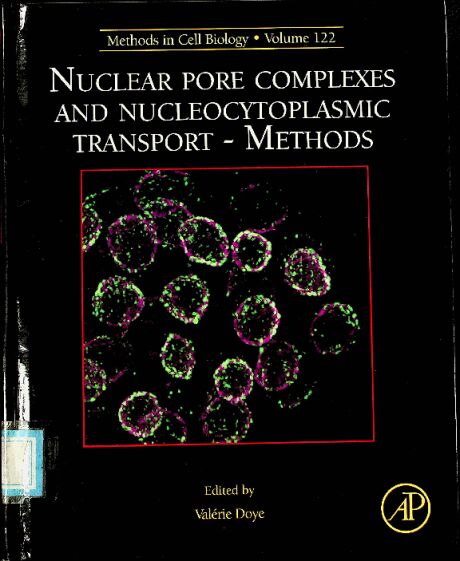
书名:Methods in cell biology. Volume 122, Nuclear pore complexes and nucleocytoplasmic transport - methods
出版时间:2014
出版社:Elsevier/Academic Press,
摘要
Volume 122 of Methods in Cell Biology describes modern tools and techniques used to study nuclear pore complexes and nucleocytoplasmic transport in diverse eukaryotic model systems (including mammalian cells, Xenopus, C. elegans, yeast).
The volume enables investigators to analyze nuclear pore complex structure, assembly, and dynamics; to evaluate protein and RNA trafficking through the nuclear envelope; and to design in vivo or in vitro assays appropriate to their research needs.
Beyond the study of nuclear pores and transport as such, these protocols will also be helpful to scientists characterizing gene regulation, signal transduction, cell cycle, viral infections, or aging. The NPC being one of the largest multiprotein complexes in the cell, some protocols will also be of interest for people currently characterizing other macromolecular assemblies. This book is thus designed for laboratory use by graduate students, technicians, and researchers in many molecular and cellular disciplines.
查看更多
目录
Contributors xiii
Preface xix
CHAPTER 1 Fifty Years of Nuclear Pores and Nucleocytoplasmic Transport Studies:
Multiple Tools Revealing Complex Rules 1
Introduction 2
1.1 The NPCs: A Modular Macromolecular Assembly 3
1.2 Nucleocytop1asmic Trafficking : The Rules of the Road 12
1.3 The Nuclear Transport Machinery: A Dynamic and Versatile Device 23
Concluding Remarks 31
Acknowledgments 31
References 32
CHAPTER 2 Imaging Metazoan Nuclear Pore Complexes by Field Emission Scanning Electron Microscopy 41
Introduction 42
2.1 Rationa1e 44
2.2 Material s 48
2.3 Anchored Nuclei 49
2.4 Mammalian Cell Nuclei 51
2.51mmunogold1abeling 52
2.6 Sample Preparation for FESEM 54
Acknow1edgments 56
References 56
CHAPTER 3 Imaging Yeast NPCs: From Classical Electron Microscopy to 1mmuno-SEM 59
Introduction 60
3.1 Conventional TEM 61
3.2 SEM and Immuno-SEM of Yeast Nuclei 65
3.3 Immunogold 1abeling of Yeast Ultrathin Cryosections 69
Conclusions and Perspectives 76
Acknowledgments 77
References 77
CHAPTER 4 Exploring Nuclear Pore Complex Molecular Architecture by1mmuno-Electron Microscopy Using Xenopus Oocytes 81
Introduction 82
4.1 Materials 86
4.2 Experimental Strategies 87
4.3 Preparation of Antibodies Conjugated with Colloidal Gold Particles 89
4.4 Immunogold1abeling of Nucleoporins Using Anti-Nucleoporin Antibodies 90
4.5 Immunogold1abeling of Nucleoporins Using Epitope-Tagged Nucleopori ns 93
Concluding Remarks 96
Acknowledgments 96
References 96
CHAPTER 5 Utilizing the Dyn2 Dimerization-Zipper as a Tool to Probe NPC Structure and Function 99
Introduction 100
5.1 Common Preparatory Steps 101
5.2 Dyn2 as an EM1abel to Map Subcomplexes and Single Nups 107
5.3 Probing the FG Network by Selective Insertion of the eDID-Dyn2 Complex into FG Repeat Domains 111
5.4 Materials and Reagents 113
Conclusion 114
Acknow1edgment 114
References 114
CHAPTER 6 The Use of Targeted Proteomics to Determine the Stoichiometry of arge Macromolecular Assemblies 111
Introduction 118
6.1 Isolation of Nuclei and Nuclear Envelopes 119
6.2 Targeted Proteomics 130
Conclusions 143
Acknowled gments 144
References 144
CHAPTER 7 A Pulse-Chase Epitope 1abeling to Study Cellular Dynamics of Newly Synthesized Proteins: A Novel Strategy to Characterize NPC Biogenesis and Ribosome Maturation/Export 147
Introduction 148
7.1 Cloning into the Saccharomyces cerevisiae Pulse-Chase Vectors 150
7.2 Epitope Pulse-Chase Protocols 151
7.3 Material 160
Conclusion and Perspectives 161
Acknowledgments 162
References 162
CHAPTER 8 Analysis of Nuclear Reconstitution, Nuclear Envelope Assembly, and Nuclear Pore Assembly Using Xenopus In Vitro Assays 165
Introduction 166
8.1 Materials 168
8.2 Xenopus Egg Extracts 170
8.3 Demembran ated Sperm Chromatin 177
8.4 In Vitro Reconstitution of Nuclei 180
8.5 Assaying Assembly and Integrity of the Nuclear Envelope .182
8.6 A Nuclear Pore Complex Assembly Assay Using Pore-Free Nuclear Intermediates 184
Conclu sion 187
References 188
CHAPTER 9 Xenopus In Vitro Assays to Analyze the Function of Transmembrane Nucleoporins and Targeting of Inner Nuclear Membrane Proteins 193
Introduction 195
9.1 Preparation of Xe11opus Egg Extract Cytosol and Membranes 196
9.2 Protein Expression 201
9.3 Biochemical Procedures 204
9.4 Nuclear Assembly Reactions 210
Conclusion 216
References 217
CHAPTER 10 Imaging the Assembly, Structure, and Function of the Nuclear Pore Inside Cells 219
Introduction 220
10.1 Measuring the Kinetics of Postmitotic NPC Assembly in1iving Cells by Multicolor 4D Imaging 221
10.2 Monjtoring NE Permeability in1iving Cells by Sequential Photoswitching 225
10.3 Structural Analysis of the NPC by Super-Resolution Microscopy 228
10.4 Future Perspective 234
10.5 Materials and Instruments 234
Acknowledgments 235
References 236
CHAPTER 11 Cell-Fusion Method to Visualize1nterphase Nuclear Pore Formation 239
Introduction 240
11.1 Materials and Equipment 246
11.2 Quantitative Analysis of Interphase NPC Formation using Cell-Fusion Method 247
11.3 Combining the Cell-Fusion Method with Drug and siRNA Treatments 249
11.4 Visualization of Interphase NPC Formation using Photobleaching 250
Conclusions 252
Acknowledgments 252
References 252
CHAPTER 12 An In Vitro System to Study Nuclear Envelope Breakdown 255
Introduction 256
12.1 Preparative Steps 258
12.2 NEBD Assay 264
12.3 Special Treatments 267
12.4 Data Analysis 270
12.5 Future Directions 273
12.6 Material and Reagents 273
Acknowledgments 275
References 275
CHAPTER 13 Modern Tools to Study Nuclear Pore Complexes and Nucleocytoplasmic Transport in Caenorhabditis elegans 211
Introduction 278
13.1 Forward and Reverse Genetics 279
13.2 Transgenesis 287
13.3 Live Imaging of Embryos 290
13.4 In Vivo Methods to Evaluate Structural and Functional Integrity of the NE 296
13.51mmunofl uorescence and Electron Microscopy 298
13.6 Interaction of Nups with Chromatin 303
Summary and Future Perspectives 304
Acknowledgments 304
References 305
CHAPTER 14 Assessing Regulated Nuclear Transport in Saccharomyces cerevisiae 311
Introduction 312
14.1 Observing Steady-State1ocalization of Kap Cargo Proteins 314
14.2 Perturbing Nuclear Transport 319
14.3 Materials and Reagents 327
Acknowledgments 328
References 328
CHAPTER 15 Analysis of Nucleocytoplasmic Transport in Digitonin-Permeabilized Cells Under Different Cellular Conditions 331
Introduction 332
15.1 Equipment, Material, Reagents, and Buffers 335
15.2 Purification of Recombinant Transport Factors 339
15.3 Use of Digitonin-Permeabilized Cells to Study Nuclear Transport Under Normal and Heat-Shock Conditions 342
15.4 Interphase Nucleocytoplasmic Transport and Mitotic Chromosome1oading of Choromokinesin hKid 346
Conclusions and Perspectives 349
Acknowledgments 349
References 349
CHAPTER 16 Novel Approaches for the Identification of Nuclear Transport Receptor Substrates 353
Introduction 354
16.1 Identification of CRMI-Dependent Export Cargos 357
16.2 Identification of Nuclear Import Cargos 364
Conclusions 375
Acknowledgments 375
References 376
CHAPTER 17 NPC Mimics: Probing the Mechanism of Nucleocytoplasm ic Transport 379
Introduction 380
17.1 Protein Production and Purification 381
17.2 Preparation of Nanoselective Filters 384
17.3 Device Setup 385
17.4 Flux Measurements 387
17.5 Materials and Reagents (Listed by Alphabetical Order) 389
Conclusions 39 1
References 391
CHAPTER 18 Analys is of RNA Transport in Xenopus Oocytes and Mammalian Cells 395
Introduction 396
18.1 Materials 398
18.2 Nuclear Export of Radiolabeled RNAs in Xenopus Oocytes 401
18.3 Nuclear1ocalization of Fluorescently1abeled RNAs in Xenopus Oocytes 405
18.4 Nuclear Export of Endogenou s poly(A) +RNA in Mammalian Cells 407
18.5 Nuclear Export of Exogenously Expressed GFP mRNA in Mammalian Cells 409
Concluding Remarks 411
Acknowledgment 411
References 412
CHAPTER 19 Strategies for Investigating Nuclear-Cytoplasmi c tRNA Dynamics in Yeast and Mammalian Cells 415
Introduction 416
19.1 Identification of tRNA-Interacting Proteins Using a Yeast Three-Hybrid Interaction Screen 419
19.2 Amber Suppression In Vivo Nuclear tRNA Export Assay 423
19.3 Fluorescence In Situ Hybridization Detection of the Cellular 1ocation of tRNA 426
19.4 Analysis of tRNA Aminoacylation Status in the Nucleus 431
Concluding Remarks 435
References 435
CHAPTER 20 Dissecting Ribosome Assembly and Transport in Budding Yeast 437
Introduction 438
20.1 Localization of Preribosomal Subunits by Fluorescence Microscopy 441
20.2 Fractionation of Cell Extracts by Sucrose Gradient Sedimentation 443
20.3 Isolation of Preribosomal Particles by TAP 450
20.4 Monitoring 1ocalization of the 40S Preribosome by Fluorescence In situ Hybridization 453
20.5 Analysis of Shuttling Trans-Acting Factors by Heterokaryon Assays 454
20.6 Material, Reagents and Yeast Media 456
Conclusions 458
Acknowled gments 458
References 458
CHAPTER 21 Approaches to Studying Subnuclear Organization and Gene-Nuclear Pore Interactions 463
Introduction 464
21.1 A Quantitative Assay for Gene1ocalization to the Nuclear Pore Complex in Yeast 465
21.2 Monitoring Interchromosomal Clustering of Genes at the NPC 471
21.3 Using Chromatin Immunoprecipitation to Probe Nuclear Organization, Transcription, and Chromat in Structure in Yeast and Human Cells 474
21.41ist of Plasmid s and Strains 481
Concluding Remarks, Possible Caveats, and Troubleshooting 482
Acknowledgments 483
References 483
lndex 485
查看更多
馆藏单位
中科院文献情报中心