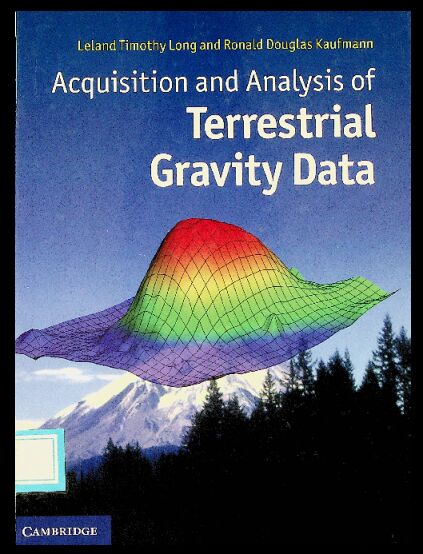
书名:Acquisition and analysis of terrestrial gravity data
责任者:Leland Timothy Long | Professor Emeritus | Georgia Institute of Technology; Ronald Douglas Kaufmann | Spotlight Geophysical Services
ISBN\ISSN:9781107024137,1107024137
出版时间:2013
出版社:Cambridge University Press
分类号:天文学、地球科学
页数:x, 171 pages
前言
Gravity surveys have a huge range of applications, indicating density variations in the subsurface and identifying man-made structures, local changes of rock type or even deep-seated structures at the crust/mantle boundary. This important one-stop book combines an introductory manual of practical procedures with a full explanation of analysis techniques, enabling students, geophysicists, geologists and engineers to understand the methodology, applications and limitations of a gravity survey. Filled with examples from a wide variety of acquisition problems, the book instructs students in avoiding common mistakes and misconceptions. It explores the increasing near-surface geophysical applications being opened up by improvements in instrumentation and provides more advance-level material as a useful introduction to potential theory. This is a key text for graduate students of geophysics and for professionals using gravity surveys, from civil engineers and archaeologists to oil and mineral prospectors and geophysicists seeking to learn more about the Earth's deep interior.
查看更多
目录
Preface page x
1 Gravitational attraction 1
1.1 Universal gravitational attraction 1
1.2 Gravitational acceleration 3
1.3 Gravitational potential of a point mass 4
1.4 Gravitational potential of a solid body 5
1.5 Surface potential 7
1.6 Attraction of a sphere 8
1.7 Units of acceleration 9
2 Instruments and data reduction 10
2.1 The gravitational constant 10
2.2 Absolute measurements 11
2.3 Relative measurements 13
2.4 Instruments for gravity-gradient measurements 16
2.5 Data reduction 17
2.6 Variation with latitude 21
2.7 Atmospheric correction 24
2.8 Free air correction 24
2.9 The simple Bouguer correction 27
2.10 Terrain corrections 29
2.11 Isostatic anomaly 32
2.12 Characteristics of the different reductions 38
3 Field acquisition of gravity data 41
3.1 Introduction 41
3.2 Planning the survey 42
3.3 Suggested documentation 43
3.4 Base station network 44
3.5 Monitoring meter drift 45
3.6 Same-day data reduction 46
4 Graphical representation of the anomalous field 48
4.1 Map scale and implied accuracy 48
4.2 Map projections 51
4.3 The accuracy of gravity data measurements 52
4.4 Observational determination of precision 54
4.5 Linear interpolation of gravity data 55
4.6 Accuracy of linear interpolation 57
4.7 Optimal linear interpolation 60
4.8 Accuracy of the gravity gradient 62
4.9 Precision of a gravity map 63
4.10 The correlation and covariance functions 63
4.11 Computation of the autocovariance function 66
5 Manipulation of the gravity field 69
5.1 Objective of gravity field manipulation 69
5.2 Anomalies: regional, local, and noise 70
5.3 Smoothing 71
5.4 Examination of a three-point smoothing operator 74
5.5 Orthogonal function decomposition 76
5.6 The discrete Fourier transform 78
5.7 Least squares criteria for fitting data 86
5.8 Polynomials 87
5.9 Upward continuation 87
5.10 Numerical integration of upward continuation 91
5.11 Fourier transform continuation 92
5.12 Finite-difference methods 93
5.13 Analytical continuation 94
6 Interpretation of density structure 99
6.1 Introduction 99
6.2 Densities of rocks 100
6.3 Nettleton’s method for determination of reduction density 104
6.4 Seismic velocity as a constraint for rock density 106
6.5 Gravity anomalies from spherical density structures 107
6.6 The attraction of a thin rod 112
6.7 Attraction of a horizontal cylinder of finite length 114
6.8 The two-dimensional potential 116
6.9 Vertical sheet 117
6.10 Horizontal half-sheet 119
6.11 Two-dimensional polygonal-shaped bodies 121
6.12 Polygons of attracting mass in a horizontal sheet 125
7 The inversion of gravity data 129
7.1 Introduction 129
7.2 Depth of a basin as layer thicknesses 131
7.3 Depth in a basin as an overdetermined inverse problem 133
7.4 Stripping by layers 136
7.5 Formulation of an underdetermined inverse problem 138
7.6 The minimum length solution of the underdetermined inverse problem 138
7.7 Seismic velocity as a constraint 142
7.8 Maximum likelihood inversion 143
8 Experimental isostasy 149
8.1 The isostatic reduction 149
8.2 The isostatic response function 149
8.3 Determination of the isostatic response function 151
8.4 Interpretation of the isostatic response function 155
8.5 Example computation of the admittance and isostatic response functions 156
8.6 Isostasy in coastal plain sediments 158
Appendix A. Common definitions and equations in potential theory 161
Appendix B. Glossary of symbols 165
References 167
Index 170
查看更多
作者简介
Ronald Douglas Kaufmann founded Spotlight Geophysical Services in 2009 and has over 20 years of geophysical consulting experience, including positions of Vice President and Senior Geophysicist at Technos, Inc. and postgraduate experience at Oak Ridge National Laboratory. He holds an MS degree in geophysics from Georgia Institute of Technology and is a licensed professional geophysicist in the State of California. He has led geophysical investigations of the Panama Canal expansion, nuclear power plants, Superfund sites, and other high-profile projects within the United States and abroad. Mr Kaufmann is an expert in the use of microgravity for karst investigations and has been instrumental in the development of geophysical methods in shallow marine environments. He is author and co-author of over thirty professional papers that focus on the application of geophysical techniques. He is a Board member of the Environmental and Engineering Geophysical Society (EEGS) and a Section officer for the Association of Environmental and Engineering Geologists (AEG).
查看更多
馆藏单位
中科院文献情报中心