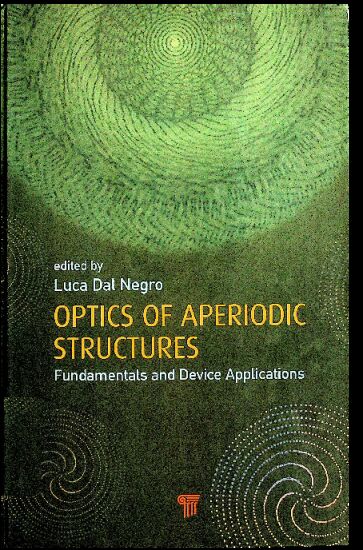
书名:Optics of aperiodic structures
ISBN\ISSN:9789814463089,9814463086
出版时间:2014
出版社:Pan Stanford Pub. ,
前言
This book presents state-of-the-art contributions from a number of leading experts that actively work worldwide in the rapidly growing, highly interdisciplinary, and fascinating fields of aperiodic optics and complex photonics. Edited by Luca Dal Negro, a prominent researcher in these areas of optical science, the book covers the fundamental, computational, and experimental aspects of deterministic aperiodic structures, as well as numerous device and engineering applications to dense optical filters, nanoplasmonics photovoltaics and technologies, optical sensing, light sources, and nonlinear optics.
查看更多
目录
Preface xvii
1 Aperiodic Order for Nanophotonics 1
Luca Dal Negro, Nate Lawrence, Jacob Trevino, and Gary Walsh
1.1 Introduction 2
1.2 Short History ofAperiodic Order 3
1.2.1 Periodic and Quasi-Periodic Order 5
1.3 Aperiodic Substitutions 9
1.4 Few Remarks on Diffraction and Spectral Properties 14
1.4.1 Diffraction and Geometrical Correlations 14
1.4.2 Coherent and Incoherent Scattering Response 16
1.4.3 Spectral Properties ofParticle Arrays 18
1.5 Number Theory and Aperiodic Order 23
1.6 Rotational Symmetry: From Tilings to Vogel Spirals 35
1.6.1 Vogel Spiral Arrays: Structural Properties 37
1.6.2 Engineering the Orbital Angular Momentum of Light 47
1.7 Conclusions 50
2 The Importance of Being Aperiodic: Optical Devices 57
Enrique Maciá
2.1 Aperiodicity vs. Periodicity and Randomness 57
2.1.1 From Periodic to Self-Similar and Quasi-Periodic Long-Range Orders 58
2.1.2 Quasi-Periodicity-Related Characteristic Properties 61
2.1.3 What about Random Structures? 66
2.1.4 Modular Designs 68
2.2 Digging Up the Fundamentals 74
2.2.1 Local Isomorphism Consequences 74
2.2.2 The Role ofPhasonic Defects 77
2.3 Aperiodicity by Design 80
2.3.1 Comparing Aperiodic Structures 80
2.3.2 Aperiodicity Degree Control 82
2.3.3 Optimization Approaches 83
3 Optical Filters Based on Fractal and Aperiodic Multilayers 91
Sergei V. Zhukovsky, Andrei V. Lavrinenko, and Sergey V. Gaponenko
3.1 Introduction 92
3.1.1 Binary Quarter-Wave Multilayers 95
3.1.2 Airy Formulas 96
3.2 Fractal Optical Filters 98
3.2.1 Fractal Multilayers 98
3.2.2 Spectral Scalability 102
3.2.3 Role ofGeometrical Self-Similarity in Spectral Scalability 106
3.2.4 Transmission Peak Splitting and Band Formation 109
3.3 Quasi-Periodic Filters 112
3.3.1 Fibonacci Potentials and Fibonacci Multilayers 112
3.3.2 Spectral Scalability and Self-Similarity 114
3.3.3 Laser Pulse Shaping with Fibonacci Filters 116
3.4 Defect-Based Aperiodic Filters and Devices 117
3.4.1 Peak Splitting in Multiple Defects 118
3.4.2 Pulse Chirp Compensation and Delay in Coupled-Defect Filters 119
3.4.3 Perfect Transmission in Asymmetric Aperiodic Structures 121
3.4.4 Optical Diode Action in an Asymmetrically Placed Defect 126
3.5 Multilayers ofArbitrary Geometry: General Constraints on Wave Propagation 129
3.5.1 Conservation ofPhotonic Density ofStates 130
3.5.2 Phase Time and Traversal Velocity 132
3.5.3 Density ofPhotonic Modes in Arbitrary 1D Structures 133
3.6 Conclusions 136
4 Lasing in Deterministic Aperiodic Nanostructures 143
Hui Cao, Luca Dal Negro, Heeso Noh, and Jacob Trevino
4.1 Introduction 143
4.2 Pseudorandom Laser 145
4.3 Optimization ofStructural Aperiodicity for Lasing 152
4.4 Golden-Angle Spiral Lattice 158
4.4.1 Structural Analysis ofthe Golden-Angle Spiral 160
4.4.2 Photonic Bandgap and Band-Edge Modes 162
4.4.3 Spatial Inhomogeneity and Localization 167
4.4.4 Discrete Angular Momentum 168
4.5 Conclusion 172
5 Optical Thue–Morse Systems for Nanophotonics Applications 179
Luigi Moretti and Vito Mocella
5.1 Introduction 180
5.2 Optical Multilayer Based on the Thue–Morse Sequence 184
5.3 Two-Dimensional Thue–Morse Systems 192
5.4 Conclusions 201
6 Nonlinear Aperiodic Multilayers 205
VictorGrigoriev and Fabio Biancalana
6.1 Introduction 205
6.2 Green’s Function for Multilayered Structures 207
6.2.1 Eigenvalue Problem for Maxwell’s Equations 207
6.2.2 Derivation ofthe SM 208
6.2.3 Modes ofthe Thue–Morse Structure 210
6.3 Broadband Transmission ofQuarter-Wave Multilayers 213
6.3.1 Exact Analytical Formulas for the Transmission Spectrum 213
6.3.2 Group Delay and Density ofModes 217
6.3.3 Reshaping ofUltrashort Pulses 218
6.4 Coupled Mode Theory and Nonlinear Properties of Multilayers 220
6.4.1 Derivation ofthe Coupled Mode Equations 220
6.4.2 Perturbations Caused by the Kerr Nonlinearity 221
6.4.3 Bistability, Multistability, and Nonreciprocal Behavior 222
6.4.4 Thue–Morse Structures as Coupled Nonlinear Microcavities 223
6.5 Practical Applications 225
6.5.1 Optical Diode Based on Coupled Nonlinear Microcavities 225
6.5.2 Switching and Self-Pulsations in Coupled Nonlinear Microcavities 229
6.6 Conclusions and Future Work 235
7 Aperiodic Nanoplasmonics 239
Luca Dal Negro, Nate Lawrence, Jacob Trevino, and Gary Walsh
7.1 Introduction 240
7.2 Aperiodic Arrays: Structure/Property Relations 241
7.2.1 Plasmonic Chains: Collective Excitations and Energy Gaps 242
7.2.2 Two-Dimensional Plasmon Arrays: Hot-Spot Engineering 250
7.3 Nanofabrication ofAperiodic Plasmon Arrays 259
7.4 Device Applications 264
7.4.1 Applications in Light Emission Enhancement 264
7.4.2 Applications in Thin-Film Solar Cell Enhancement 268
7.4.3 Applications in Surface-Enhanced Raman Spectroscopy 274
7.4.4 Colorimetric Optical Detection 282
7.4.5 Structural Color Engineering 288
7.4.6 Optical Angular Momentum Engineering 292
7.5 Outlook and Conclusions 297
8 Numerical Methods for the Electromagnetic Simulation of Complex Plasmonic Nanostructures 311
Carlo Forestiere, Antonio Capretti, Luca Dal Negro, Guglielmo Rubinacci, Antonello Tamburrino, and Giovanni Miano
8.1 Introduction 311
8.2 Mie Scattering 314
8.2.1 Single-Particle Mie Theory 315
8.2.2 Generalized Multiparticle Mie Theory 318
8.3 Point Dipole Approximation 323
8.3.1 Full Retarded Point Dipole Approximation 323
8.3.2 Modified Long-Wavelength Approximation 325
8.3.2.1 Nanoplasmonics ofprime number arrays 327
8.3.3 Electrostatic Approximation and Mode Analysis 333
8.3.3.1 Nanoparticle chains 336
8.3.3.2 The plasmonic resonance frequencies of the Fibonacci chain 336
8.4 Integral Equations 340
8.4.1 Problem Statement 341
8.4.2 Volume Integral Equations 342
8.4.2.1 The electroquasistatic approximation 343
8.4.2.2 Numerical models 344
8.4.2.3 The fast solver 345
8.4.2.4 Numerical results 346
8.4.3 Electrostatic Resonance Calculations 348
8.4.4 Surface Integral Equations 351
8.4.4.1 Love’s field equivalence principle 352
8.4.4.2 SIEs with a singular kernel 354
8.4.4.3 Combined region integral equations 355
8.4.4.4 Combined field integral equations 356
8.4.4.5 Null field method 357
8.4.4.6 Numerical results 358
8.5 Conclusions 360
9 Quasi-Periodic Plasmonic Concentrators for Ultrathin Film
Photovoltaics 369
Patrick W. Flanigan, Aminy E. Ostfeld, Natalie G. Serrino,nZhen Ye, and Domenico Pacifici
9.1 Introduction 370
9.2 Generalized Construction Algorithm for Periodic and Quasi-Periodic Arrays 373
9.3 The Physics ofPlasmonic Concentrators and Thin-Film Solar Cells 379
9.3.1 Overview ofSurface Plasmons and Plasmonic Concentrators 379
9.3.2 Application ofPlasmonic Concentrators to Thin-Film Organic Solar Cells 381
9.4 SPP Interference Behavior in Quasi-Periodic, Periodic, and Random Nanohole Arrays 387
9.4.1 Description ofa Simulation Program 387
9.4.2 Absorption Enhancement as a Function ofGrid Number 389
9.4.3 Absorption Enhancement as a Function of Array Scaling 396
9.5 Conclusion 401
10 Wave Propagation in One Dimension: Methods and Applications to Complex and Fractal Structures 407
E. Akkermans, G. V. Dunne, and E. Levy
10.1 Introduction 407
10.2 Wave Equations 408
10.2.1 The Helmholtz Equation 408
10.2.2 The Schrödinger Equation 409
10.3 Tight-Binding Formalism 410
10.3.1 Tight-Binding Approach to the Helmholtz Equation 412
10.4 Scattering Matrix Formalism 412
10.4.1 Derivation 2: Green’s Function and Resolvent 415
10.4.2 Gelfand–Yaglom Description and Transmission Probability 417
10.5 Transfer Matrix Formalism 420
10.5.1 Transfer Matrices and a Discrete Riccati Equation 422
10.5.2 Continuous Limit ofa Discrete Riccati Equation 423
10.5.3 Transfer Matrix Description for the Helmholtz Equation 426
10.6 Illustrative Examples ofLayered Systems 432
10.6.1 Free Space 432
10.6.2 Fabry–Perot Structure 433
10.6.3 Periodic Structure: Photonic Crystal 433
10.6.4 Random Structures 437
10.6.5 Fibonacci Structures 440
10.6.6 Fractal Cantor Set Structures 444
10.6.7 Defect Modes in Photonic Crystal Structures 445
10.7 Discussion 447
11 Computation and Visualization of Photonic Quasicrystal Spectra 451
Steven G. Johnson, Alexander P. McCauley, and Alejandro Rodriguez-Wong
11.1 Introduction and Background 452
11.1.1 Quasicrystals via Cut-and-Project 455
11.1.2 Supercell Approach 458
11.2 Computations in Higher Dimensions 459
11.2.1 Bloch’s Theorem and Numerics for Quasicrystals 461
11.2.2 The Spectrum ofthe Quasicrystal 462
11.3 One-Dimensional Results 463
11.3.1 Fibonacci Quasicrystal 463
11.3.1.1 Spectrum 463
11.3.1.2 Spurious modes 465
11.3.1.3 Visualizing the eigenmodes in super-space 467
11.3.2 Defect Modes 471
11.3.3 Continuously Varying the Cut Angle 473
11.3.4 Smooth Super-Space Structures 476
11.3.5 Optimization ofOne-Dimensional Smoothed Structures 477
11.4 Two-Dimensional Results 480
11.4.1 Octagonal Quasicrystals 480
11.5 Concluding Remarks 483
Index 491
查看更多
馆藏单位
中科院文献情报中心