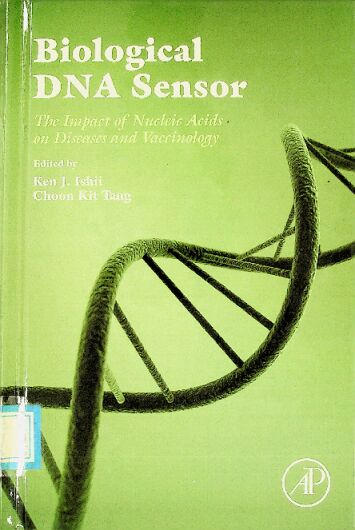
书名:Biological DNA sensor
责任者:Ken J. Ishii | Choon Kit Tang.
ISBN\ISSN:9780124047327,0124047327
出版时间:2014
出版社:Elsevier/Academic Press,
前言
Deoxyribonucleic acid (DNA), the fundamental molecule that packsgenetic instructions for the development of living organisms, has been dis-covered to hold yet another vital function for our biology — inflammation.The fact that DNA is an abundant commodity in our body and causes itsimmunogenic property is one that cannot be taken lightly. Now, we knowthat DNA induced inflammation is responsible for the pathogenicity ofautoimmune and infectious diseases and metabolic disorders. Furthermore,we have evidence that DNA induced inflammation is involved in thedevelopment of cancer. Therefore the awareness of the immunogenicnature of dsDNA has provided us with the opportunity to gain furtherinsights into the workings of human diseases. DNA seemed to be anironic choice as a trigger molecule for inflammation. After all, who wouldexpect that self-products containing our genetic blueprint could turnagainst us and induce adverse inflammatory reactions upon detection bythe immune system? However, on deeper reflection, it does make practi-cal sense to have nucleic acids as signaling entities that sound off the alarmto indicate impending danger to the body. Pathogens including viruses,bacteria and parasites, like human beings, have their genetic informationstored in nucleic acids. Their invasion into the host system is likely to beassociated with the introduction of their genetic materials and thereforeit would be the most appropriate indication of pathogenic invasion. Onthe other hand, the release of our own DNA into the surrounding physi-ological environment could also indicate cell death as a result of trauma,which may invite infection to occur and require immune defenses to beput in place. Therefore in more ways than one, DNA is an aptly chosenalarm molecule for the immune system to react to danger. Regarding thepotential impact it has on various aspects of our health, we have seen anexplosion of research on DNA sensing in the past eight years. This surgein publication was due in part to the discovery that DNA could be sensednot only by TLR9 in the endosomes, but also by sensors present in thecytosol. More importantly, DNA from pathogens as well as from mamma-lian derived sources is equally potent in inducing inflammation.
It is the purpose of this book to bring together the research on thesignaling mechanism of DNA induced inflammation as well as its impacton diseases and vaccinology. The book has three sections: In Section I,Ishii, Fitzgerald, Barber and Saitoh discuss the signaling pathway leadingto DNA induced inflammation, in Section II, Kawai, Marshak—Rothstein,Opitz, Bowie, Gasser and Arditi discuss the impact of DNA inflamma-tion on human diseases and lastly, in Section Ill, Coban, Desmet and Lenzcomment on how the inflammatory response of DNA could influence theoutcome of vaccination in DNA vaccination strategies and adjuvants tar-geting the DNA sensing pathway.
We are greatly indebted to the contributors whose participation andcooperation made this book possible. We thank them for their patiencewith our persistent requests for completion of their manuscript. We areappreciative for the editorial and technical assistance provided by ElizabethGibson and Mary Preap. To the publisher we are grateful for this timelyopportunity to consolidate the wealth of knowledge we have acquired onDNA sensing which could facilitate future investigations. Lastly, we wouldlike to pay tribute to Alick Issacs and his colleagues who were way aheadof their time in that they had the audacity to identify a molecule thatis so fundamental to our existence, namely, DNA, as a danger signalingmolecule.
查看更多
目录
List of Contributors xi
Preface xv
Section A The Discovery of dsDNA Immunogenicity and the Definition of DNA Sensing Pathways 1
1.Route to Discovering the Immunogenic Properties of DNA from TLR9 to Cytosolic DNA Sensors Choon Kit Tang, Cevayir Coban, Shizuo Akira and Ken J. Ishii 3
Introduction 3
The Importance of the Innate Immune System 4
Endosomal-Membrane Bound DNA Sensor —TLR9 7
Cytosolic DNA Sensors 11
Conclusion 35
Acknowledgment 35
References 35
2.The PYHIN Family of Molecules and their Functions Sensing dsDNA Sivapriya Kailasan Vanaja, Vijay A. K. Rathinam and Katherine A. Fitzgerald 43
Introduction 43
Members of the PYHIN Family 44
Structural Basis of DNA Recognition by PYHIN Proteins 46
Microbial DNA Sensing and Signaling by PYHIN Proteins 47
Transcriptional Regulation by PYHIN Proteins 55
Role of PYHIN Proteins in the Development of Autoimmunity 56
Regulation of PYHIN Proteins 57
Conclusions 59
References 59
3.Cytosolic DNA-Sensing and the STING Pathway Glen N. Barber 67
Introduction 67
The Toll-Like Pathway: TLR9 and CpG DNA 68
The STING Pathway and Intracellular DNA Signaling 70
STING and Inflammatory Disease 75
Other Sensors of Intracellular DNA 76
Conclusion 77
References 78
4.Regulation of Intracellular dsDNA-Induced Innate Immune Responses by Autophagy-Related Proteins Tatsuya Saitoh 83
Part I. Autophagy-Related Proteins and STING-Dependent IFN Responses 83
Part II. Autophagy and STING-Dependent Bactericidal Responses 88
Part III. Autophagy and AIM2-Dependent Inflammatory Responses 90
Conclusion 95
References 96
Section B dsDNA and Its Part in Modulating Human Diseases 101
5.Host DNA Induced Inflammation and Autoimmune
Diseases Surya Pandey and Taro Kawai 103
Introduction 103
The Type I IFN System as the Crux of Autoimmunity 104
Self and Non-Self-DNA Recognition 105
Heterogeneity in Innate Receptors for DNA 107
Mechanisms Underlying Host DNA Induced Inflammation and Autoimmunity 113
Conclusions and Future Perspectives 124
References 125
6.Toll-Like Receptor 9 and Toll-Like Receptor 7 in the Development and Regulation of Systemic Autoimmune Disease Ann Marshak-Rothstein and Michael P. Cancro 133
Introduction 133
Nucleic Acid Sensing TLRs 134
Immune Complex Activation of pDCs and Type I IFN 134
Activation of Autoreactive B Cells Depends on BCR/TLR Co-Engagement 136
Autoantigens and TLR Activation 137
Aberrant Self-Antigen Clearance and Detection 138
Paradoxical Roles ofTLR9 and TLR7 in Murine Models of SLE 140
Critical Role for B Cells in TLR-Mediated Regulation of Autoimmune
Disease and TLR9-Dependent Suppression of Autoimmune Disease 142
Cell Intrinsic Regulation ofTLR9 and TLR7 in B Cells 143
Compartmental Restriction of TLR Responses 145
Summary and Unanswered Questions 146
References 147
7.Bacterial Infections and the DNA Sensing Pathway Jan Naujoks and Bastian Opitz 153
Introduction 153
The Role of TLR9 in Bacterial Infections 154
The AIM2 Inflammasome as a Sensor of Bacterial DNA 156
STING-Dependent Cytosolic DNA Sensors and Type I IFN Responses
During Bacterial Infections 158
Conclusion 163
Acknowledgments 163
References 164
8.Viral Infections and the DNA Sensing Pathway: Lessons from Herpesviruses and Beyond Soren R. Paludan and Andrew G. Bowie 171
Introduction 171
Innate Immunological Recognition of Herpesvirus DNA 173
DNA Sensors Involved in Recognition of Herpesvirus DNA 175
Role for STING in the Response to Intracellular DNA Sensing 183
Roles of Known DNA Sensors in Herpesvirus Infection Independent of their Role as PRRs 185
Viral Evasion of DNA-Driven Innate Immune Responses 187
DNA Sensing Beyond Herpesviruses 190
Concluding Remarks 193
Acknowledgments 194
References 194
9.Cancer Pathogenesis and DNA Sensing Y.J. Shen, A.R. Lam, S.S.W. Ho, C.X. Koo, N. Le Bert and S. Gasser 205
IFN-Inducing Cytosolic DNA Sensors 205
Mediators of IFN-Inducing Cytosolic DNA Sensors 211
STING and TRIF Pathways 211
NF-xB 213
Proinflammatory Cytokines 214
Inflammasome-Inducing Cytosolic DNA Sensors 215
Conclusion 217
References 217
10.DNA Damage Responses in Atherosclerosis Kenichi Shimada, Timothy R. Crother and Moshe Arditi 231
Background 231
Evidence of DNA Damage in Atherosclerosis 232
Types of DNA Damage 234
Mitochondrial DNA Damage 236
DNA Damage Responses in Atherosclerosis 237
DNA Damage Sensing and Inflammation in Atherosclerosis 243
Conclusion 246
Acknowledgment 247
References 247
Section C The DNA Sensing Pathway and Its Impact on Vaccinology 255
11.DNA Vaccine: Does it Target the Double Stranded-DNA Sensing
Pathway? Cevayir Coban, Miyuki Tozuka, Nao Jounai, Kouji Kobiyama,Fumihiko Takeshita, Choon Kit Tang and Ken J. Ishii 257
Introduction 257
DNA Vaccines: Proof of Concept 258
DNA Vaccines: Mouse vs. Man 258
What Immunological Responses are Triggered after DNA Vaccination? 259
Cytosolic Double Stranded (ds)-DNA Sensing by Immune System 261
Does Plasmid DNA act in a Common Immunological way of DNA Sensing? 263
DNA Sensing Machinery: Is there a Hope to Improve DNA Vaccine
Immunogenicity in Humans? 265
Can DNA Plasmid Metabolites Be Adjuvant? 266
Conclusions 267
Acknowledgments 268
References 268
12.Adjuvants Targeting the DNA Sensing Pathways — Alum Based Adjuvants Christophe J. Desmet 271
Understanding the Mechanisms of Action of Alum Through Vaccine
Immunology 271
Recent Immunological Insights Into the Mechanisms of Action of Alum 273
Triggering of Innate Immune Signaling Following Alum-Adjuvanted Immunization 278
DNA Release and Signaling in the Adjuvant Activity of Alum 284
A Model for Self-DNA Induced Responses in Alum Immunization 298
Conclusions and Perspectives on the Role of Self-DNA Sensing in Vaccination 304
References 305
13. Adjuvants Targeting the DNA Sensing Pathways — Cyclic-di-GMP and other Cyclic-Dinucleotides Rebecca Schmidt and Laurel L. Lenz 313
Introduction 313
Production and Functions of Cyclic-Dinucleotides in Bacteria 314
Production and Measurement of c-di-NMPS 319
Effects of c-di-NMPS on Cancer Cells 320
Effects of c-di-NMPS on Mammalian Innate Immune Responses 322
c-di-NMPS as Vaccine Adjuvants 328
Conclusions 335
References 336
Index 341
查看更多
馆藏单位
中科院文献情报中心