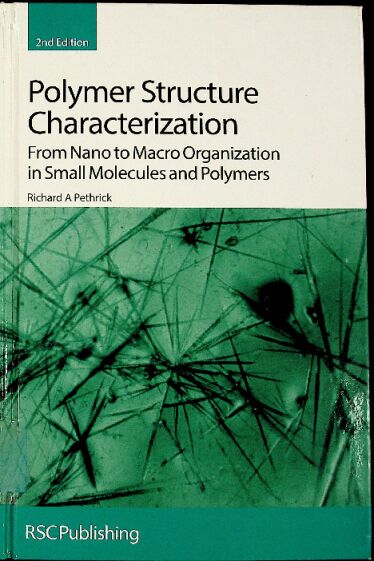
书名:Polymer structure characterization
ISBN\ISSN:9781849734332,184973433X
出版时间:2014
出版社:RSC Publishing,
前言
Behind the apparently innocuous smooth structure of hair or a poly- mer fibre lies a complex structure which dictates the physical properties of that material. This book attempts to give the reader the necessary background to understand the factors that influence molecu- lar organization and control the way in which these structures are formed.The book is written to be useful as support material for undergraduate and postgraduate courses on molecular organization and structure. As the subtitle implies, in order to truly appreciate the factors that influence the properties of many molecular materials, it is necessary to be able to observe the materials over length scales which range form nanometres to millimetres. Within this scale range many materials exhibit different levels of organization, and it is to understand the factors which control this structure building that is the aim of this book. The coverage of the book has been limited to consideration of the'solid'state. Organization in the liquid state— colloids and lyotropic liquid crystals—has been included as it helps us to understand the way in which many biological systems are able to undertake self assembly in solution prior to forming an ordered solid. In the second edition we have added two new chapters. Chapter 12,which explores the processes of self assembly,and chapter 13, which explores the organization which is observed in bio- logical molecules.
It is hoped that this book will aid the teaching of crystal growth in small molecules as well as polymers, and help with the development of an understanding of both the chemical and physical characteristics of liquid crystalline materials and provide the tools to attempt torationalize the varied structures which nature creates. These topics are often covered as part of undergraduate courses in chemistry,physics and materials science. The more detailed discussion of the topics on polymer crystallization and morphology form part of postgraduate or advanced masters courses in materials science. This monograph does not attempt to produce a comprehensive review of the literature on these topics, but rather tries to illustrate some of the basic principles with selected examples. Large textbooks have been written on topics such as polymer crystallization, morphology,etc.,and it would be an impossible task to cover all aspects of the subject in detail in a small monograph.It is hoped, however, that this selected digest presents the topics at an understandable level and provides a good foundation upon which more detailed exploration of the literature can be based.
Similarly,a number of the techniques used in the study ofmorphology and various related aspects have been summarized. Each technique is worth a volume in its own right and the reader is encouraged to consult more specialist texts to gain a greater insight into their use and appli- cations. It is hoped that the material presented will provide the reader with a sufficient appreciation of the methods to be able see how the information they provide can be used to gain greaterinsight into the way molecules are organized within solids.
Morphology and structure in solids are the results of a delicate interplay of forces which act at atomic, molecular and macroscopic levels. Liquid crystalline materials have become of importance through their use in displays; however, the principles underlying their organ- ization and self assembly are very important to understand how simple molecules behave as well as biomolecular systems.
The general structure of the monograph follows the format that has been used for a number of years in teaching these subjects at undergraduate and postgraduate level. Each chapter should build on the previous chapters to help the reader gain an appreciation of the factors that are critical in determining that nature of the organization which is developed in a particular system. Whilst the thrust of the monograph is consideration of order; disordered systems play an im- portant part in materials technology and the area of amorphous ma- terials logically results from a combination of a number of factors influencing the 'structure', or rather the lack of it, being developed in the solid.
To understand many of the topics covered in this book it is necessary to appreciate the way in which information has been obtained. Scat- tered through the book are sections on various experimental techni- ques. They have been introduced at appropriate points in the volume understanding of these areas.I hope that the reader will find the de- velopment of thesubject matter easy to follow and that it will create an interest in the subject of molecular organization at a molecular, nano and macro level.R. A. Pethrick West CHEM, Department of Pure and Applied Chemistry
查看更多
目录
Chapter 1 Concept of Structure-Property Relationships in Molecular Solids and Polymers 1
1.1 Introduction 1
1.2 Construction of a Physical Basis for Structure-Property Relationships 3
1.2.1 Ionic Solids 3
1.2.2 The Crystal Surface 6
1.2.3 Molecular Solid 7
1.2.4 Low Molar Mass Hydrocarbons 9
1.2.5 Poly(methylene) Chains 12
1.3 Conformational States of Real Polymer Molecules in the Solid State 13
1.3.1 Crystalline Polymers 13
1.3.2 Disordered or Amorphous Polymers 14
1.4 Classification of Polymers 15
1.4.1 What Factors Determine Whether a Polymer will form a Crystalline Solid or Not? 16
1.5 Influence of Molecular Weight: Flexibility on the Physical Properties 17
1.5.1 Flexible Polymer Backbone Forming an Amorphous Solid 17
1.5.2 Polymers which are able to Crystallize in the Solid Phase 18
Learning Outcomes 19
Recommended Reading 20
References 20
Chapter 2 Crystal Growth in Small Molecular Systems 22
2.1 Introduction 22
2.1.1 Crystal Types 23
2.2 Crystallization 28
2.2.1 Supersaturation and Crystallization 29
2.3 Nature of Crystal Structures: Morphology and Habit 31
2.3.1 Morphology Predication 32
2.4 Homogenous Crystal Growth 33
2.4.1 Empirical Description of Nucleation 35
2.4.2 Stages of Crystal Growth 37
2.4.3 Heterogeneous Crystal Growth 39
2.4.4 Nucleation and Growth Rates 40
2.4.5 Methods of Attachment to the Growth Surface 40
2.4.6 Bravais-Friedel-Donnay-Harker Approach 41
2.4.7 Periodic Bond Chains42
2.4.8 Attachment Energy 43
2.4.9 Ising Model Surface Roughening 44
2.5 Sources of Nucleation Sites on Surfaces, Steps and Dislocations 45
2.5.1 Two-dimensional Nucleation 46
2.5.2 Dislocations and Related Defects 47
2.5.3 Screw Dislocation (BCF)Mechanism 49
2.5.4 Birth and Spread (B&S)Mechanism 50
2.5.5 Rough Interface Growth(RIG) Mechanis 50
2.5.6 Relative Rates of Crystal Growth 50
2.5.7 Computer Prediction of Morphology 50
2.6 Macrosteps 52
2.6.1 Ostwald Ripening 52
2.6.2 Impurities53
2.7 Analysis of the Data from Step Growth 55
2.8 Refinements of the Theory 55
2.9 Methods of Micro-structural Examination 57
2.10 Zone Refining, Racemic Mixture Resolution and Habit Control 60
2.11 Non Centrosymmetric Crystals—Piezoelectricity 62
2.12 Summary 63
Learning Outcomes 63
References 64
Chapter 3 Liquid Crystalline State of Matter 68
3.1 Introduction 68
3.1.1 The Liquid Crystalline State 68
3.1.2 Historical Perspective 69
3.1.3 Mesophase Order 69
3.1.4 Nematic Liquid Crystals (N) 69
3.1.5 Smectic Liquid Crystals 70
3.1.6 Cholesteric Liquid Crystal (C) 72
3.2 Influence of Molecular Structure on the Formation of Liquid Crystalline Phases 72
3.2.1 Influence of Chain Rigidity 73
3.2.2 Influence of Size of Rigid Block 74
3.2.3 Influence of Sequence Structure in Chain 74
3.2.4 Variations within a Homologous Series of Molecules 75
3.2.5 Changes in Substituents 76
3.3 Common Features of Many Liquid Crystal Forming Molecules 76
3.3.1 Nematic Liquid Crystals 77
3.3.2 Influence of the Linking Group on the Thermal Stability of the Nematic Phase 76
3.3.3 Terminal Group Effects 81
3.3.4 Pendant Group Effects 82
3.3.5 Terminal Substitution Effects 82
3.4 Cholesteric Liquid Crystals 84
3.5 Smectic Liquid Crystals 84
3.6 Theoretical Models for Liquid Crystals 87
3.6.1 Statistical Models 87
3.6.2 Development of Statistical Mechanical Models 90
3.6.3 Distributions and Order Parameters 90
3.7 Elastic Behaviour of Nematic Liquid Crystals 93
3.8 Computer Simulations 98
3.9 Defects, Dislocations and Disclinations 100
3.10 Applications 103
3.10.1 Electric and Magnetic Field Effects 103
3.10.2 Surface Preparation 105
3.10.3 Freedericksz Transition 105
3.10.4 Display Device 105
3.10.5 Effect of Chirality 107
3.11 Polymeric Liquid Crystals 107
3.12 Polymeric Liquid Crystalline Materials 108
3.12.1 General Factors Influencing Polymeric Liquid Crystalline Materials 108
3.12.2 Main Chain Crystalline Polymers 110
3.12.3 Side Chain Liquid Crystalline Polymers 114
3.12.4 Nature of Flexible Spacer and Its Length 114
3.12.5 Nature of the Backbone 115
3.12.6 Polymer Network Stabilized Liquid Crystal Phase 116
3.13 Structure Visualization 117
3.14 Discotic and Sanidic Liquid Crystalline Materials 118
3.14.1 Some of the Configurations Observed with Discotic and Sanidic Systems 118
3.14.2 Areas of Potential Application 121
3.15 Conclusions 122
Learning Outcomes 122
Recommended Reading 122
References 123
Chapter 4 Plastic Crystals 132
4.1 Introduction 132
4.2 Plastic Crystalline Materials 132
4.3 Alkanes and Related Systems 136
4.4 Commensurate-incommensurate Phase Transitions 138
4.5 Conclusions 142
Learning Outcomes 142
References 142
Chapter 5 Morphology of Crystalline Polymers and Methods for its Investigation 146
5.1 Introduction 146
5.2 Crystallography and Crystallization 147
5.2.1 Polyethylene 147
5.2.2 Polypropylene 148
5.2.3 Polyoxymethylene 150
5.2.4 Polyethyleneoxide 150
5.3 Single Crystal Growth 151
5.3.1 Habit of Single Crystals 153
5.4 Crystal Lamellae and Other Morphological Features 155
5.4.1 Solution-grown Crystals 155
5.4.2 Chain Folding 155
5.4.3 Crystal Habit 156
5.4.4 Sectorization 156
5.4.5 Non-planar Geometries 157
5.5 Melt-grown Crystals 157
5.5.1 Melt-crystallized Lamellae 157
5.5.2 Polymer Spherulites 158
5.6 Annealing Phenomena 164
5.7 Experimental Techniques for the Study of Polymer Crystals 165
5.7.1 Optical Microscopy 166
5.7.2 Microtomes 168
5.7.3 Basic Light Microscopy 169
5.7.4 Light Versus Electron Microscopy 170
5.7.5 Phase Contrast Microscopy 171
5.7.6 Polarized Light Microscopy 171
5.7.7 Origins of Birefringence 172
5.7.8 Orientation Birefringence 172
5.7.9 Strain Birefringence 172
5.7.10 Form Birefringence 173
5.7.11 Polarization Colours 173
5.7.12 Modulation Contrast Techniques 174
5.7.13 Interference Microscopy 175
5.8 Electron Microscopy 175
5.8.1 Sample Preparation: Etching and Staining 176
5.9 X-ray Diffraction 177
5.10 Raman Scattering and Phonon Spectra 178
5.11 Degree of Crystallinity 178
5.11.1 Density and Calorimetric Methods 179
5.11.2 X-ray Scattering 180
5.11.3 General Observations 181
5.12 Conclusions 182
Learning Outcomes 182
Recommended Reading 182
References 182
Chapter 6 Polymer Crystal Growth 185
6.1 Introduction 185
6.1.1 Thermodynamic of Polymer Molecule in the Melt 185
6.1.2 Nucleation 186
6.2 Minimum Energy Conditions and Simple Theory of Growth 188
6.3 Nature of Chain Folding 191
6.4 Crystals Grown from the Melt and Lamellae Stacks 193
6.4.1 Location of Chain Ends 196
6.5 Crystallization Kinetics 196
6.6 Equilibrium Melting Temperature 199
6.7 General Avrami Equation 202
6.8 Comparison of Experiment with Theory 206
6.9 Growth Theories 206
6.9.1 Lauritzen-Hoffman Theory 207
6.9.2 Sadler-Gilmer Theory 217
6.10 Crystallization via Metastable Phases 219
6.10.1 Potential Impact of Rotator Phase on Crystallization 219
6.10.2 Behaviour of other Polymers Systems 220
6.11 Molecular Fractionation 221
6.11.1 Metallocene Polymers 222
6.12 Orientation-induced Crystallization 223
6.13 Analysis of Non-isothermal Crystallization 225
6.13.1 Ozawa Model 225
6.13.2 Combined Ozawa/Avrami Model 226
6.14 Nucleating Agents on the Crystallization Process 227
6.15 Summary 229
Learning Outcomes 229
Recommended Reading 230
References 230
Chapter 7 Glasses and Amorphous Material 234
7.1 Introduction 234
7.2 Phenomenology of the Glass Transition 235
7.2.1 Dynamic Mechanical Thermal Analysis 237
7.2.2 Dielectric Relaxation Spectroscopy (DRS) 239
7.2.3 Positron Annihilation Lifetime Spectroscopy (PALS) 245
7.3 Free Volume and the Williams-Landel-Ferry Equation 247
7.4 How Big is the Element that Moves in the Tg Process? 249
7.5 Physical Characteristics of Tg 250
7.5.1 Factors Influencing the Value of Tg 250
7.5.2 Molar Mass Effects 251
7.5.3 Influence of Chemical Structure on the Tg 251
7.5.4 Plasticization Effect 258
7.5.5 Incorporation of Comonomer and Blends 258
7.6 Kauzmann Paradox 259
7.7 Pressure Dependence of the Glass Transition 260
7.8 Physical Ageing 260
7.9 Distribution of Free Volume in a Glass 262
7.10 Fragility 264
7.11Theories of Tg 267
Learning Outcomes 268
Recommended Reading 268
References 269
Chapter 8 Polymer Blends and Phase Separation 271
8.1 Introduction 271
8.2 Thermodynamics of Phase Separation 272
8.2.1 Thermodynamics of Polymer-Polymer Miscibility 273
8.2.2 Enthalpy and Entropy Changes on Mixing 276
8.3 Phase Separation Phenon 278
8.3.1 The Phase Diagram for Nearly Miscible Blends 278
8.4 Parameters Influencing Miscibility 280
8.4.1 Molar Mass Dependence of the Phase Diagrams 280
8.4.2 The Effect of Pressure on Miscibility 282
8.4.3 Addition of Block Copolymers 282
8.4.4 Refinements of Theory 282
8.5 Kinetics of Phase Separation: The Spinodal Decomposition 283
8.6 Specific Examples of Phase-separated System 285
8.6.1 High-impact Polystyrene 285
8.6.2 Epoxy Resins 287
8.6.3 Rubber Toughened Epoxy Resins 288
8.6.4 Thermoplastically Toughened Epoxy Resins 289
8.7 Block Copolymers: Polystyrene-Block-Polybutadiene-Block-polystyrene Block Copolymer (SBS) 291
8.7.1 General Characteristics 291
8.7.2 Thickness of the Domain Interface 294
8.8 Polyurethanes 296
Learning Outcomes 299
Recommended Reading 299
References 299
Chapter 9 Molecular Surfaces 301
9.1 Introduction 301
9.2 Gibbs Approach to Surface Energy 301
9.2.1 Contact Between a Liquid and a Surface 302
9.2.2 Derivation of Young's Equation and Definition of Contact Angle 303
9.2.3 Effects of Surface Roughne 305
9.2.4 Petal or Lotus Effe 308
9.2.5 Cassie-Baxter/Wenzel Transition 308
9.2.6 Spreading Dynamics 309
9.2.7 Thermodynamic Consideration of the Surface Energy 310
9.2.8 Effect of Surfactants on Wetting 311
9.3 Surface Characterization 312
9.3.1 Classical Surface Assessment Methods, Contact Angle Measurements 312
9.3.2 Visualization of the Polymer Surface 314
9.3.3 Atomic Force Microscopy 318
9.4 Spectroscopic Assessment of the Surface: Attenuated Total Reflection Infrared,Fluorescence and Visible Spectroscopy 321
9.5 X-ray and Neutron Diffraction Analysis 321
9.5.1 Neutron and X-ray Reflectivity 321
9.6 Ion Beam Analysis: Electron Recoil and Rutherford Backscattering 327
9.7 Vacuum Techniques: X-ray Photoelectron Spectroscopy (XPS), Secondary Ion Mass Spectroscopy (SIMS), Auger Electron Spectroscopy (AES) 327
9.7.1 X-ray Photoelectron Spectroscopy 328
9.7.2 Electron Mean Free Path,Attenuation and Escape Depth 333
9.7.3 XPS Depth Profiling 336
9.7.4 Secondary Ion Mass Spectrometry (SIMS) 339
9.8 Fourier Transform Infrared (FTIR)Imaging 342
9.9 Raman Confocal Microscopy and Total Internal Reflection Raman Spectroscopy 343
Learning Outcomes 345
Recommended Reading 345
References 346
Chapter 10 Polymer Surfaces and Interfaces 349
10.1 Introduction 349
10.1.1 Crystalline Polymers 349
10.1.2 Amorphous Polymers 350
10.1.3 Polymer Blends 352
10.2 Theoretical Description of the Surface of a Polymer 352
10.2.1 Surface Tension of Homopolymers 352
10.2.2 Theories of Homopolymer Surface Tension 353
10.3 Surface Segregation 355
10.4 Binary Polymer Blends 355
10.5 End Functionalized Polymers 357
10.6 Phase Segregation and Enrichment at Surfaces 358
10.7 Electrohydrodynamic (EHD)Instabilities in Polymer Films 359
10.8 Environmental Effects on Polymer Surfaces 362
10.9 Conformational Effects 362
Learning Outcomes 363
Recommended Reading 363
References 363
Chapter 11 Colloids and Molecular Organization in Liquids 365
11.1 Introduction 366
11.2 Ideal Non-mixing Liquids 366
11.3 Minimum Surface Energy Conditions 369
11.4 Langmuir Trough 371
11.5 Langmuir-Blodgett Films 372
11.6 Micelle Formation 374
11.7 Stability Energy and Surface Area Considerations in Colloids 375
11.8 Stability of Charged Colloids 376
11.9 Electrical Effects in Colloids 377
11.10 Electrical Double Layer 377
11.11Particle (micelle) Stabilization 379
11.11.1 Charge Stabilization: Derjaguin-Landau-Verivey-Overbeek (DLVO) Theory 379
11.11.2 Steric or Entropic Stabilization? 379
11.11.3 Entropic Theory 383
11.12 Phase Behaviour of Micelle Systems 384
11.13 Phase Structures in Polymer Systems 387
11.13.1 Block Copolymers and Associated Phase Diagrams 387
11.13.2 Pluronics 388
Learning Outcomes 390
Recommended Reading 390
References 391
Chapter 12 Self Assembly and Building Nano Structures 393
12.1Nano Structures as Self Assembly 393
12.2Carbon-based Nano Structures 393
12.2.1 Carbon and Boron Spheres and Nano Tubes 394
12.2.2 Carbon Nano Tubes 396
12.3 Graphene 398
12.4 Exfoliated Graphite 399
12.5 Carbon Fibres 400
12.6 Polyacetylene and Related Polymer Systems 403
12.7 Clay and Related Nano Systems 406
12.8 Metal-organic Framework Compounds 409
12.8.1 Tilings for Nets 413
12.9 Biomineralization 415
12.10 Organic Hydrogen Bonding Self Assembling Molecules 418
12.10.1 Double Hydrogen Bonding Systems 420
Learning Outcomes 421
References 422
Chapter 13 Biopolymer and Related Systems 425
13.1 Introduction 425
13.2 Polypeptides 425
13.2.1 Chemical Structure 425
13.2.2 Peptide Primary Structure 428
13.2.3 Secondary Structure 429
13.2.4 Tertiary Structure 431
13.2.5 Quaternary Structure 432
13.3Protein Synthesis 432
13.4 Collagen 433
13.5 Nucleic Acids 435
13.5.1 Chemical Structure 436
13.5.2 Helical Structure 437
13.5.3 Branched Chain and Other Structures 440
13.6 Ribose Nucleic Acid RNA 441
13.7 DNA-Protein Interactions 442
Learning Outcomes 443
References 444
Chapter 14 Molecular Organization and Higher Order Structures 445
14.1 Introduction 445
14.2 Hair 446
14.3 Structure in Cellulose Fibres 448
14.3.1 Cellulose Nano Fibres 455
14.4 Natural silks 456
14.4.1 Silk Fibre Chemistry 456
14.4.2 Silk Fibre Processing 457
14.4.3 Silk Fibre Microstructures 458
Learning Outcomes 459
References 460
Subject Index 462
查看PDF
查看更多
馆藏单位
中科院文献情报中心