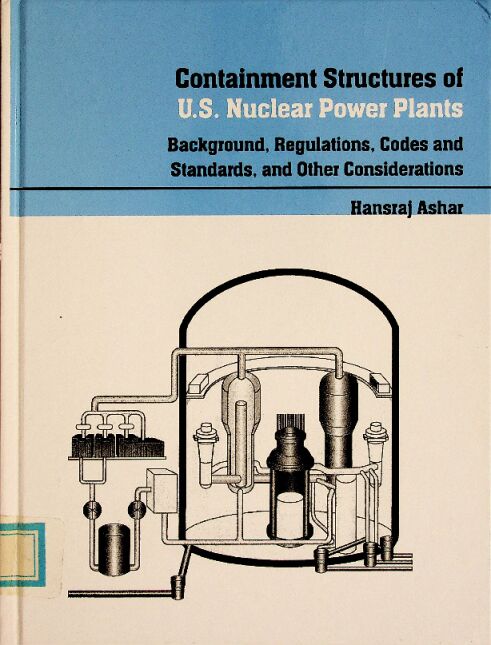
书名:Containment structures of U.S. nuclear power plants
责任者:contributors Hansraj Ashar [and 10 others].
ISBN\ISSN:9780791860175,0791860175
出版时间:2013
出版社:ASME Press,
前言
We (the contributing authors) collectively recognized the renewed relevance of nuclear power in the US, after decades of stagnation. We felt that it was imperative to develop an up-to-date, scholarly work on containment structures, incorporating the underlying regulations, safety significance, history, design philosophy, design experience, operating experience, and application to new design. It would benefit the nuclear industry as it transitions to a new generation of designers, constructors, and regulators. We think the book will be a valuable asset to the nuclear utilities, nuclear regulators, A/Es, and international organizations involved in the design and construction of nuclear power plants (NPPs).
With this basic purpose, coupled with my extensive experience in various aspects of NPP containment design, construction, inspection, and testing, principally, with the Nuclear Regulatory Commission (NRC), where I worked for the last 36 years before retiring in December 2010, I thought about developing this type of book in early 2010. As I wanted to explore historical background, as well as how and when of the nuclear reactors and containments, I first contacted Dr. Samuel J. Walker, the NRC historian, and requested him, if he could write this preface for the book, or help me construct the historical background related to nuclear reactors and containments. At the time (~June 2010), when I contacted him, he was preparing to retire from the NRC and told me that he could not find time to write such a preface. However, he assured me that I would find the required historical information in two NRC published books: (1) Controlling the Atom, and (2) Containing the Atom, the books, he was involved in authoring. Most of the historical background that I have compiled in the Preface and in Chapters 1 and 2 are based on the contents of these books.
Among a number of potential technical publishers, such as American Society of Civil Engineers (ASCE), American Society of Mechanical Engineers (ASME), American Nuclear Society (ANS), and Elsevier, I finally corresponded with ASME, because of my long-term association with ASME in the development of the standards related to the NPP containment structures. I had also realized that I am not an expert in various specialized subjects (e.g. severe accident considerations), I started looking for appropriate experts in these areas. Fortunately, I found these experts in National Laboratories, NRC, and in Nuclear Industry.
This preface provides an overview of the historical developments relevant to the content of the book. It briefly provides historical background related to the development of commercial use of nuclear energy, as well as a brief description of the physical processes involved during the operation of nuclear reactors.
In the late 1930s, scientists had discovered that when an atom of uranium was bombarded by neutrons, the uranium atom would sometimes split or fission. Later, the scientists found that when the atom of uranium fissioned, additional neutrons were emitted and became available for further reaction with other uranium atoms. These facts demonstrated that it was possible to device perpetual chain reactions. In December 1942, underneath the West Stands of Stagg Field at the University of Chicago, a team of scientists led by Enrico Fermi created man’s first controlled nuclear chain reaction. A crude reactor, remembered, as the first pile (CP-1), consisted of uranium embedded in a matrix of graphite. With sufficient uranium in the pile, the few neutrons emitted in a single fission may accidentally strike neighboring atoms, which in turn undergo fission and produce more neutrons. The atomic pile was controlled and prevented from burning itself by cadmiumplated rods which absorbed neutrons and stopped the process. The pile was square at the bottom and flattened sphere on the top. Around the pile, there was a tent of cloth fabric balloon provided so that the reactor could be sealed to minimize unproductive loss of neutrons.
Following the success of the CP-1 experiment, in February 1943, the U.S. Army moved the CP-1 pile to the south of Chicago, where it was reassembled as CP-2. CP-2 was considerably larger than CP-1, and had a 5-ft concrete shield building around it to protect the personnel working around the pile. The shield building can be termed as a containment structure that protected the general public and the staff against radiation hazard. However, readers should recognize that the early use of the technology was in developing atomic weapons during World War II. The neutrons that are produced in a fission reaction are fast neutrons and are less likely to cause fission than slower neutrons. As a consequence, in the most common type of power reactors, the kinetic energy of the fissionable neutrons is reduced to a value, where it is more likely to cause fission. This is accomplished by introducing a medium between the fuel rods that would slow down the fission neutrons. The medium used is called the moderator. Light water, graphite, heavy water, and other materials have been used as moderators in commercial and research reactors. Approximately, 90% of the energy released in a nuclear reactor manifests itself as heat energy near the point of fission in the core of the reactor.Two major considerations associated with the products of fission process were (1) the products that include radio isotopes could damage the fuel elements and thus limit the time the fuel can be allowed to remain in the reactor, and (2) the fission products are the sources of most of the radioactivity in irradiated fuel. It is the second consideration that the reactor designers and operators have to control and provide containment for the fission products, under both the normal and abnormal conditions. Thus, maintaining adequate protection of the health and safety of the general public was a major requirement in exploring power reactor design for commercial use of nuclear energy. The Atomic Energy Act of 1946, signed by President Truman, paved the way for transferring the function of civilian use of the Atom in the jurisdiction of Atomic Energy Commission (AEC). It was in December 1953, when President Dwight D. Eisenhower’s “Atoms for Peace” speech to the United Nations General Assembly, envisaged peaceful nuclear technology which would be made available to all nations under appropriate international controls. Subsequently, the 1954 Atomic Energy Act made it possible to encourage the commercial use of atomic energy in the U.S. for producing power.
The earlier reactors built as research and demonstration reactors, e.g. Hanford, Savannah River, and the Idaho National Laboratory Reactor Testing Station were located at remote locations away from the population centers. These reactors normally had concrete shield buildings enclosing the reactors for protecting the working personnel against ionizing radiation. However, some other AEC facilities, constructed in early 1950s, such as, Argonne Research Reactor, near Chicago, and the Submarine Intermediate Reactor at West Milton, NY, indicated the need for reliance on engineered safety features that would compensate for their proximity to population centers. The General Electric (GE), designer of the West Milford reactor, sets a major safety precedent by enclosing the reactor in a large steel containment structure. Later, the Argonne Research Rector was enclosed in a leak tight concrete building. Containment was also a major design feature of the Westinghouse designed Shippingport reactor. Except for a few experimental reactors, constructed at remote sites, and some gas-cooled reactors, all power reactor facilities in the United States after that time included provisions for containment structures, as the major safety features of the reactor facilities.
This book is devoted to the subject of containment structures in the United States. The following is a brief description of the content of this book. Readers should note that “containment structure” is a part of the containment or containment system. Sometimes, these phrases (containment, containment systems) are used interchangeably with containment structure, as the final physical barrier that would prevent release of the ionizing radiation. Containments are also described as “containment vessels,” i.e., reinforced concrete containment vessels (RCCVs) and prestressed concrete containment vessels (PCCVs).
The book is divided into nine chapters. Each chapter describes specific aspect of containment structures. I am one of the seven prime contributors of the book. The four co-authors provided specialized inputs. The table below provides information regarding the chapter titles and the authors. It should be noted that Chapters 1 to 5 principally discuss History, Design, Construction, Inspection, and License Renewal aspects of operating reactors. Chapters 6 to 8 discuss more generic aspects of containment analysis under various loadings, and Chapter 9 discusses containment systems of Advanced Reactors.
查看更多
目录
Acknowledgments iii
Contributor Biographies v
Preface xvii
Chapter 1 Evolution of Power Reactors and Containments Hansraj Ashar 1
1.1 Introduction 1
1.2 Steps toward Development of Commercial Nuclear Reactors 2
1.3 Reactor Concepts and Containments 4
1.3.1 Pressurized Water Reactors 5
1.3.2 Boiling Water Reactors 6
1.4 Containment and Containment Structures 7
1.4.1 PWR Containments 7
1.4.1.1 Large Dry PWR Containments 9
1.4.1.2 PWR Subatmospheric Containments 9
1.4.1.3 PWR Ice Condenser Containments 12
1.4.2 BWR Containments 12
1.4.2.1 Early BWR Containments 12
1.4.2.2 BWR Mk I Containments 14
1.4.2.3 BWR Mk II Containments 17
1.4.2.4 BWR Mk III Containments 18
Appendix 1A — Plant Specific Information 19
References 22
Chapter 2 Regulatory Requirements and Containments
Hansraj Ashar 23
2.1 Introduction (Historical Background) 23
2.2 Development of Regulations 25
2.3 Regulatory Frameworks 25
2.3.1 Guidance Documents and Reports 26
2.3.1.1 Regulatory Guides (RGs) 26
2.3.1.2 Standard Review Plan (SRP) 26
2.3.1.3 NUREG-Series Reports 26
2.3.1.4 Other NRC Documents 27
2.4 Technical Parts of Chapter 1 of Title 10 27
2.4.1 Requirements of Parts 20 and 21 27
2.4.2 Requirements of Part 50 and Its Subsections 27
2.4.3 Requirements of Part 50 Appendices 31
2.4.4 Requirements of Part 52 to Part 100 34
2.5 Containment-Related Regulations 35
2.5.1 Reactor Site Criteria 35
2.5.2 General Design Criteria 37
2.5.3 Implementation of Containment-Related GDC 37
References 43
Chapter 3 Design, Construction, Inspection and Testing of Containment Structures Javeed Munshi, Shen Wang and Abdul Sheikh 45
3.1 Concrete Containments 45
3.1.1 Introduction 45
3.1.2 Conventionally Reinforced Concrete Containments 46
3.1.3 Prestressed Concrete Containments 46
3.1.4 Modeling and Analysis Considerations 47
3.1.5 Concrete Containment Design Criteria 48
3.1.6 Design Considerations for Prestressed Containments 49
3.1.7 Liner and Liner Anchor Design 51
3.1.8 Pre-Service Inspection and Testing (Concrete) 51
3.1.9 Severe Accident Analysis 53
3.2 Steel Containments 54
3.2.1 Introduction 54
3.2.2 Modeling and Analysis Considerations 55
3.2.3 Steel Containment Design Criteria 55
3.2.4 Buckling Analysis 57
3.2.5 Severe Accident Evaluation 57
3.2.6 Fabrication and Installation 58
3.2.7 Pre-Service Inspection and Testing 58
3.3 Containment Evaluation for Impact and Impulse 59
3.3.1 Evaluation of Local Effect 60
3.3.2 Evaluation of Global Response 60
3.3.3 Finite Element Analysis 61
3.3.4 Special Consideration for Aircraft Impact Assessment 61
References 62
Chapter 4 Inservice Inspections and Leak Rate Testing of Containments
Hansraj Ashar 67
4.1 Introduction 67
4.2 Purpose of Periodic ISI and Leak Rate Testing 68
4.3 Deterministic Approach 68
4.3.1 Containment Inservice Inspection 68
4.3.1.1 ASME Code 69
4.3.1.2 Requirements of Subsection IWE 69
4.3.1.3 Requirements of Subsection IWL 72
4.3.2 Prescriptive Leak Rate Testing Requirements 74
4.3.2.1 Type A Testing 75
4.3.2.2 Type B Testing 76
4.3.2.3 Type C Tests 76
4.3.2.4 Other Requirements 77
4.4 Performance Based Approach (PBA) 77
4.4.1 Inservice Inspections and PBA 77
4.4.2 Leak Rate Testing and PBA 78
4.4.2.1 Type A Test Requirements 78
4.4.2.2 Type B Test Requirements 79
4.4.2.3 Type C Test Requirements 79
4.4.3 Risk Informed Approach (RIA) 79
4.4.3.1 Discussion of RIA Issues 81
4.4.3.2 Industry Actions on ILRT Intervals 82
4.5 Miscellaneous Remarks 85
References 86
Chapter 5 License Renewal and Aging Management for Continued Service
Dan Naus and Hansraj Ashar 89
5.1 Introduction 89
5.2 License Renewal Process, Safety Principles, and Regulations 89
5.2.1 10 CFR Part 54 (Rule) 90
5.2.2 10 CFR Part 51 91
5.3 Guidance Documents 91
5.3.1 NRC Guidance Documents 91
5.3.1.1 Regulatory Guide 1.188, Revision 1 92
5.3.1.2 Generic Aging Lessons Learned (GALL) Report 92
5.3.1.3 Standard Review Plan for License Renewal (SRP-LR) 94
5.3.1.4 Nuclear Plant Aging Research (NPAR) Reports 95
5.3.1.5 Technical Reports in NUREG Series (NUREGs) 95
5.3.2 Industry Guidance Documents 95
5.3.2.1 NUMARC Reports 95
5.3.2.2 NEI 95-10 96
5.4 License Renewal Inspections 96
5.5 Operating Experience 97
References 98
Appendix 5A Monitoring and Trending of Prestressing Forces in Prestressed Concrete Containments 101
5A.1 Introduction 102
5A.2 Construction and Design Features 102
5A.2.1 Prestressing Systems 102
5A.2.2 Corrosion Inhibitors for Prestressing Tendons 103
5A.2.2.1 Portland Cement Grout 104
5A.2.2.2 Petrolatum-Based Grease 104
5A.2.3 Design Considerations 105
5A.3 Factors Contributing to Prestress Losses 105
5A.3.1 Shrinkage of Concrete 105
5A.3.2 Creep of Concrete 105
5A.3.3 Relaxation of Prestressing Steel 106
5A.3.4 Losses Caused by Degradation of Prestressing Elements 106
5A.3.5 Effects of Temperature 106
5A.4 Monitoring Prestressing Forces 107
5A.4.1 Grouted or Bonded Tendons 107
5A.4.2 Greased or Unbonded Tendons 107
5A.5 Trending Prestressing Forces 108
5A.5.1 Bonded Tendons 108
5A.5.2 Unbonded Tendons 108
5A.6 Discussion 109
5A.7 Concluding Remarks 110
References 111
Appendix 5B Summary of Major Degradation in Containments 113
5B.1 Introduction 113
5B.2 Reinforced Concrete Containments and Steel Liners 113
5B.2.1 Post-Tensioning System 113
5B.2.2 Concrete Containment Vessel 114
5B.2.3 Steel Liner 118
5B.3 Steel Containments 120
5B.3.1 BWR Free-Standing Steel Containment 120
5B.3.2 Steel Cylinder of PWR Ice-Condenser Primary Containments 121
5B.3.3 Torus of BWR MK I Plants 121
References 124
Chapter 6 Containment Structure Testing, Modeling, and Degradation
Jason Petti 125
6.1 Introduction 125
6.2 Early Estimates of Containment Structural Response to Severe Accidents 126
6.3 Large-Scale Containment and Component Testing 127
6.3.1 Containment Testing Purpose 128
6.3.2 Containment Tests 128
6.3.2.1 Reinforced Concrete Containment Tests 128
6.3.2.2 Prestressed Concrete Containment Tests 130
6.3.2.3 Steel Containment Tests 133
6.3.2.4 Containment Component Testing 135
6.4 Containment Severe Accident Modeling and Insights 138
6.4.1 Concrete Containment Analyses 138
6.4.2 Steel Containment Analyses 140
6.4.3 Probabilistic Modeling of Containment Severe Accident Response 141
6.5 Effects of Containment Degradation on Its Severe Accident Response 142
6.5.1 Examples of Deterministic Modeling 142
6.5.1.1 PWR Ice Condenser Steel Containment 143
6.5.1.2 BWR Mark I Steel Containment 144
6.5.1.3 PWR Reinforced Concrete Containment 146
6.5.1.4 PWR Prestressed Concrete Containment 146
6.5.2 Probabilistic Analysis of Degradation Effects 148
6.5.2.1 PWR Ice Condenser Steel Containment 149
6.5.2.2 BWR Mark I Steel Containment 150
6.5.2.3 PWR Reinforced Concrete Containment 151
6.5.2.4 PWR Prestressed Concrete Containment 153
6.5.3 Risk-Informed Assessment of Degraded Containments 155
6.5.4 Containment Degradation Effects on Severe Accident Consequences 156
References 158
Chapter 7 Containment System Challenges Under Severe Accidents
Dana Powers, Shawn Burns and Hansraj Ashar 163
7.1 Introduction 164
7.2 Hydrogen Combustion 164
7.2.1 Hydrogen Sources 164
7.2.2 Modes of Combustion 165
7.2.2.1 Deflagrations 166
7.2.2.2 Detonations 169
7.2.2.3 Deflagration to Detonation Transitions 170
7.2.3 Hydrogen Combustion Mitigation 171
7.3 Core Debris Interactions with Coolant 171
7.3.1 Core Debris Quenching 171
7.3.2 Explosive Interactions of Core Debris with Water 172
7.4 High Pressure Melt Expulsion and Direct Containment Heating 178
7.4.1 Experimental and Analytic Investigations of Direct Containment Heating 180
7.4.2 Resolution of the Direct Containment Heating Issue 183
7.4.3 Ongoing Research 184
7.5 Interaction of Core Debris with Concrete 184
7.5.1 Nature of Ex-Vessel Core Debris 185
7.5.2 Nature of Concrete 186
7.5.3 Experimental Investigations of Core Debris Interactions with Concrete 186
7.5.4 Modeling Core Debris Interactions with Concrete 188
7.5.5 Mitigation of Core Debris Interactions with Concrete 189
7.6 Aerosol Behavior in Reactor Containments 191
7.6.1 Aerosol Formation and Growth 192
7.6.2 Natural Particle Removal Processes 192
7.6.3 Effects of Engineered Safety Features 194
7.6.4 Aerosol Leakage Out of Containment 195
7.6.5 Filtered Vents 196
7.7 Gaseous Iodine in Containment 196
7.8 Consideration of Severe Accidents in Regulatory Framework 199
7.8.1 Operating Reactors 199
7.8.2 Advanced Reactors 200
References 202
Chapter 8 Design Basis and Beyond Design Basis Considerations of Natural Phenomena Nilesh Chokshi and Goutam Bagchi 211
8.1 Introduction 211
8.2 Summary of Design Basis for Natural Phenomena 212
8.2.1 Key Regulations Related to Containment Design 213
8.2.2 Seismic 214
8.2.3 Flooding 214
8.2.4 High Winds 215
8.2.5 Other Natural Hazards 215
8.3 Design Basis and Beyond Design Basis Events 215
8.3.1 Historical Perspective 215
8.3.2 Evolution of Hazard Understanding 216
8.3.2.1 Seismic 216
8.3.2.2 Flooding 217
8.3.2.3 High Winds 218
8.3.3 Recent Experiences Related to Natural Phenomena Hazards 220
8.3.3.1 Seismic Experience 220
8.3.3.2 Flood Experience 223
8.3.4 Risk-Informed Considerations 225
8.4 Methods for Beyond Design Basis Evaluations 225
8.4.1 Historical Perspective — Evolution of Methods 225
8.4.2 Seismic Probabilistic Risk Assessment (SPRA) Methods 226
8.4.2.1 General 226
8.4.2.2 Probabilistic Seismic Hazard Analysis 228
8.4.2.3 Fragility Analysis 228
8.4.2.4 Systems Analysis and Quantification 229
8.4.3 Containment Capacity and Fragility Analysis 230
8.4.3.1 Seismic Capacity and Fragility Analysis 230
8.4.3.2 Internal Pressure Capacity and Fragility Analysis 235
8.4.4 Examples and Insights Related to Containment Performance 238
8.4.5 Consideration for New Reactors 239
8.4.6 Methods for Other Natural Hazards 240
8.5 Current Initiatives Following the Fukushima Event 241
8.6 Summary and General Conclusions 246
Acknowledgments 246
References 246
Chapter 9 Evolution of Containment Systems for Gen III Reactors Jim Xu 251
9.1 Introduction 251
9.2 Regulatory Perspectives for Generation III/III+ Reactors 252
9.2.1 Part 52 Regulatory Process 252
9.2.2 Standardization of Reactor Designs 253
9.3 Design and Analysis Considerations for Standard Designs 255
9.3.1 Structural Aspects of Standardized Designs 255
9.3.2 Technical Considerations and Challenges in Structural Designs and Analyses 258
9.3.2.1 Certified Seismic Design Response Spectra (CSDRS) and
Associated Generic Site Conditions for Design Certification 259
9.3.2.2 Structural Models for Seismic Analysis 261
9.3.2.3 Stability Evaluation for Seismic Design 261
9.3.2.4 Considerations of Settlement Effect in Standard Designs 262
9.4 Containment Features of Generation III/III+ Reactors 264
9.4.1 Advances of Generation III/III+ Reactor Designs 264
9.4.2 Generation III/III+ BWR Designs 265
9.4.2.1 ABWR 265
9.4.2.2 ESBWR 267
9.4.3 Generation III/III+ PWR Designs 271
9.4.3.1 AP1000 271
9.4.3.2 US EPR 276
9.4.3.3 US APWR 281
References 285
Appendix A Glossary of NPP-Related Terms 289
查看更多
馆藏单位
中科院文献情报中心