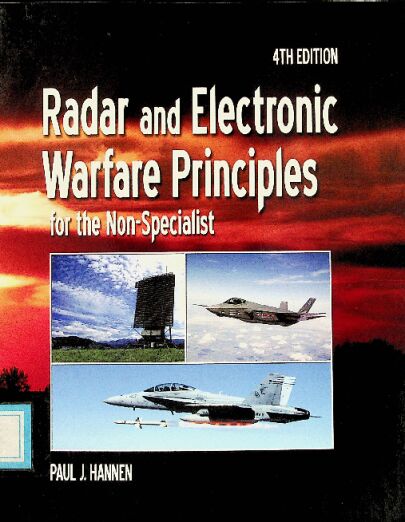
书名:Radar and electronic warfare principles for the non-specialist
责任者:Paul Hannen. | Toomay, J. C.
ISBN\ISSN:9781613530115,1613530110
出版时间:2014
出版社:SciTech Publishing,
分类号:无线电电子学、电信技术
版次:4th ed.
摘要
This enhanced and fully revised 4th Edition of Radar and Electronic Warfare Principles for the Non-specialist presents a comprehensive set of radar and electronic warfare principles including many of the latest applications with the addition of new EW principles.
Significant revisions to; target signal-to-noise ratio, target detection theory, array antennas, radar measurements and tracking, and target signatures
The addition of new EW-related material addressing electronic support (ES), electronic attack (EA), and electronic protection (EP)
The advanced radar concepts chapter has been revised, including the addition of a section on modern multi-function, -mode, -mission radar systems.
Most of the chapters are stand-alone allowing the reader to be selective and still benefit from the content.
查看更多
前言
What This Book Is
This book is about radar and electronic warfare (EW). It will teach you the essentials of radar and EW, the underlying principles, in a clear and consistent way. It is not like an engineering handbook that provides detailed design equations without explaining either derivation or rationale. It is not like a graduate school textbook that maybe abstruse and esoteric to the point of incomprehensibility. Moreover, it is not like an anthology of popular magazine articles that maybe gaudy but superficial. It is an attempt to distill the very complex, rich technology of radar and EW into its fundamentals, tying them to the laws of nature on one end and to the most modern and complex systems on the other.
Radar Principles for the Non-Specialist by John C. Too may provided the foundation of this book. For over 20 years, Too may (Major General, U.S. Air Force, retired) was associated with scientists, engineers, mathematicians, business administration graduates, and other college-educated people, all of whom aspired to jobs with broader responsibilities. One of the principal technical areas was radar. Surprisingly, even the electrical engineers with recent bachelor's degrees had no knowledge of radar, which is really a specialty topic to be taken up in graduate school. In response, in the 1970s Too may put together a rudimentary version of this book. However, his subsequent experience revealed an even greater need for radar knowledge, leading to the first two editions of the book in 1982 and 1989 (reissued in 1998 by SciTech Publishing), respectively. I wrote the third edition in 2004, building on the unique style and solid foundation of the previous ones. Every section of each chapter was revised and enhanced in some way. These enhancements were aimed at making the book easier to learn from and teach out of, which I do—both undergraduate and graduate level college classes and professional short courses.
What Is New in the Fourth Edition
Several years of using the third edition, combined with numerous comments and suggestions from interested parties, revealed what was needed to make it even better. The most obvious addition is the EW-related material, which addresses electronic support (ES), electronic attack (EA), and electronic pro-tection (EP) and is consistent in both scope and depth with the radar-related material. All the radar-related material was reviewed, revised, and enhanced as necessary, with the following significant updates: target signal-to-noise ratio, target detection theory, array antennas, radar measurements and tracking, and target signatures. The advanced radar concepts chapter was revised, including the addition of a section on modern multifunction, multimode, multi mission radar systems. The fourth edition remains true to the traditional strength of the book, providing radar principles for the non-specialist while now also offering EW principles.
Who It Is For
If you are intellectually curious about the way radar systems and EW systems work and their inherent interrelationships, if you are not satisfied with a casual explanation, yet you are without the time to take a course leading to a master's degree, this book will provide you the level of comprehension you seek. If you have taken a radar or EW short course but find you need a better foundation or want the concepts to be tied together better, then this book will do that.
If your work requires you to supervise or meet as coequals with radar systems or EW engineers or designers, this book will allow you to understand them, to question them intelligently, and perhaps to provide them with a per-spective (a dispassionate yet competent view) that they lack. If you are trained in another discipline but have been made the manager of a radar or EW project or of a system program with one or more radar systems as subsystems, this book will provide you with the tools you need, not only to give your team members confidence but also to make a substantive technical contribution yourself.
How It Approaches Radar and Electronic Warfare
This book is focused on imparting whole pieces of knowledge, developed with an evolutionary approach and tied together with a consistent thread of logic through the radar and EW material. It starts with electromagnetic propagation, describes a radar system of the utmost simplicity, and derives the associated radar equation. Once the radar equation is available, the book enhances the meaning of each term in it and concept behind it, moving through target detection, antennas, measurements and tracking, radar cross section, and sys-tem applications in an orderly progression. Similarly, the book continues with an introduction to EW, moving through ES, EA, and EP. At the finish, the reader should be able to perform a respectable, first-order radar and EW system design or analysis, including trading radar parameters or concepts. However, more importantly, the reader should know enough to critique the designs or analysis of others and to understand which technical issues are fundamental and which are secondary. While clever design ideas, and acronyms for them, are rampant, radar and EW functions do not change. Thus, while there is no way to keep up with each new design wrinkle, knowledge of the principles governing them will give instant critical understanding
What Is Unusual
This book does three unusual, although perhaps not unique, things. It presents a comprehensive set of radar and EW principles—including many of the latest applications—in a relatively modest volume. It outlines these principles with their underlying derivations, using the simplest mathematics possible, explaining the steps, and using only popularly tabulated functions, integrals, and other expressions. In addition, it uses the same method of derivation, the same mathematics, and the same conceptual approach to discussing both radar and EW.
What Is Useful
This book presents information in logical chunks, which are meant to be self-contained. Most chapters standalone so the reader maybe selective and still benefit from their content. The chapters are scaled to their information content rather than to the time required absorbing them. Some readers will require much more effort than others to master a particular chapter. There are two levels of comprehension provided. The reader may simply memorize key relationships, which are always identified in the text, or may master the prin-ciple and its derivation. Useful (mostly generally available) references are provided throughout. Exercises at the end of each chapter are calculated not to stump the reader but to reinforce the concepts presented and illustrate their applications. The answers to the exercises at the end of each chapter have been double-checked, and a solution set (Mathcad and PDF) is available for down-load from the publisher's website.
How It Is Organized
The book goes from the fundamental toward the more complex and from phi-losophy to quantification. It starts with an introduction to radar and EW and then moves to an incremental discussion first of radar systems and then of EW as the following outline shows:
Chapter Summary
1 INTRODUCTION TO RADAR AND ELECTRONIC WARFARE Introduction to radar and electronic warfare
2 RADAR SYSTEMS History, technical fundamentals, deriving the radar equation
3 TARGET DETECTION Building on the radar equation and explaining how a radar systems detects the presence of targets
4 RADAR ANTENNAS Addressing and expanding on an important term in the radar equation
5 RADAR MEASUREMENTS AND TARGET TRACKING Explaining how a radar system measures characteristics of the target—range, range rate, and angle—and tracks the target
6 TARGET SIGNATURE Addressing and expanding on the only target-related term in the radar equation
7 ADVANCED RADAR CONCEPTS Explaining advanced radar concepts, both common and uncommon
8 ELECTRONIC WARFARE OVERVIEW Introduction to the components of electronic warfare: electronic support, electronic attack, and electronic protection
9 ELECTRONIC WARFARE RECEIVERS Defining and discussing electronic warfare receivers, the most common element of electronic support
10 SELF-PROTECTION JAMMING Defining and discussing self-protection jamming electronic attack
11 SUPPORT JAMMING Defining and discussing support jamming electronic attack
12 ELECTRONIC PROTECTION CONCEPTS Defining and discussing electronic protection concepts
13 LOOSE ENDS OF RADAR AND/OR ELECTRONIC WARFARE LORE Cleaning up loose ends
Acknowledgements
A special thanks to my colleagues and friends, Mr. Bruce Es ken, Mr. James Helton, and Mr. Mike Sutton, for their countless suggestions, detailed discus-sions, and thorough technical review of the manuscript. Your scrutiny and big-picture focus are invaluable. If this book looks like it was written by someone who actually has a command of the English language, as opposed to just radar and electronic warfare, you can thank Miss Jackie San saver a; I know I do. Also, thanks to my family, friends, colleagues, students, and anyone who at one time or another said, "You should just write your own book. "
Paul J. Hannen
查看更多
目录
Preface xv
Publisher's Acknowledgments xix
Symbols xxi
1 Introduction to Radar and Electronic Warfare 1
1.1 Radar Systems 1
1.2 Electronic Warfare 4
2 Radar Systems 7
2.1 Radio Frequency Waves 7
2.2 A Basic Radar System 9
2.3 The Radar Equation 12
2.4 A Basic Radar Receiver 22
2.5 Summary 27
2.6 Exercises 27
2.7 References 29
3 Target Detection 31
3.1 The Problem of Target Detection 32
3.2 Detection Theory 33
3.3 Integration of Multiple Pulses 48
3.4 Some Detection Techniques 57
3.5 Detection Threshold and Radar Detection Range 64
3.6 Summary 65
3.7 Exercises 66
3.8 References 68
4 Radar Antennas 71
4.1 The Antenna Gain Pattern 72
4.2 Reflector Antennas 82
4.3 Array Antennas 83
4.4 Summary 99
4.5 Exercises 100
4.6 References 101
5 Radar Measurements and Target Tracking 103
5.1 Radar Waveforms: Time and Frequency Domains 104
5.2 Range Measurement 110
5.3 Range Rate Measurements 124
5.4 Angle Measurements 136
5.5 Measurement Loose Ends 142
5.6 Sophisticated Target Trackers 147
5.7 Summary 151
5.8 Exercises 152
5.9 References 154
6 Target Signature 155
6.1 Radar Cross Section of a Sphere 156
6.2 Radar Cross Section of Simple Geometric Objects 158
6.3 Target Spectrum 161
6.4 Target Radar Cross Section and Radar Detection Range 163
6.5 Polarization 164
6.6 Chaff Characteristics 165
6.7 Clutter Characteristics 167
6.8 Radar Signatures 170
6.9 Summary 172
6.10 Exercises 172
6.11 References 173
7 Advanced Radar Concepts 175
7.1 Clutter Rejection 176
7.2 Synthetic Aperture Radar Systems 189
7.3 Bistatic Radar Systems 205
7.4 Modern Multifunction, Multimode Mission Radar Systems 209
7.5 Over-the-Horizon Radar Systems 212
7.6 Radar Altimeters 215
7.7 Ionospheric Radar Systems 218
7.8 Laser Radar Systems 220
7.9 Summary 225
7.10 Exercises 225
7.11 References 227
8 Electronic Warfare Overview 231
8.1 Electronic Support: Electronic Support Measures 232
8.2 Electronic Attack: Electronic Countermeasures 232
8.3 Electronic Protection: Electronic Counter-Countermeasures 239
8.4 Summary 241
8.5 References 241
9 Electronic Warfare Receivers 243
9.1 Electronic Receiver Principles 243
9.2 Electronic Warfare Receiver Equation 244
9.3 Electronic Warfare Receiver Metrics 252
9.4 Radar Signal Parameter Extraction, Deinterleaving Identification, and Output 255
9.5 Summary 256
9.6 Exercises 257
9.7 References 258
10 Self-Protection Jamming Electronic Attack 259
10.1 Self-Protection Jamming Principles 259
10.2 Self-Protection Jamming Equation 260
10.3 Self-Protection Noise Jamming 266
10.4 Self-Protection False Target Jamming 274
10.5 Self-Protection Expendables 281
10.6 Other Self-Protection Jamming Deception Techniques 288
10.7 Summary 291
10.8 Exercises 291
10.9 References 293
11 Support Jamming Electronic Attack 295
11.1 Support Jamming Principles 296
11.2 Support Jamming Equation 296
11.3 Support Noise Jamming 302
11.4 Support False Target Jamming 312
11.5 Support Expendables 318
11.6 Summary 318
11.7 Exercises 319
11.8 References 320
12 Electronic Protection Concepts 321
12.1 Waveform Diversity and Low Probability of Intercept 322
12.2 Antenna-Based Signal Processing 323
12.3 Sophisticated Target Trackers 329
12.4 Summary 331
12.5 Exercises 332
12.6 References 333
13 Loose Ends of Radar and/or Electronic Warfare Lore 335
13.1 Radar Line of Sight 335
13.2 Properties of the Propagation Medium 339
13.3 Far Field of an Antenna or a Target 343
13.4 Convenient Radar and Electronic Warfare Rules-of-Thumb 344
13.5 Summary 345
13.6 Exercises 345
13.7 References 346
Appendix 1: Decibels 347
Appendix 2: The Radar Spectrum 349
Appendix 3: Fourier Series and Transforms 351
Appendix 4: Answers to Exercises 357
Appendix 5: Glossary 363
Index 381
查看更多
作者简介
Paul Hannen has over 30 years of extensive radar and electronic warfare (EW), survivability assessment, modeling, simulation and analysis (MS&A) expertise. He has taught the senior/graduate level electrical engineering class, Introduction to Radar Systems and the graduate class, Modern Radar Theory as an adjunct professor for the Department of Electrical Engineering, Wright State University.
查看更多
馆藏单位
中科院文献情报中心