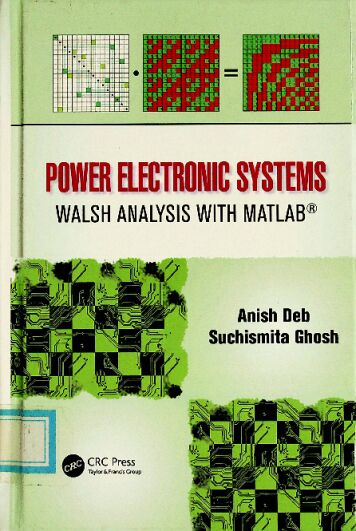
书名:Power electronic systems
责任者:Anish Deb | Suchismita Ghosh.
ISBN\ISSN:9781482215960,1482215969
出版时间:2014
出版社:CRC Press/Taylor & Francis Group,
前言
About 80 years ago, Walsh functions were presented in the literature by Professor J. L. Walsh. However, he was not the first to propose a complete orthonormal function set that was very much unlike the well-known sine— cosine functions. Precisely, the Walsh functions were piecewise constant in nature as well as bivalued—and hence digital application friendly. Although Walsh functions are so different from the sine—cosine set, they still have some basic similarities with the good old sine—cosine functions. These fun- damental properties made Walsh functions to become a strong candidate to application engineers from the mid-1960s.
The proposition of piecewise constant orthonormal function sets was pio- neered by Alfred Haar in 1910. Haar function set is now known to be the ear- liest wavelet function having both scaling and shifting properties. Although each component function in the Haar set is bivalued, its amplitude is dif- ferent from most of the other members. But in the Walsh set, all the compo- nent functions are piecewise constant and switch between two fixed values +1 and —1. This property seemed to be an added advantage for engineer- ing application though the Walsh function set, Haar function set, and block pulse function set are related to one another by similarity transformation.
From the early 1970s, a horde of researchers started working with Walsh functions. They set the ball rolling with the solution of differential as well as integral equations, thus leading to many applications in the area of control theory, including system analysis and identification. Concurrently, the theo- retical basis of Walsh analysis has also been strengthened mainly by control engineers and mathematicians.
Walsh functions first attracted Anish Deb (the first author) way back in 1982, when he noted the striking similarity between the shapes of dif- ferent Walsh functions and different power electronic waveforms, i.e. the output waveforms of chopper, converters, inverters, etc. He initiated the idea of mingling power electronics with Walsh functions and mak- ing good use of the advantages offered by this "alternative" piecewise constant function set.
In this book, which is essentially a sort of "marriage" between power elec- tronics and Walsh functions, we have explored many advantages offered by Walsh domain analysis of power electronic systems and have proposed a strong case in its favor to establish its right as an interesting as well as a pow- erful analysis tool for the study of power electronic systems.
The book starts with the background and evolution of power electronics, then proceeds gradually with a discussion of Walsh and related orthogonal basis functions and develops the mathematical foundation of Walsh analysis and first- and second-order system analyses by Walsh technique.
After presenting the underlying principles of Walsh analysis, the book deals with pulse-width modulated chopper, phase-controlled rectifiers, and inverter systems with many illustrative examples. The two appendices at the end of the book include a basic introduction to linear algebra and a few MATLAB@ programs for some important numerical experiments treated in the book.
The book is targeted at postgraduate students, researchers, and acade- micians in the area of power electronics as well as systems and control. It may prove to be a source of new knowledge, and Walsh analysis hopefully deserves to be a new potential tool for further application and exploration.
Anish Deb gratefully acknowledges the support of the University of Calcutta in all phases of preparation of the book, while Suchismita Ghosh remains grateful to MCKV Institute of Engineering for providing her the opportunity for research and study to offer strong regular support to Deb.
Finally, the authors are indebted to CRC Press for accepting and publish- ing their work in such an attractive form.
查看更多
目录
List of Principal Symbols xi
Preface xiii
Authors xv
1 Introduction 1
1.1 Evolution of Power Electronics 1
1.2 Analysis of Power Electronic Circuits 2
1.2.1 Fourier Series Technique 4
1.2.2 Laplace Transform Method 4
1.2.3 Existence Function Technique 5
1.2.4 State Variable Method 5
1.2.5 Averaging Technique 6
1.2.6 z-Transform Analysis 6
1.2.7 Other Methods of Analysis 6
1.3 Search for a New Method of Analysis 7
References 8
2 An Alternative Class of Orthogonal Functions 11
2.1 Orthogonal Functions and Their Properties 11
2.2 Haar Functions 13
2.3 Rademacher and Walsh Functions 15
2.3.1 Representation of a Function Using Walsh Functions 21
2.4 Block Pulse Functions and Their Applications 22
2.4.1 Representation of a Function as a Linear Combination of BPFs 25
2.5 Slant Functions 27
2.6 Delayed Unit Step Functions 28
2.7 General Hybrid Orthogonal Functions 30
2.8 Sample-and-Hold Functions 30
2.9 Triangular Functions 32
2.10 Hybrid Function: A Combination of SHF and TF 34
2.11 Applications of Walsh Functions 36
References 40
3 Walsh Domain Operational Method of System Analysis 47
3.1 Introduction to Operational Matrices 47
3.1.1 Operational Matrix for Integration 48
3.1.1.1 Representation of Integration of a Function Using Operational Matrix for Integration 55
3.1.2 Operational Matrix for Differentiation 58
3.1.2.1 Representation of Differentiation of a Function Using Operational Matrix for Differentiation 59
3.2 Time Scaling of Operational Matrices 62
3.2.1 Time-Scaled Operational Matrix for Integration 63
3.2.2 Time-Scaled Operational Matrix for Differentiation 65
3.3 Philosophy of the Proposed Walsh Domain Operational Technique 65
3.4 Analysis of a First-Order System with Step Input 69
3.5 Analysis of a Second-Order System with Step Input 72
3.6 Oscillatory Phenomenon in Walsh Domain System Analysis 73
3.6.1 Oscillatory Phenomenon in a First-Order System 74
3.6.2 Analytical Study of the Oscillatory Phenomenon 75
3.7 Conclusion 86
References 86
4 Analysis of Pulse-Fed Single-Input Single-Output Systems 89
4.1 Analysis of a First-Order System 90
4.1.1 Single-Pulse Input 90
4.1.2 Pulse-Pair Input 92
4.1.3 Alternating Double-Pulse Input 92
4.2 Analysis of a Second-Order System 94
4.2.1 Single-Pulse Input 94
4.2.2 Pulse-Pair Input 95
4.2.3 Alternating Double-Pulse Input 95
4.3 Pulse-Width Modulated Chopper System 97
4.3.1 Case I: Stepwise PWM 97
4.3.1.1 Walsh Function Representation of Significant Current Variables 97
4.3.1.2 Determination of Normalized Average and rms Currents through Load and Semiconductor Components 100
4.3.1.3 Determination of Exact Normalized Average and rms Current Equations Considering Switching Transients 103
4.3.2 Case II: Continuous PWM 107
4.3.2.1 Mathematical Operations 111
4.3.2.2 Simulation of an Ideal Continuously Pulse-Width Modulated DC Chopper System 112
4.3.2.3 Determination of Normalized Average and rms Currents through Load and Semiconductor Components 113
4.3.2.4 Simulation of an Ideal Chopper-Fed DC Series Motor 120
4.4 Conclusion 127
References 128
5 Analysis of Controlled Rectifier Circuits 131
5.1 Representation of a Sine Wave by Walsh Functions 132
5.2 Conventional Analysis of Half-Wave Controlled Rectifier 134
5.3 Walsh Domain Analysis of Half-Wave Controlled Rectifier 137
5.3.1 Computational Algorithm 140
5.4 Walsh Domain Analysis of Full-Wave Controlled Rectifier 145
5.4.1 Single-Phase Full-Wave Controlled Rectifier 146
5.4.2 Representation of the Load Voltage by Walsh Functions 147
5.4.3 Determination of Normalized Average and rms Currents 151
5.4.3.1 Exact Equations for Phase-Controlled Rectifier 152
5.4.4 Computational Algorithm 160
5.5 Conclusion 162
References 163
6 Analysis of Inverter Circuits 165
6.1 Voltage Control of a Single-Phase Inverter 166
6.1.1 Single-Pulse Modulation 168
6.1.1.1 Walsh Function Representation of Single-Pulse Modulation 169
6.1.1.2 Computation of Normalized Average and rms Load Currents for Single—Pulse Modulation 172
6.2 Analysis of an RL Load Fed from a Typical Three-Phase Inverter Line-to-Neutral Voltage 175
6.3 Conclusion 179
References 179
Appendix A: Introduction to Linear Algebra 181
Appendix B: Selected MATLAB' Programs 191
Index 275
查看更多
作者简介
Suchismita Ghosh, born in 1986, obtained her BTech (2008) from the Calcutta Institute of Engineering and Management, West Bengal University of Technology, India, and MTech (2010) from the Department of Applied Physics, University of Calcutta, India. She has been involved in research from her masters days (2009), and currently she is an assistant professor in the Department of Electrical Engineering, MCKV Institute of Engineering, West Bengal University Of Technology, India. She has taught courses on power electronics, basic electrical engineering, control systems, and electrical machines. Her research area includes automatic control in general and application of "alternative" orthogonal functions in systems and control. She is presently involved in research with Anish Deb and has published five research papers in international journals and national conferences.
查看更多
馆藏单位
中科院文献情报中心