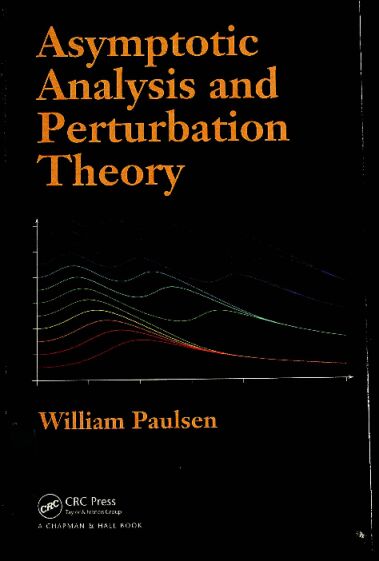
书名:Asymptotic analysis and perturbation theory
责任者:William Paulsen | Arkansa Atate University | USA.
ISBN\ISSN:9781466515116,1466515112
前言
The goal of this textbook is to present the topics of asymptotic analysis and perturbation theory to a level obtainable to students who have only completed the standard calculus sequence. Even though the most common application of asymptotics is in analyzing differential equations,students need not have prior knowledge of differential equations for this text. Rather,the book begins by immediately introducing the asymptotic notation,and applying this new tool to problems that the students will already be familiar with: limits, inverse functions,and integrals. In fact, only the simplest differential equations,such as first order linear or separable equations, will the students need to learn how to solve exactly. Hence,there is very little overlap between this text and a standard differential equation textbook.
The text follows the traditional organization, with plenty of exercises at the end of each section, and the answers to the odd numbered problems in the back. However, it also includes an abundance of computerized graphs and tables that will illustrate how well the asymptotic approximations approach the actual solutions. These graphs and charts enhance the student's learning of the material,giving them visual evidence that these approximation methods can be applied to the many types of problems that the student will encounter in his or her field.
This book will benefit instructors in that it will allow them to offer a course in Applied Mathematics that does not require a differential equations prerequisite. It will benefit students by bringing this difficult subject material to an easy to comprehend level. The book will benefit the mathematics department by making a course which is attractive to both majors and non-majors alike. The fields of engineering, physics,and even computer science utilize the study of asymptotic analysis and perturbation theory.
Although the emphasis of this book is problem-solving, there are some proofs scattered throughout the book. The purpose of these proofs is to give the students a justification for the methods that they will be using.Just as there are some proofs in a freshman level calculus book which are not as rigorous as the corresponding proofs in an advanced calculus text, these proofs are more informal, and often will refer the students to other sources for the details. These proofs enrich the students understanding of the material.
Another focus of this textbook is fexibility. Knowing that the readership will be extremely diverse,the aim was to include material that would be beneficial to both beginning students and researchers. Also, the book was designed to be completely self-contained,requiring only a calculus sequence background.There is a section giving the necessary background material for complex variables,since this knowledge tends to belacking in the undergradu- ate curriculum.References to differentialequations is deferred until chapter4, where the small amount of background is covered, with minimal duplication of a standard differential equations course. Since the goal is to onlyappro- imate the solutions to such equations, it is not necessary for the students to know how to solve differential equations exactly, except for first order linearor separable equations. Hence,an undergraduate course can easily be designed using this text.
There is also more than enough material needed for a semester course. Professors may choose to skip chapter 3,(or even chapter 4,if differential equations is a prerequisite,)in order to reach the latter chapters.On the other hand,the frst 6 chapters will make a good undergraduate course on asymptotics. There are a myriad of possibilities between these two extremes.
Finally, there are plenty of homework problems of various levels of dif- culty. Most sections have between 20 to 30 problems,giving professors enough choices for assignments. Also,the answers to the odd numbered problems ap- pear in the back of the book.
查看更多
目录
List of Figures ix
List of Tables xiii
Preface xv
Acknowledgments xvii
About the Author xix
Symbol Description xxi
1 Introduction to Asymptotics 1
1.1 Basic Definitions 1
1.1.1 Definition of ~ and << 1
1.1.2 Hierarchy of Functions 4
1.1.3 Big O and Little o Notation6
1.2 Limits via Asymptotics 8
1.3 Asymptotic Series 13
1.4 Inverse Functions 22
1.4.1 Reversion of Series 26
1.5 Dominant Balance 30
2 Asymptotics of Integrals 37
2.1 Integrating Taylor Series 37
2.2 Repeated Integration by Parts 44
2.2.1 Optimal asymptotic approximation 48
2.3 Laplace's Method 53
2.3.1 Properties of Γ(x)59
2.3.2 Watson's Lemma 61
2.4 Review of Complex Numbers 69
2.4.1 Analytic Functions 73
2.4.2 Contour Integration 77
2.4.3 Gevrey Asymptotics 80
2.4.4 Asymptotics for Oscillatory Functions 84
2.5 Method of Stationary Phase 90
2.6 Method of Steepest Descents 97
2.6.1 Saddle Points 101
3 Speeding Up Convergence 111
3.1 Shanks Transformation 111
3.1.1 Generalized Shanks Transformation 114
3.2 Richardson Extrapolation117
3.2.1 Generalized Richardson Extrapolation 120
3.3 Euler Summation 124
3.4 Borel Summation 130
3.4.1 Generalized Borel Summation 132
3.4.2 Stieltjes Series 137
3.5 Continued Fractions 144
3.6 Padé Approximants 154
3.6.1Two-point Padé 158
4 Differential Equations 163
4.1 Classification of Differential Equations 163
4.1.1Linear vs. Non-Linear 166
4.1.2 Homogeneous vs. Inhomogeneous 168
4.1.3 Initial Conditions vs. Boundary Conditions 173
4.1.4 Regular Singular Points vs. Irregular Singular Points 175
4.2 First Order Equations 181
4.2.1 Separable Equations 181
4.2.2 First Order Linear Equations 184
4.3 Taylor Series Solutions187
4.4 Frobenius Method 197
5 Asymptotic Series Solutions for Differential Equations 207
5.1 Behavior for Irregular Singular Points 207
5.2 Full Asymptotic Expansion 217
5.3 Local Analysis of Inhomogeneous Equations 228
5.3.1 Variation of Parameters 234
5.4 Local Analysis for Non-linear Equations 243
6 Difference Equations 253
6.1 Classification of Difference Equations253
6.1.1 Anti-differences 256
6.1.2 Regular and Irregular Singular Points 259
3.2 First Order Linear Equations 263
6.2.1 Solving General First Order Linear Equations265
6.2.2 The Digamma Function 269
6.3Analysis of Linear Difference Equations 274
6.3.1 Full Stirling Series 278
6.3.2 Taylor Series Solution 281
6.4 The Euler-Maclaurin Formula 286
6.4.1 The Bernoulli Numbers 289
6.4.2 Applications of the Euler-Maclaurin Formula 294
6.5 Taylor-like and Frobenius-like Series Expansions 301
7 Perturbation Theory 317
7.1 Introduction to Perturbation Theory 317
7.2 Regular Perturbation for Differential Equations 326
7.3 Singular Perturbation for Differential Equations 337
7.4 Asymptotic Matching 352
7.4.1 Van Dyke Method 362
7.4.2 Dealing with Logarithmic Terms 374
7.4.3 Multiple Boundary Layers 380
8 WKBJ Theory 389
8.1 The Exponential Approximation 391
8.2 Region of Validity 403
8.3 Turning Points 417
8.3.1 One Simple Root Turning Point Problem 426
8.3.2 Parabolic Turning Point Problems 428
8.3.3 The Two-turning Point Schrödinger Equation 436 C1\9Multiple-Scale Analysis 443
9.1 Strained Coordinates Method (Poincaré-Lindstedt) 443
9.2 The Multiple-Scale Procedure 457
9.3 Two-Variable Expansion Method 465
Appendix-Guide to the Special Functions 479
Answers to Odd-Numbered Problems 495
Bibliography 519
Index 521
查看PDF
查看更多
馆藏单位
中科院文献情报中心