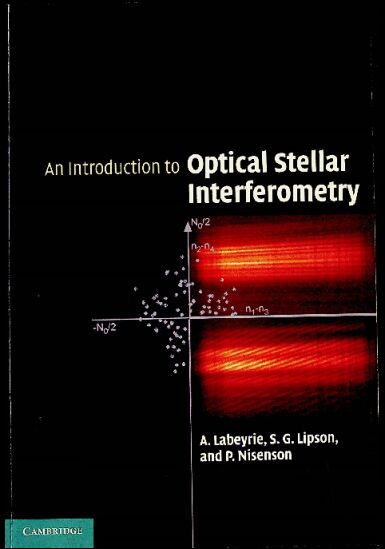
书名:An introduction to optical stellar interferometry
责任者:A. Labeyrie | S.G. Lipson | P. Nisenson. | Nisenson, P.
出版时间:2013
出版社:Cambridge University Press,
前言
During the last two decades, optical stellar interferometry has become an important tool in astronomical investigations requiring spatial resolution well beyond that of traditional telescopes. This book, first published in 2006, was the first to be written on the subject. The authors provide an extended introduction discussing basic physical and atmospheric optics, which establishes the framework necessary to present the ideas and practice of interferometry as applied to the astronomical scene. They follow with an overview of historical, operational and planned interferometric observatories, and a selection of important astrophysical discoveries made with them. Finally, they present some as-yet untested ideas for instruments both on the ground and in space which may allow us to image details of planetary systems beyond our own.
查看更多
目录
List of Illustrations page xii
Preface xxviii
1 Introduction 1
1.1 Historical introduction 1
1.2 About this book 7
References 7
2 Basic concepts: a qualitative introduction 9
2.1 A qualitative introduction to the basic concepts and ideas 9
2.1.1 Young’s experiment (1801–3) 9
2.1.2 Using Young’s slits to measure the size of a light source 11
2.2 Some basic wave concepts 13
2.2.1 Plane waves 15
2.2.2 Huygens’ principle 15
2.2.3 Superposition 17
2.3 Electromagnetic waves and photons 19
References 22
3 Interference, diffraction and coherence 23
3.1 Interference and diffraction 23
3.1.1 Interference and interferometers 24
3.1.2 Diffraction using the scalar wave approximation 28
3.1.3 Fraunhofer diffraction patterns of some simple apertures 31
3.1.4 The point spread function 37
3.1.5 The optical transfer function 39
3.2 Coherent light 40
3.2.1 The effect of uncertainties in the frequency and wave vector 40
3.2.2 Coherent light and its importance to interferometry 41
3.2.3 Partial coherence 41
3.2.4 Spatial coherence 42
3.2.5 Temporal coherence 43
3.3 A quantitative discussion of coherence 44
3.3.1 Coherence function 45
3.3.2 The relationship between the coherence function and fringe visibility 45
3.3.3 Van Cittert–Zernike theorem 46
3.4 Fluctuations in light waves 52
3.4.1 A statistical model for quasimonochromatic light 52
3.4.2 The second-order coherence function 55
3.4.3 Photon noise 56
3.4.4 Photodetectors 58
References 62
4 Aperture synthesis 64
4.1 Aperture synthesis 64
4.1.1 The optics of aperture synthesis 64
4.1.2 Sampling the (u, v) plane 66
4.1.3 The optimal geometry of multiple telescope arrangements 69
4.2 From data to image: the phase problem 71
4.2.1 Phase closure 73
4.3 Image restoration and the crowding limitation 75
4.3.1 Algorithmic image restoration methods 76
4.3.2 The crowding limitation 77
4.4 Signal detection for aperture synthesis 78
4.4.1 Wave mixing and heterodyne recording 78
4.5 A quantum interpretation of aperture synthesis 81
4.6 A lecture demonstration of aperture synthesis 83
References 87
5 Optical effects of the atmosphere 88
5.1 Introduction 88
5.2 A qualitative description of optical effects of the atmosphere 90
5.3 Quantitative measures of the atmospheric aberrations 93
5.3.1 Kolmogorov’s (1941) description of turbulence 93
5.3.2 Parameters describing the optical effects of turbulence: Correlation and structure functions, B(r) and D(r). 95
5.4 Phase fluctuations in a wave propagating through the atmosphere 96
5.4.1 Fried’s parameter r0 describes the size of the atmospheric correlation region 99
5.4.2 Correlation between phase fluctuations in waves with different angles of incidence: the isoplanatic patch 100
5.5 Temporal fluctuations 102
5.5.1 The wind-driven“frozen turbulence” hypothesis 102
5.5.2 Frequency spectrum of fluctuations 102
5.5.3 Intensity fluctuations: twinkling 103
5.6 Dependence on Height 108
5.7 Dependence of atmospheric effects on the wavelength 108
5.8 Adaptive optics 109
5.8.1 Measuring the wavefront distortion 111
5.8.2 Deformable mirrors 113
5.8.3 Tip–tilt correction 114
5.8.4 Guide stars 114
5.9 Short exposure images: speckle patterns 115
5.9.1 A model for a speckle image 116
References 119
6 Single-aperture techniques 120
6.1 Introduction 120
6.2 Masking the aperture of a large telescope 123
6.3 Using the whole aperture: speckle interferometry 126
6.3.1 Theory of speckle interferometry 128
6.3.2 Experimental speckle interferometry 130
6.3.3 Some early results of speckle interferometry 133
6.4 Speckle imaging 134
6.4.1 The Knox–Thompson algorithm 135
6.4.2 Speckle masking, or triple correlation 136
6.4.3 Spectral speckle masking 139
References 139
7 Intensity interferometry 141
7.1 Introduction 141
7.2 Intensity fluctuations and the second-order coherence function 142
7.2.1 The classical wave interpretation 142
7.2.2 The quantum interpretation 146
7.3 Estimating the sensitivity of fluctuation correlations 147
7.4 The Narrabri intensity interferometer 149
7.4.1 The electronic correlator 150
7.5 Data analysis 152
7.5.1 Double stars 152
7.5.2 Stellar diameters 154
7.5.3 Limb darkening 154
7.6 Astronomical results 154
7.7 Retrieving the phase 155
7.8 Conclusion 156
References 157
8 Amplitude interferometry: techniques and instruments 158
8.1 Introduction 158
8.1.1 The Michelson stellar interferometer 159
8.1.2 The Narrabri Intensity Interferometer 160
8.1.3 Aperture masking 161
8.2 What do we demand of an interferometer? 161
8.3 The components of modern amplitude interferometers 162
8.3.1 Subapertures and telescopes 163
8.3.2 Beam lines and their dispersion correction 165
8.3.3 Correction of angular dispersion 167
8.3.4 Path-length equalizers or delay lines 168
8.3.5 Beam-reducing optics 170
8.3.6 Beam combiners 170
8.3.7 Semireflective beam-combiners 172
8.3.8 Optical fiber and integrated optical beam-combiners 174
8.3.9 Star tracking and tip–tilt correction 175
8.3.10 Fringe dispersion and tracking 179
8.3.11 Estimating the fringe parameters 180
8.3.12 Techniques for measuring in the photon-starved region 183
8.4 Modern interferometers with two subapertures 184
8.4.1 Heterodyne interferometers 185
8.4.2 Interf´erom`etre `a 2 T´elescopes (I2T) 186
8.4.3 Grand interf´erom`etre `a deux t´elescopes (GI2T) 186
8.4.4 The Mark III Interferometer 189
8.4.5 Sydney University stellar interferometer (SUSI) 189
8.4.6 The large binocular telescope (LBT) 191
8.4.7 The Mikata optical and infrared array (MIRA-I.2) 193
8.4.8 Palomar testbed interferometer (PTI) 193
8.4.9 Keck interferometer 196
8.5 Interferometers with more than two subapertures 197
8.5.1 The Cambridge optical aperture synthesis telescope (COAST) 197
8.5.2 Center for High Angular Resolution Astronomy (CHARA) 200
8.5.3 Infrared optical telescope array (IOTA) 202
8.5.4 Navy prototype optical interferometer (NPOI) 203
8.5.5 The Berkeley infrared spatial interferometer (ISI) 205
8.5.6 Very large telescope interferometer (VLTI) 208
References 210
9 The hypertelescope 212
9.1 Imaging with very high resolution using multimirror telescopes 212
9.2 The physical optics of pupil densification 214
9.2.1 A random array of apertures 214
9.2.2 A periodic array of apertures 219
9.3 The field of view of a hypertelescope and the crowding limitation 221
9.4 Hypertelescope architectures 224
9.4.1 Michelson’s stellar interferometer as a hypertelescope, and multi-aperture extensions 224
9.4.2 Hypertelescope versions of multitelescope interferometers 224
9.4.3 Carlina hypertelescopes 224
9.4.4 A fiber-optical version of the hypertelescope 226
9.5 Experiments on a hypertelescope system 228
References 231
10 Nulling and coronagraphy 232
10.1 Searching for extrasolar planets and life 232
10.2 Planet detection methods 233
10.2.1 The relative luminosities of a star and planet 234
10.2.2 Requirements for imaging planet surface features 235
10.3 Apodization 236
10.3.1 Apodization using binary masks 238
10.3.2 Apodization using phase masks 239
10.4 Nulling methods in interferometers 240
10.4.1 Bracewell’s single-pixel nulling in nonimaging interferometers 241
10.4.2 Bracewell nulling in imaging interferometers 242
10.4.3 Achromatic nulling in Bracewell interferometers 243
10.4.4 Starlight leakage in nulling interferometers 245
10.5 Imaging coronagraphy 247
10.5.1 The Lyot coronagraph in its original and stellar versions 248
10.5.2 The Roddier–Roddier phase-dot coronagraph 251
10.5.3 Four-quadrant phase-mask and phase-spiral coronagraphs 251
10.5.4 The achromatic interference coronagraph 252
10.5.5 Elementary modeling of mask coronagraphs 252
10.5.6 Mirror bumpiness tolerance calculated with Mar´echal’s equation 253
10.6 High contrast coronagraphy and apodization 256
10.6.1 Adaptive coherent correction of mirror bumpiness 256
10.6.2 Adaptive hologram within the coronagraph 257
10.6.3 Incoherent cleaning of recorded images 259
10.6.4 Comparison of coherent and incoherent cleaning 259
References 260
11 A sampling of interferometric science 262
11.1 Interferometric science 262
11.2 Stellar measurements and imaging 262
11.2.1 Stellar diameters and limb darkening 262
11.2.2 Star-spots, hot spots 265
11.2.3 Pulsating stars 266
11.2.4 Miras 267
11.2.5 Young stellar object disks and jets 268
11.2.6 Dust shells, Wolf–Rayets 268
11.2.7 Binary stars 270
11.3 Galactic and extragalactic sources 271
11.3.1 SN1987a 271
11.3.2 R136a 272
11.3.3 The galactic center 273
11.3.4 Astrometry 273
11.4 Solar system 274
11.4.1 The Galilean satellites 274
11.4.2 Asteroid imaging 274
11.4.3 Pluto–Charon 275
11.5 Brown dwarfs 275
11.6 Solar feature imaging and dynamics measurements 275
References 276
12 Future ground and space projects 278
12.1 Future ground-based projects 278
12.1.1 New ground-based long-baseline interferometers 279
12.1.2 The optical very large array (OVLA) 280
12.1.3 Toward large Carlina hypertelescopes 281
12.1.4 Comparison of OVLA and Carlina concepts 281
12.1.5 Comparing compact and exploded ELTs 282
12.1.6 Coupling telescopes through fibers: the OHANA project at Mauna Kea 283
12.2 Future space projects 284
12.2.1 Flotillas of mirrors 285
12.2.2 Darwin 285
12.2.3 Terrestrial planet finder (TPF) 287
12.2.4 Space interferometry mission (SIM) 288
12.2.5 The exo-Earth imager (EEI) 289
12.3 Simulated Exo-Earth-Imager images 290
12.3.1 Some speculations on identifying life from colored patches 291
12.4 Extreme baselines for a Neutron Star Imager 292
References 294
Appendix A 295
A.1 Electromagnetic waves: a summary 295
A.1.1 Plane and spherical electromagnetic waves 296
A.1.2 Energy and momentum in waves 297
A.2 Geometrical phase in wave propagation 298
A.3 Fourier theory 300
A.3.1 The Fourier transform 301
A.3.2 Some simple examples 302
A.3.3 Convolution 305
A.3.4 Sampling and aliasing 307
A.4 Fraunhofer diffraction 311
A.4.1 Random objects and their diffraction patterns: speckle images 313
Appendix B 316
References 317
Index 319
查看更多
馆藏单位
中科院文献情报中心