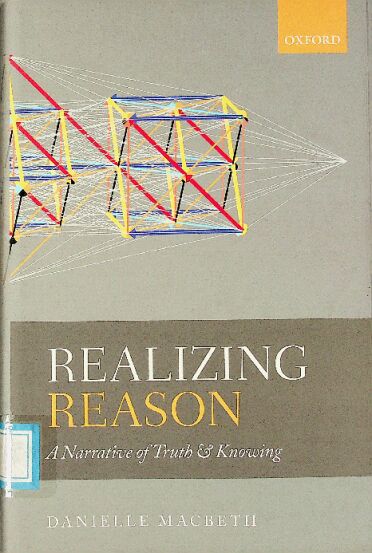
书名:Realizing reason
ISBN\ISSN:9780198704751,0198704755
出版时间:2014
出版社:Oxford University Press,
前言
When I began this project it had a different title and a more modest ambition. Only very recently did it become apparent to me that not only was I tracing developments in the practice of mathematics I was tracking also the realization of reason as a power of knowing. In retrospect, I think that it had to be this way: only after reason is realized as a power of knowing is it possible to recognize the process of its realization as such. And having become clear on the end of project, the book I was actually writing, I became clear also about its beginning, where, how, and when this project seems actually to have started, namely, I now think, with my dissertation in the philosophy of mind written under John Haugeland (and inspired by his reading of Heidegger) at the University of Pittsburgh in the 1980s. I could not have anticipated then that to understand our intentional directedness on objective reality would require, first, a radically new reading of Frege's Begriffsschrift notation (the reading I develop in Frege's Logic), and building on that reading, the account of the whole of the history of Western mathematics that I offer here. Nevertheless, that, so it seems to me, is what has happened.
Mathematics and philosophy have of course been intimately related throughout their history in the West. For Plato, the study of mathematics was a propaedeutic to the philosophical inquiry he called dialectic. For Descartes, method in metaphysics was modeled on his new method in mathematics. Leibniz, Kant, and Frege all held that one way or another the practice of mathematics was central to the practice of philosophy. And so it is here. To understand the nature of mathematics is, on our account, integral to understanding ourselves as the rational beings we are. This is due in part to the fact that mathematics, like philosophy, is a paradigm of rational activity. But it depends also on the fact that in mathematics, and only in mathematics, can a language be developed that, like natural language, serves as a medium of our cognitive commerce with reality. (This is not to say that one needs to have special training in mathematics to comprehend this work. One does not.) Understanding how a mathematical language such as Frege's concept-script can serve as a medium of our cognitive involvements in the world is the first step in understanding even our everyday involvements in the world. The most technically challenging material here is not, then, in the chapters on mathematical practice but instead in Chapter 7 on Frege's notation. I have aimed, in that chapter, to go into detail sufficient to satisfy anyone who wants actually to work through and master Frege's proof of theorem 133 in Part III of his 1879 logic, Begriffsschrift. There is much in that chapter that the less committed reader may want to skim. Nonetheless, the details matter. Frege is doing what I claim he is doing but the only way to see that he is, is by gaining proficiency in the language. To understand everything that is claimed in Chapter 7, by having worked through all the details of Frege's proof that are there discussed, is to have the literacy that is needed fully to understand Frege's notation. A proof in mathematics is of course very different from the sort of narrative that is told here.
A proof is a kind of argument, a giving of reasons, grounds, or justifica-tions, and a narrative is not. But perhaps this is too simple. After all, the proofs that mathematicians concern themselves with generally have, as stories do, a central idea on which the whole development turns. And there is development in a mathematical proof. Things happen in a (real) proof; proofs unfold and can have surprising turns. Mathematical proofs—good ones, interesting ones—are, in short, rather like narra-tives. And narratives can in their way provide reasons, grounds, and justifications insofar as they can help one to learn new ways of making sense of things, and to see how old ways of making sense do not in fact withstand critical scrutiny. If one is trying to change a reader's conception of what makes sense at all, trying to change the space of possibilities within which a reader's thought moves (as I aim to here), then a traditional philosophical argument is of little use. Arguments can be formulated only within established disciplinary boundaries, where the rules and acceptable starting points have already been agreed upon, at least in the main. What is needed, and what these pages provide, is a narrative of our intellectual maturation and growth, one that, if successful, will change a reader's way of looking at things.
查看更多
目录
Introduction 1
Perception
1. Where We Begin 19
1.1 The Limits of Cartesianism 20
1.2 Biological Evolution and the Concept of Life 27
1.3 The Emergence of Human Culture and Social Significances 35
1.4 The World in View 41
1.5 The Nature of Natural Language 50
1.6 Conclusion 56
2. Ancient Greek Diagrammatic Practice 58
2.1 Some Preliminary Distinctions 60
2.2 Euclid's Constructions 68
2.3 Propaedeutic to the Practice 72
2.4 Generality in Euclid's Demonstrations 78
2.5 Diagrammatic Reasoning in the Elements 87
2.6 Ancient Greek Philosophy of Mathematics 99
2.7 Conclusion 104
3. A New World Order 107
3.1 The Clockwork Universe 110
3.2 Viete's Analytical Art 118
3.3 Mathesis Universalis 127
3.4 The Order of Things 135
3.5 Descartes' Metaphysical Turn 141
3.6 Conclusion 148
Understanding
4. Kant's Critical Turn 153
4.1 The Nature of Mathematical Practice 157
4.2 An Advance in Logic 166
4.3 Kant's Transcendental Logic 176
4.4 The Forms of Judgment 182
4.5 Kant's Metaphysics of Judgment 188
4.6 The Limits of Reflection 194
4.7 Conclusion 199
5. Mathematics Transformed, Again 202
5.1 Intuition Banished 204
5.2 Constructions Banished 212
5.3 The Peculiar Purity of Modern Mathematics 220
5.4 Prospects for the Philosophy of Mathematics 231
5.5 Conclusion 243
6. Mathematics and Language 247
6.1 Quantifiers in Mathematical Logic 250
6.2 The Model-Theoretic Conception of Language 262
6.3 Meaning and Truth 272
6.4 The Role of Writing in Mathematical Reasoning 276
6.5 The Leibnizian Ideal of a Universal Language 285
6.6 Condusion 292
Reason
7. Reasoning in Frege's Begriffsschnft 297
7.1 The Idea of a Begriffsschrift 300
7.2 The Basics 308
7.3 A Second Pass Through 326
7.4 Seeing How It Really Goes 348
7.5 Conclusion 361
8. Truth and Knowledge in Mathematics 364
8.1 What We Have Seen 367
8.2 The Science of Mathematics 372
8.3 The Nature of Ampliative Deductive Proof 383
8.4 Frege's Logical Advance 400
8.5 The Achievement of Reason 411
8.6 Conclusion 419
9. The View from Here 422
9.1 Einstein's Revolutionary Physics 425
9.2 The Quantum Revolution 433
9.3 Completing the Project of Modernity 445
9.4 Conclusion 451
Afterword 452
Bibliography 454
Name Index 473
Subject Index 477
查看PDF
查看更多
作者简介
Danielle Macbeth is T. Wistar Brown Professor of Philosophy at Haverford College in Pennsylvania and the author of Frege's Logic (Harvard University Press, 2005). She has also published on a variety of issues in the history and philosophy of mathematics, philosophy of language, philosophy of mind, pragmatism, and other topics. She was a Fellow at the Center for Advanced Study in the Behavioral Sciences in 2002-3, and has been the recipient of both an ACLS Burkhardt Fellowship and a Fellowship from the National Endowment for the Humanities.
查看更多
馆藏单位
中科院文献情报中心