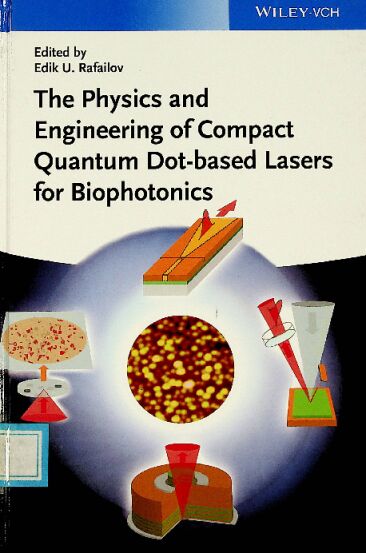
书名:The physics and engineering of compact quantum dot-based lasers for biophotonics
摘要
Written by a team of European experts in the field, this book addresses the physics, the principles, the engineering methods, and the latest developments of efficient and compact ultrafast lasers based on novel quantum-dot structures and devices, as well as their applications in biophotonics. Recommended reading for physicists, engineers, students and lecturers in the fields of photonics, optics, laser physics, optoelectronics, and biophotonics.
Dieses Buch befasst sich mit den physikalischen Prinzipien und technischen Methoden von effizienten und kompakten ultraschnellen Lasern, die auf neuartigen Quantenpunkt-Strukturen basieren, von den neuesten Entwicklungen bis zu den Anwendungen im Bereich der Biophotonik.
查看更多
前言
This is a unique book that covers abroad spectrum of work that includes theoretical and experimental details of recent results in the development of compact ultra-short-pulse lasers based on quantum-dot materials. It also reports the progress in some related new application areas.
Nanomaterials such as quantum dots are tiny clusters of semiconductor material with dimensions of only a few nanometers. These nanostructures are often called artificial atoms, because the charge carriers in these systems (electrons or holes) can only occupy a restricted set of energy levels, similar to the electrons in an atom. Such materials exhibit the ultimate in ultrafast recovery time under both gain and absorption conditions. The remarkable achievements in the epitaxial growth of quantum-dot structures have enabled fabrication with laser-compatible optical quality, which facilitates the generation of light with high efficiency. Owing to the control available using the latest growth techniques, the emission/absorption wavelengths can be engineered over wide latitude and this is exploited in a range of applications.
This book offers coverage of many of the recent results in the area of quantum-dot-based ultrafast lasers. It contains discussions of a new generation of compact and efficient laser sources, with accompanying descriptions on how these new lasers have been deployed in applications that are currently served by conventional, more bulky and expensive, ultrafast solid-state lasers. One such application sector is biomedical photonics, where compact simple-to-use sources are needed to enhance system-adoption in these new application areas and to move these newly emerging techniques toward the point of care. These advances offer the opportunity for the integration of these practical and efficient devices into sophisticated, minimally/noninvasive optical diagnostics and therapeutics.
March 2013 Professor Wilson Sibbett CBE, FRS, FRSE
University of St Andrews
School of Physics and Astronomy
查看更多
目录
Foreword IX
List of Contributors XI
Introduction 1
Edik U. Rafailov
References 5
1 Quantum Dot Technologies 7
Richard A. Hogg and Ziyang Zhang
1.1 Motivation for Development of Quantum Dots 7
1.2 Gain and Quantum Confinement in a Semiconductor Laser 7
1.2.1 Top-Down Approach 10
1.2.2 Bottom-Up Approach 13
1.3 Self-Assembled Quantum Dot Technology 14
1.3.1 Molecular Beam Epitaxy 14
1.3.2 Growth Modes 17
1.3.3 Quantum Dot Growth Dynamics 18
1.3.3.1 The Interaction of the Quantum Dot and the Wetting Layer 18
1.3.3.2 The Interaction of the Quantum Dot with Underlying Layers and Capping Layers 19
1.3.3.3 Growth Interruption 19
1.3.3.4 Arsenic Pressure 20
1.3.3.5 Growth Temperature 20
1.3.3.6 Growth Rate and Material Coverage 21
1.3.4 Quantum Dot Growth Thermodynamic Processes 21
1.4 Physics and Device Properties of S-K Quantum Dots 23
1.4.1 Temperature Insensitivity 23
1.4.2 Low Threshold Current Density 24
1.4.3 Material Gain and Modal Gain 25
1.4.4 Broad Spectral Bandwidth Devices and Spectral Coverage 25
1.4.5 Ultrafast Gain Recovery 29
1.5 Extension of Emission Wavelength of GaAs-Based Quantum Dots 31
1.5.1 Short-Wavelength Quantum Dot Light Emission 31
1.5.1.1 InP/GaInP Quantum Dots 31
1.5.1.2 Type II InAlAs/AlGaAs Quantum Dots 33
1.5.2 Long-Wavelength QD Light Emission 33
1.5.2.1 Low Growth Temperature InAs/GaAs Quantum Dots 34
1.5.2.2 InAs QDs Grown on an InGaAs Metamorphic Layer 34
1.5.2.3 InGaAsSb Capped InAs/GaAs Quantum Dots and InGaNAs Capped InAs/GaAs Quantum Dots 34
1.5.2.4 Bilayer InAs/GaAs QD Structures 34
1.5.2.5 Asymmetric Dot in WELL QD Structure 34
1.6 Future Prospects 36
Acknowledgments 37
References 37
2 Ultra-Short-Pulse QD Edge-Emitting Lasers 43
Stefan Breuer, Dimitris Syvridis, and Edik U. Rafailov
2.1 Introduction 43
2.2 Simulations 45
2.3 Broadly Tunable Frequency-Doubled EC-QD Lasers 48
2.4 Two-Section Monolithic Mode-Locked QD Lasers 52
2.4.1 Simultaneous GS and ES ML 53
2.4.2 QD Absorber Resistor-SEED Functionality 57
2.4.3 Pulse Width Narrowing due to GS Splitting 59
2.5 Tapered Monolithic Mode-Locked QD Lasers 61
2.5.1 High-Peak Power and Sub picosecond Pulse Generation 62
2.5.2 Suppression of Pulse Train Instabilities of Tapered QD-MLLs 69
2.6 QD-SOAs 71
2.6.1 Straight-Waveguide QD-SOAs 71
2.6.2 Tapered-Waveguide QD-SOAs 72
2.6.3 QD-SOA Noise 75
2.7 Pulsed EC-QD Lasers with Tapered QD-SOA 77
2.7.1 EC-MLQDL77
2.7.2 EC-MLQDL with Post amplification by Tapered QD-SOA 80
2.7.3 Wavelength-Tunable EC-MLQDL with Tapered QD-SOA 84
2.8 Conclusion 87
Acknowledgments 88
References 89
3 Quantum Dot Semiconductor Disk Lasers 95
Jussi Rautiainen, Mantas Butkus, and Oleg Okhotnikov
3.1 Introduction 95
3.2 General Concept of Semiconductor Disk Lasers 96
3.3 Toward Operation at the 1-1.3pm Spectral Range 98
3.4 Quantum Dots Growth and Characterization 98
3.5 Quantum Dots for Laser Application: From Edge Emitters to Disk Lasers 99
3.6 Details of the Quantum Dot Gain Media for Disk Cavity 99
3.6.1 1040nmDiskGain Design 101
3.6.2 1180nmDiskGain Structure 101
3.6.3 1260nmDiskGain Structure 101
3.6.4 Gain Medium Characterization at the Wafer Level 103
3.7 Disk Laser Performance 107
3.7.1 Gain Chip Assembly and Thermal Management 107
3.7.2 1040nmInGaAsDotDisk Laser 107
3.7.3 1180nmDisk Laser 108
3.7.4 1260nmQuantumDotDisk Laser 109
3.8 Tunable Quantum Dot Semiconductor Disk Laser 111
3.9 Second Harmonic Generation with Quantum Dot Disk Laser Cavity 111
3.9.1 Experimental Results 113
3.10 Disk Laser with Flip-Chip Design of the Gain Medium 114
3.10.1 Gain Structure Description 115
3.10.2 Experimental Results 115
3.11 Conclusions 116
Acknowledgments 116
References 116
4 Semiconductor Quantum-Dot Saturable Absorber Mirrors for Mode-Locking Solid-State Lasers 121
Valdas Pasiskevicius, Niels Meiser, Mantas Butkus, Bojan Resan, Kurt J. Weingarten, Richard A. Hogg, and Ziyang Zhang
4.1 Scope of the Chapter 121
4.2 Introduction 122
4.3 Quantum-Well Saturable Absorbers: Overview 123
4.4 Quantum-Dot Saturable Absorbers: Basic Principles and Fabrication Technologies 126
4.5 Quantum-Dot Saturable Absorbers for Mode-Locking of Solid-State Laser sat1um 132
4.5.1 QD-SAM Design and Characterization 132
4.5.2 QD-SAM Mode-Locked Yb: KYW Lasers 140
4.6 p-i-n Junction QD SESAMs and Their Applications 143
4.6.1 Cr: forsterite Laser Mode-Locked Using p-i-n QD SESAM 145
4.6.2 Nonlinear Reflectivity and Absorption Recovery Dynamics in p-i-n QD-SAM 147
4.7 InAs/GaAs QD-SAM for 10 GHz Repetition Rate Mode-Locked Laser at 1.55 μm 151
4.8 InP Quantum Dot Saturable Absorbers for Mode-Locking High-Repetition Rate Ti: sapphire Lasers 157
4.9 Conclusions 160
Acknowledgments 160
References 160
5 QD Ultrafast and Continuous Wavelength Laser Diodes for Applications in Biology and Medicine 171
Pablo Loza-Alvarez, Rodrigo Aviles-Espinosa, Steve J. Matcher, D. Childs, and Sergei G. Sokolovski
5.1 Compact Laser Systems for Nonlinear Imaging Applications 171
5.1.1 Introduction 171
5.1.1.1 The Multimodal Microscope 174
5.1.2 Microscopy Workstation Preparation for Infrared Wavelengths 176
5.1.2.1 Long-Term Exposure Effects on Living Samples at 1550 nm 178
5.1.3 Quantum-Dot-Based Optically Pumped Vertical Extended Cavity Surface-Emitting Lasers for Nonlinear Imaging 181
5.1.3.1 The Compact Femtosecond Semiconductor Disk Laser System 181
5.1.3.2 Nonlinear Imaging Tests 182
5.1.4 Future Prospects: Edge-Emitting Laser Prototypes for Nonlinear Imaging 188
5.1.4.1 Ultra-Short Pulsed Semiconductor Edge-Emitting Lasers 188
5.1.5 Conclusions 194
5.2 QD Devices and Their Application in Optical Coherence Tomography 196
5.2.1 Overview of Optical Coherence Tomography 196
5.2.2 SLD Devices 199
5.2.3 Broadband Gain Material 202
5.2.3.1 Use of QDs SLDs for Time-Domain OCT 204
5.2.4 Swept Lasers 206
5.2.5 The QD Swept Source Laser for OCT 209
5.2.6 Summary and Future Outlook 212
5.3 Infrared QD Laser Application in Cancer Photodynamic Therapy: Killing Tumor Cells without Photosensitizers 212
5.3.1 Introduction 213
5.3.2 Singlet Oxygen in Organic Solution 214
5.3.3 Laser-Induced 1O2 Production in Living Cells 216
5.3.4 Cytosolic Free Calcium Level and Ion Channel Activity under Laser Pulse 218
5.3.5 Laser-Triggered Cancer Cell Death 220
5.3.6 Conclusions and Future Perspectives 221
Acknowledgments 222
References 222
6 Conclusion and Future Perspectives 231
Edik U. Rafailov
Color Plates 233
Index 249
查看更多
作者简介
Professor Edik Rafailov has been engaged in the research and development of high-power cw and ultra-short pulse lasers, nonlinear and integrated optics since 1987. In 2005, he moved to Dundee University and established a new Photonics and Nanoscience group. He was previously a senior researcher at Ioffe Institute, St Petersburg, and a research fellow at the University of St Andrews. He has authored and co-authored over 250 articles in refereed journals and conference proceedings, and has co edited a book and four invited chapters, as well as invited talks at many conferences including CLEO, SPIE and IEEE. He also holds eight UK and two US patents. He is the coordinator of EU and UK EPSRC funded projects. His current research interests include novel high-power CW, short and ultrashort-pulse lasers, generation of UV/visible/IR and THz radiation, nano-structures, nonlinear optics and biophotonics.
查看更多
馆藏单位
中科院文献情报中心