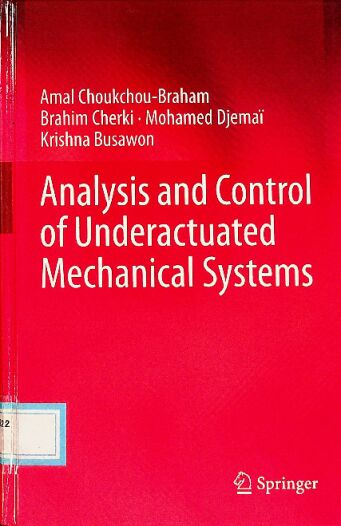
书名:Analysis and control of underactuated mechanical systems
责任者:Amal Choukchou-Braham | Brahim Cherki | Mohamed Djema | Krishna Busawon.
ISBN\ISSN:9783319026350,3319026356
摘要
This monograph provides readers with tools for the analysis, and control of systems with fewer control inputs than degrees of freedom to be controlled, i.e., underactuated systems. The text deals with the consequences of a lack of a general theory that would allow methodical treatment of such systems and the ad hoc approach to control design that often results, imposing a level of organization whenever the latter is lacking.
The authors take as their starting point the construction of a graphical characterization or control flow diagram reflecting the transmission of generalized forces through the degrees of freedom. Underactuated systems are classified according to the three main structures by which this is found to happen-chain, tree, and isolated vertex-and control design procedures proposed. The procedure is applied to several well-known examples of underactuated systems: acrobot; pendubot; Tora system; ball and beam; inertia wheel; and robotic arm with elastic joint.
The text is illustrated with MATLAB®/Simulink® simulations that demonstrate the effectiveness of the methods detailed.
Readers interested in aircraft, vehicle control or various forms of walking robot will be able to learn from Underactuated Mechanical Systems how to estimate the degree of complexity required in the control design of several classes of underactuated systems and proceed on to further generate more systematic control laws according to its methods of analysis.
查看更多
前言
An under actuated mechanical system (UMS) is a system that has fewer control inputs than degrees of freedom. In contrast, a fully actuated mechanical system is one that has the same number of actuators as degrees of freedom. Underactu-ated mechanical systems arise in many real-life applications such as aircrafts, he-li copters, spacecrafts, vertical take-off and landing aircrafts, underwater vehicles, mobile robots, walking robots, just to mention a few. Unlike fully actuated me-chanical systems, the control of UMSs is quite a challenging task because the latter present a restriction on the control authority that makes the control design for these systems rather complicated. Also, very often it gives rise to complex theoretical problems that are not found in fully actuated systems and that cannot be solved us-ing classical control techniques. In effect, some established results and properties of nonlinear systems such as feedback linearizability and passivity are no longer valid in the case of UMSs. Other undesirable properties like possessing an undetermined relative degree or being in an on-minimum phase are also customarily present in these systems. Moreover, several of these systems present a structural obstruction to the existence of smooth time invariant stabilizing control laws. Also, it is gener-ally not easy to determine the controllability, at least locally, for these systems and even when they are controllable, the control laws can be discontinuous, periodic, and variant in time.
The control of UMSs has been investigated for quite a long time in the control lit-erature and has been attracting more attention in recent years because of the growing interests in new robotic applications such as unmanned under actuated aerial or un-der water vehicles. Different control strategies have been proposed in the literature, including back stepping, sliding mode, intelligent control, and much more. Several authors have attempted to present a classification and a generalization of these sys-tems with the aim of proposing a systematic control design method for UMSs. De-spite the diversity and large amount of research on the topic, it is difficult to highlight the structural properties of UMSs in a sufficiently general and exploitable manner that allows an unified treatment for the latter. As a matter of fact, there is no general theory that allows to conduct a systematic analysis and synthesis of control design for all UMSs. This has been the main motivating factor for us to write this current monograph.
The book presents theoretical explorations on the fundamental classification methods that are available in the literature; namely, the control flow diagram (CFD) -based classification of Seto and Baillieu land the structural properties-based classifi-cation of Olfati-Saber. It also proposes some tools for the systematic control design for under actuated systems. It aims to present a reference material for researchers and students working in the field of under actuated mechanical control. As such, the book is primarily intended for researchers and engineers in the system and control community. It can also serve as a complementary reading for post-graduated stu-dents studying control system theory.
Tlemcen, Algeria Amal Choukchou-Braham
August 2013 Brahim Cherki
Mohamed Djemai
Krishna Busawon
查看更多
目录
1 Introduction 1
References 4
2 Generalities and State-of-the-Art on the Control of Under actuated Mechanical Systems 7
2.1 Under actuated Mechanical Systems:Generalities and Motivations 7
2.2 Brief State-of-the-Art on the UMSs Control 9
2.3 Scope and Objectives of This Book 10
References 11
3 Under actuated Mechanical Systems from the Lagrangian Formalism 15
3.1 Lagrangian System 15
3.2 Fully Actuated Mechanical Systems 17
3.3 Under actuated Mechanical Systems 17
3.4 Non-holonomic Mechanical Systems 18
3.5 Under actuation and Non-holonomy 19
3.6 Problematics Associated with UMSs 21
3.7 Partial Linearization by Feedback 23
3.7.1 Collocated Partial Linearization 24
3.7.2 Non-collocated Partial Linearization 24
3.7.3 Partial Linearization Under Coupled Inputs 25
3.8 Symmetry in Mechanics 26
3.9 Examples of Under actuated Mechanical Systems 27
3.9.1 The Cart-Inverted-Pendulum System 28
3.9.2 The Sliding Masson Cart System 28
3.9.3 The Tora System 29
3.9.4 The Acrobot and the Pendubot Systems 29
3.9.5 The Inertial Wheel Pendulum System 30
3.9.6 The Ball and Beam System 31
3.10 Summary 31
References 31
4 Classification of Underactuated Mechanical Systems 35
4.1 Classification of UMSs According to Seto and Baillieul 35
4.1.1 Principle of Control Flow Diagram 36
4.1.2 Examples 40
4.2 Classification of UMSs According to Olfati-Saber 43
4.2.1 Normal Forms of UMSs 44
4.2.2 UMSs with Two Degrees of Freedom 47
4.2.3 Classification of High-Order UMSs 49
4.3 Comparison Between the Classifications 51
4.4 Summary 53
References 54
5 Control Design Schemes for Under actuated Mechanical Systems 55
5.1 Stabilization of Under actuated Systems in Chained Form 55
5.2 Systematic Control of Systems Possessing a Tree Structure 65
5.2.1 Stabilization of UMSs Actuated Under Mode A1 65
5.2.2 Stabilization of UMSs Actuated Under Mode A2 78
5.3 Stabilization of UMSs with an Isolated Vertex Structure 82
5.3.1 Control Law via Approximate Linearization 83
5.3.2 Control Law via High Order Approximate Linearization 85
5.3.3 Application: The Ball and Beam System 85
5.4 Summary 88
References 90
Appendix A Theoretical Background of Nonlinear System Stability and Control 93
A.1 Stability of Systems 93
A.1.1 What to Choose? 94
A.1.2 The Lyapunov Stability Theory 94
A.1.3 Stability of Switching Systems 100
A.1.4 Stabilization of a System 105
A.2 Control Theory 105
A.2.1 Local Stabilization 106
A.2.2 Feedback Linearization 107
A.2.3 Few Words on Passivity 113
A.2.4 Back stepping Technique 114
A.2.5 Sliding Mode Control 116
A.2.6 Control Design Technique Based on the Switching Between Several Controllers 121
A.3 Summary 121
Appendix B Limits of Linearization and Dangers of Destabilization 123
Appendix C A Little Differential Geometry 127
Appendix D Controllability of Continuous Systems 129
D.1 Controllability of Linear Systems 129
D.1.1 Kalman Controllability Criterion 129
D.1.2 State Feedback Stabilization 130
D.2 Controllability Concepts for Nonlinear Systems 131
References 133
Index 137
查看更多
作者简介
Krishna Busawon: Faculty of Engineering and Environment, Northumbria University, Newcastle-upon-Tyne, United Kingdom
查看更多
馆藏单位
中科院文献情报中心