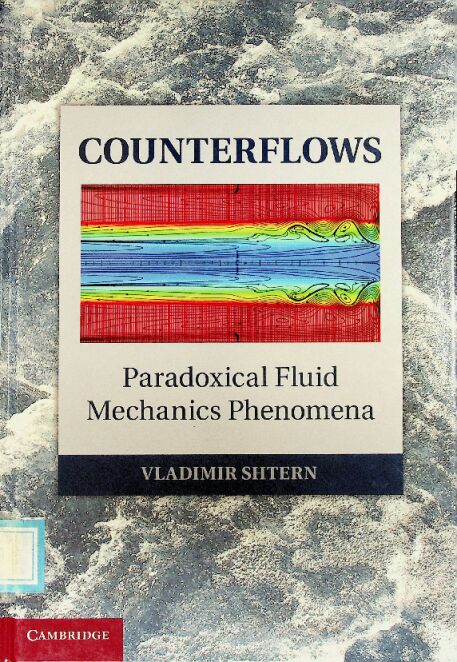
书名:Counterflows
责任者:Vladimir Shtern. | Shtern, V. N.
ISBN\ISSN:9781107027596,1107027594
出版时间:2012
出版社:Cambridge University Press,
摘要
This book discusses the physical mechanisms that drive counterflows, examining how they emerge, develop, become double and multiple counterflows and comprise both global and local circulations. Counterflows play an important role in nature and technology. A natural example is the Gulf Stream and the opposite flow in the ocean depths. Technological applications include hydrocyclones, vortex tubes and vortex combustors. These elongated counterflows are wildly turbulent but survive intense mixing, a seeming paradox. Local counterflows, whose spatial extent is small compared with that of surrounding flows, occur behind bluff bodies and in swirling streams. The latter are often referred to as vortex breakdown bubbles, which occur in tornadoes and above delta wings. Most scale counterflows are cosmic bipolar jets. Most miniature counterflows occur in capillary menisci of electrosprays and fuel atomisers.
查看更多
目录
Acknowledgments page xiii
1 Introduction 1
1.1. Natural and Technological Counterflows 1
1.2. Physical Mechanisms of Counterflows 2
1.2.1. Accumulation 2
1.2.2. Swirl Effect 4
1.2.3. Separation 7
1.2.4. Thermal Convection 8
1.3. Counterflow Applications, Control, and Stability 9
1.4. Approach 10
2 Accumulation Counterflows 11
2.1. Conical Similarity Flows 11
2.2. Conical Jets 13
2.2.1. Equation Reduction 13
2.2.2. Jet in the Free Space 14
2.2.3. Jet Above a Plane 15
2.3. Super-Collimated Jet 16
2.4. Capillary Jet 20
2.4.1. Features of Capillary Jets 20
2.4.2. Conical Similarity Model of the Meniscus Flow 22
2.4.3. Numerical Simulations of the Cone-Jet Flow 24
3 Bifurcation of Swirl in Conical Counterflows 28
3.1. Observations of Spontaneous Swirl Appearance 28
3.2. Bifurcation of Swirl as Symmetry Breaking 30
3.2.1. Reduction to a Boundary-Value ODE Problem 30
3.2.2. Necessary Conditions for Swirl Bifurcation 32
3.3. Swirl Appearance in Capillary Flows 33
3.3.1. Two-Medium Flows 33
3.3.2. Swirl Origination 34
3.3.3. Swirl Development 35
3.3.4. Two-Cell Circulation 37
3.3.5. Collimated Annular Jets 38
3.3.6. Swirl Bifurcation in the Meniscus Flow 40
3.4. Swirl Appearance in Electro-Vortex Flows 43
3.4.1. Problem Formulation 43
3.4.2. Forced Swirl 44
3.4.3. Multi-Cell Counterflows 46
3.4.4. Self-Swirling 51
3.5. Mechanism of Swirl Appearance in Conical Flows 56
3.5.1. Comparison of Self-Swirling Capillary and Electro-Vortex Flows 56
3.5.2. Mechanism of Swirl Accumulation 56
3.5.3. Destroyed Bifurcation 58
4 Bifurcation of Counter-Swirl 60
4.1. Outline of Stability and Bifurcation Features 60
4.2. Parallel Jetlike Flows 62
4.3. Secondary Flows 62
4.4. The Lyapunov-Schmidt Method 63
4.5. Bifurcations in the Jetlike Flows 66
4.6. MHD Flow in an Annular Pipe 68
4.7. Solving Stability Problems for Large Re 68
4.8. Bifurcations in the Annular-Pipe Flows 70
5 Conical Counterflows Driven by Swirl 73
5.1. Swirling Jet Above a Plane 73
5.1.1. Reduction to a Boundary-Value ODE Problem 73
5.1.2. Asymptotic Analysis of Two-Cell Flow 75
5.1.3. Hysteresis 79
5.1.4. Vortex Breakdown 83
5.1.5. Vortex Consolidation 85
5.1.6. Cusp Catastrophe 87
5.1.7. Near-Plane Outflow 90
5.2. A Half-Line Vortex in a Free Space 92
5.2.1. Tornado and Delta-Wing Vortices 92
5.2.2. Multiple Solutions 94
5.2.3. Modeling Turbulent Vortex Breakdown 98
5.3. Swirling Jets in Conical Regions 98
5.3.1. Suction Devices and Their Modeling 98
5.3.2. Asymptotic Analysis 100
5.3.3. Decomposition of the Flow Force 102
5.3.4. Descending One-Cell Flow 103
5.3.5. Ascending One-Cell Flow 106
5.3.6. Flow Inside the 0c=45° Cone 107
5.3.7. Flow Outside the0c=45° Cone 109
5.3.8. Pressure Peak in Swirling Annular Jets 112
5.4. Super-Collimation in Swirling Counterflows 114
5.4.1. Bipolar Jet Induced by Vortex-Sink Accretion 114
5.4.2. Analysis of Super-Collimation 115
5.4.3. Vortex-Wall Interaction as a Model Tornado 118
6 Jetlike Swirling Counterflows 122
6.1. Power-Law Jets 122
6.1.1. Introduction 122
6.1.2. Problem Formulation 123
6.1.3. Features of Power-Law Jets 125
6.2. Analytical Modeling of Multiple Counterflows 132
6.2.1. Motivation 132
6.2.2. Generalized Vortex Sink 134
6.2.3. Shape of the Surface of Revolution 136
6.2.4. Inner Solutions 139
6.2.5. Composite Vortex Sink 142
6.2.6. Applications of the Generalized Vortex Sink 148
6.2.7. Applications of the Composite Solutions 152
6.3. Swirling Counterflows in a Capillary Meniscus 160
6.3.1. Effects of Swirling Gas Jet 160
6.3.2. Analysis of Changing Flow Topology 164
7 Swirling Counterflows in Cylindrical Devices 168
7.1. Swirl-Decay Mechanism 168
7.1.1. Elongated Counterflows 168
7.1.2. Problem Formulation 168
7.1.3. Modeling Swirl Decay 170
7.1.4. Velocity Profiles 172
7.1.5. Pressure Distribution 173
7.1.6. End-Wall Effects 175
7.2. Modeling Counterflows in Vortex Separators 177
7.2.1. Introduction 177
7.2.2. Two Flow Components 178
7.2.3. Core Flow Features 181
7.2.4. Flow Approximation Near End Walls 184
7.2.5. Particle Trajectories 185
7.2.6. Pressure Distribution 187
7.2.7. Centrifugal Stratification 188
7.2.8. Summary of the Asymptotic Analysis 189
7.3. Numerical Study of Vortex Breakdown and Double Counterflow 190
7.3.1. Technological Importance of Local and Global Circulations 190
7.3.2. Formulation of the Numerical Problem 190
7.3.3. Development of Global Counterflow as Swirl Number Increases 192
7.3.4. Development of Global Counterflow as Re Increases 193
7.3.5. Comparison with the Asymptotic Theory 194
7.3.6. Vortex Breakdown Development 196
7.3.7. Double Counterflow Development 199
7.3.8. Summary of Double Counterflow Features 205
7.4. Double Counterflow in a Vortex Trap 206
7.4.1. Technological Importance of Vortex Traps 206
7.4.2. Development of a Global Counterflow 207
7.4.3. Analytical Approximation of the Global Counterflow in the Vortex Trap 209
7.4.4. Solid Particle Trajectory in the Single Counterflow 210
7.4.5. Double Counterflow in the Vortex Trap 212
7.4.6. Solid Particle Trajectories in the Double Counterflow 213
7.4.7. Development of Karman Vortex Street 216
7.4.8. Summary of the Vortex Trap Features 217
8 Separation Counterflows 219
8.1. Counterflows in a Plane Diverging Channel 219
8.1.1. Brief Literature Review 219
8.1.2. Problem Formulation 220
8.1.3. Patterns of Jeffery-Hamel Counterflows 221
8.1.4. Scaling
8.1.5. Counting
8.2. Counterflows Due to Bifurcations of Vortex Source Flow 225
8.2.1. Equations for Disturbances 225
8.2.2. Bifurcation Character 227
8.2.3. Phase Pattern and Asymptotic Features 228
8.2.4. Spiral Vortices 229
8.3. Stability of Plane Counterflows 233
8.3.1. Approach 233
8.3.2. Stability of Vortex-Source Flow 235
8.3.3. Spatial Stability of the Jeffery-Hamel Flow 236
8.4. Transition Flows 238
8.4.1. Jet in the Sink Flow 238
8.4.2. Tripolar Jet 240
8.4.3. Attachment Flow in the Diverging Channel 242
8.4.4. Jet Emerging from a Slit in a Wall 243
8.4.5. Jet Emerging from a Thin Plane Channel 245
8.5. Summary of Plane Counterflow Features 247
8.5.1. Spatial Instability 247
8.5.2. Further Applications 248
8.5.3. Limitations 250
8.6. Counterflows Due to Internal Separation in Spatial Conical Flows 250
8.6.1. Introduction 250
8.6.2. Governing Equations 252
8.6.3. Basic Flows 253
8.6.4. Experiment 254
8.6.5. Linear Stability Approach 256
8.6.6. Instability of the Squire-Wang Flow 257
8.6.7. Instability of Divergent Flow in a Conical Region 259
8.6.8. Instability of Marangoni Flow 260
8.6.9. Concluding Remarks 264
9 Temperature Distribution in Swirling Counterflows 266
9.1. Temperature Distribution in Conical Similarity Jets 266
9.1.1. Reduction of the Heat Equation 266
9.1.2. Point Source of Heat in the Landau Jet 267
9.1.3. Point Source of Heat in the Half-Line Vortex 267
9.1.4. Point Source of Heat in Long's Jet 270
9.1.5. Heat Transfer in a Near-Wall Jet 273
9.1.6. Summary of the Heat Transfer Features in Conical Swirling Counterflows 279
9.2. Temperature Distribution in Generalized Vortex-Sink 280
9.2.1. Reduction of Energy Equation 280
9.2.2. Axisymmetric Temperature Distribution 281
9.2.3. Spiral Thermal Distribution 281
9.2.4. Species Distribution 283
9.2.5. Three-Dimensional Temperature Distribution 284
9.3. Temperature Distribution in a Cylindrical Counterflow 285
10 Onset of Buoyancy Similarity Counterflows 288
10.1. Development of Conical Buoyancy Bipolar Jets 288
10.1.1. Introduction 288
10.1.2. Problem Formulation 289
10.1.3. Instability of the Rest State 290
10.1.4. Weakly Nonlinear Analysis of Convection Onset 292
10.1.5. Development of Bipolar Convection via Hysteresis 294
10.1.6. Development of Strong Jets 296
10.1.7. Effects of Swirl on the Jets 300
10.1.8. Stability of Conical Buoyancy-Driven Flows 303
10.1.9. Concluding Remarks 306
10.2. Onset of Keplerian Buoyancy Flows 308
10.2.1. Introduction 308
10.2.2. Similarity Family 309
10.2.3. Keplerian Convection 311
10.2.4. Infinitesimal Disturbances of the Equilibrium State 312
10.2.5. Critical Rayleigh Numbers for Convection Onset 313
10.2.6. Neutral Modes for a Few Small Values of Racr 313
10.2.7. Concluding Remarks 314
11 Thermal Convection Counterflows 316
11.1. Model of a Free Convection Near a Black Smoker 317
11.1.1. Reduction of the Boussinesq Equations 317
11.1.2. Flow Features at Pr=0 318
11.1.3. Super-Collimation 319
11.2. Model of a Free Convection Near a Volcano 321
11.2.1. Reduction of the Boussinesq Equations 321
11.2.2. Flow Features at Pr=0 321
11.2.3. Super-Collimation 324
11.2.4. Thermal Quadruple on the Horizontal Wall 326
11.2.5. Convection Inside a Conical Crater 329
11.3. Centrifugal Convection 330
11.3.1. Introduction 330
11.3.2. Problem Formulation 331
11.3.3. Parallel Flow 332
11.3.4. End-Wall Effect 336
11.3.5. Rapid Rotation 338
11.4. Centrifugal Convection of a Perfect Gas 339
12 Control of Vortex Breakdown 342
12.1. Introduction 342
12.2. Experimental Study of VB Control 344
12.2.1. Experimental Setup and Technique 344
12.2.2. Co-rotation 346
12.2.3. Counter-rotation 351
12.2.4. Concluding Remarks 356
12.3. Numerical Study of VB Control by Temperature Gradients 357
12.3.1. Problem Formulation 357
12.3.2. Numerical Procedure 358
12.3.3. Centrifugal Convection in a Rotating Container 359
12.3.4. Control of VB by Thermal Convection 360
12.3.5. Suppressing VB by Centrifugal Convection for Other Flow Configurations 367
12.3.6. Effects of Gravitational Convection 368
12.3.7. Conclusions 368
12.4. VB Control by Adding Near-Axis Swirl and Temperature Gradients 369
12.4.1. Vortex Breakdown Control by Adding Near-Axis Rotation 369
12.4.2. Near-Axis Rotation and Axial Temperature Gradient 374
12.5. Concluding Remarks 377
13 Magnetic Counterflows 379
13.1. Problem Formulation 379
13.1.1. Governing Equations 379
13.1.2. Bifurcation in a Planar Sink Flow 380
13.1.3. Reduction of the MHD Equations 381
13.1.4. Linear Problem for a Swirl-Free Flow 382
13.2. Magnetic Field Bifurcation in the Bipolar Accretion Flow 383
13.2.1. Flow Map 383
13.2.2. Nonlinear MHD Problem 383
13.2.3. Asymptotic MHD Flow as Re→∞ 384
13.2.4. Bifurcation of Magnetic Field in a Super-Collimated Flow 385
13.3. Magnetic Field Bifurcation in the Bipolar Vortex-Sink Accretion Flow 386
13.3.1. Flow Map 386
13.3.2. Analytical Solution 388
13.3.3. Development of Hysteresis 390
13.4. Magnetic Field Bifurcation Near a Point Source of Heat and Gravity 390
13.4.1. Linear Problem 390
13.4.2. Super-Collimated Convection 395
13.4.3. MHD Bifurcation in the Super-Collimated Convection 396
13.4.4. Nonlinear MHD Problem 397
13.4.5. Swirling MHD Flows 398
13.4.6. Separated Branches of MHD Convection 399
13.4.7. Features of MHD Flows 401
13.5. Instability Nature of MHD Bifurcation 403
13.5.1. Formulation of the Stability Problem 403
13.5.2. Linear Stability 404
13.5.3. Nonlinear Stability 405
13.5.4. Physical Interpretation 406
13.6. Bifurcation of Magnetic Field in an Electro-Vortex Flow 407
13.6.1. Problem Formulation 407
13.6.2. Bifurcation of the Meridional Induction 408
13.6.3. Bifurcation in the Super-Collimated Flow 409
14 Stability of Conical Flows 411
14.1. Formulation of the Stability Problem 411
14.1.1. Transformation of Governing Equations 411
14.1.2. Equations for Infinitesimal Disturbances 413
14.1.3. Boundary Conditions 414
14.1.4. Eigenvalue Problem 415
14.2. Stability of the Fluid at Rest 416
14.2.1. Modified Equations for Disturbances 416
14.2.2. Spectrum for the Unbounded Still Fluid 416
14.2.3. Spectrum for a Conical Region 419
14.3. Instability Nature of Folds and Hysteresis in Swirl-Free Jets 421
14.3.1. Multiple Flow States in Swirl-Free Jets 421
14.3.2. Fold-Catastrophe Instability 423
14.3.3. Space-Oscillatory Instability 426
14.4. Deceleration Instability of Jets 430
14.4.1. Review of Stability Studies 430
14.4.2. Stability of Swirl-Free Jets 431
14.5. Instability of Swirling Jets 439
14.5.1. Stability of One-Cell Flows 439
14.5.2. Stability of Two-Cell Flows 442
14.6. Instability Nature of Swirl Bifurcation 445
14.6.1. One-Phase Flow in a Capillary Meniscus 445
14.6.2. Two-Phase Flow 446
14.6.3. Instability of the Flow Driven by Electric Current 447
14.7. Instability of Flows Diverging Near a Surface 447
14.7.1. Azimuthal Instability of the Squire-Wang Flow 447
14.7.2. Diverging Electro-Vortex Flow 448
14.7.3. Flow Near a Glacier 449
14.8. Concluding Remarks 451
14.8.1. Inner and Outer Modes 451
14.8.2. The Role of Similarity 452
14.8.3. Unsteadiness 453
14.8.4. Deceleration Instability 453
References 457
Index 467
查看PDF
查看更多
作者简介
Dr Vladimir Shtern is an applied mathematician. He received his PhD (1970), Doctor of Sciences (1978) and Professor (1990) degrees from the Institute of Thermal Physics in Novosibirsk, Russia. He has worked at the University of Houston (1990–2003), the University of Seville (1993–1994), the DLR Institute of Fluid Mechanics in Gottingen, Germany (1994–1995), the University of Bristol (1997) and as the Senior Scientist of General Vortex Energy Inc. in Missouri City, Texas (2008–2010). He has also served as a consultant for Shell US and BP-Amoco Exploration. Dr Shtern is a specialist in fluid mechanics and heat transfer with a focus on vortex flows, thermal convection, combustion, hydrodynamic instability and bifurcation theory. His results include analytical solutions of the Navier–Stokes, Boussinesq, MHD and compressible gas equations, and explaining mechanisms of intriguing and practically important flow effects, such as multiple solutions, hysteretic transitions and vortex breakdown among others. Dr Shtern is an author of three books and more than one-hundred papers in referred archival journals.
查看更多
馆藏单位
中科院文献情报中心