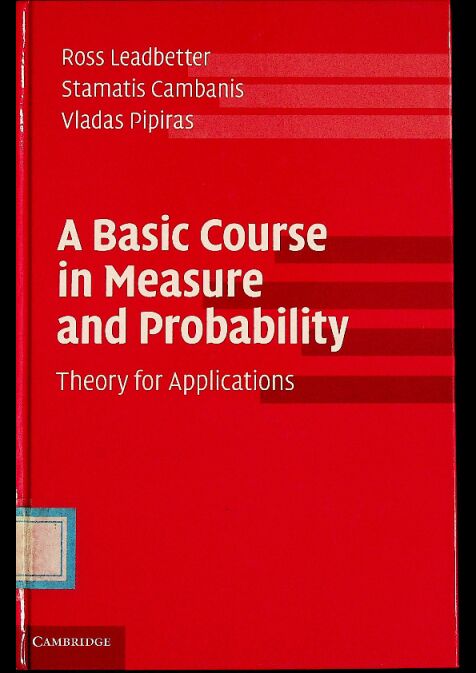
书名:A basic course in measure and probability
责任者:Ross Leadbetter | University of North Carolina | Chapel Hill | Stamatis Cambanis | University of North Carolina | Chapel Hill | Vladas Pipiras | University of North Carolina | Chapel Hill.
ISBN\ISSN:9781107020405,9781107652521
出版时间:2014
出版社:Cambridge University Press,
前言
Originating from the authors' own graduate course at the University of North Carolina, this material has been thoroughly tried and tested over many years, making the book perfect for a two-term course or for self-study. It provides a concise introduction that covers all of the measure theory and probability most useful for statisticians, including Lebesgue integration, limit theorems in probability, martingales, and some theory of stochastic processes. Readers can test their understanding of the material through the 300 exercises provided. The book is especially useful for graduate students in statistics and related fields of application (biostatistics, econometrics, finance, meteorology, machine learning, and so on) who want to shore up their mathematical foundation. The authors establish common ground for students of varied interests which will serve as a firm 'take-off point' for them as they specialize in areas that exploit mathematical machinery.
查看更多
目录
Preface page ix
Acknowledgements xiii
1 Point sets and certain classes of sets 1
1.1 Points, sets and classes 1
1.2 Notation and set operations 2
1.3 Elementary set equalities 5
1.4 Limits of sequences of sets 6
1.5 Indicator (characteristic) functions 7
1.6 Rings, semirings, and fields 8
1.7 Generated rings and fields 11
1.8 σ-rings, σ-fields and related classes 13
1.9 The real line - Borel sets 16
Exercises 18
2 Measures: general properties and extension 21
2.1 Set functions, measures 21
2.2 Properties of measures 23
2.3 Extension of measures, stage 1: from semiring to ring 27
2.4 Measures from outer measures 29
2.5 Extension theorem 31
2.6 Completion and approximation 34
2.7 Lebesgue measure 37
2.8 Lebesgue-Stieltjes measures 39
Exercises 41
3 Measurable functions and transformations 44
3.1 Measurable and measure spaces, extended Borel sets 44
3.2 Transformations and functions 45
3.3 Measurable transformations and functions 47
3.4 Combining measurable functions 50
3.5 Simple functions 54
3.6 Measure spaces, "almost everywhere" 57
3.7 Measures induced by transformations 58
3.8 Borel and Lebesgue measurable functions 59
Exercises 60
4 The integral 62
4.1 Integration of nonnegative simple functions 62
4.2 Integration of nonnegative measurable functions 63
4.3 Integrability 68
4.4 Properties of the integral 69
4.5 Convergence of integrals 73
4.6 Transformation of integrals 77
4.7 Real line applications 78
Exercises 80
5 Absolute continuity and related topics 86
5.1 Signed and complex measures 86
5.2 Hahn and Jordan decompositions 87
5.3 Integral with respect to signed measures 92
5.4 Absolute continuity and singularity 94
5.5 Radon-Nikodym Theorem and the Lebesgue decomposition 96
5.6 Derivatives of measures 102
5.7 Real line applications 104
Exercises 112
6 Convergence of measurable functions, Lp-spaces 118
6.1 Modes of pointwise convergence 118
6.2 Convergence in measure 120
6.3 Banach spaces 124
6.4 The spaces Lp 127
6.5 Modes of convergence - a summary 134
Exercises 135
7 Product spaces 141
7.1 Measurability in Cartesian products 141
7.2 Mixtures of measures 143
7.3 Measure and integration on product spaces 146
7.4 Product measures and Fubini's Theorem 149
7.5 Signed measures on product spaces 152
7.6 Real line applications 153
7.7 Finite-dimensional product spaces 155
7.8 Lebesgue-Stieltjes measures on Rn 158
7.9 The space (RT, BT) 163
7.10 Measures on RT, Kolmogorov's Extension Theorem 167
Exercises 170
8 Integrating complex functions, Fourier theory and related topics 177
8.1 Integration of complex functions 177
8.2 Fourier-Stieltjes, and Fourier Transforms in L1 180
8.3 Inversion of Fourier-Stieltjes Transforms 182
8.4 "Local" inversion for Fourier Transforms 186
9 Foundations of probability 189
9.1 Probability space and random variables 189
9.2 Distribution function of a random variable 191
9.3 Random elements, vectors and joint distributions 195
9.4 Expectation and moments 199
9.5 Inequalities for moments and probabilities 200
9.6 Inverse functions and probability transforms 203
Exercises 204
10 Independence 208
10.1 Independent events and classes 208
10.2 Independent random elements 211
10.3 Independent random variables 213
10.4 Addition of independent random variables 216
10.5 Borel-Cantelli Lemma and zero-one law 217
Exercises 219
11 Convergence and related topics 223
11.1 Modes of probabilistic convergence 223
11.2 Convergence in distribution 227
11.3 Relationships between forms of convergence 235
11.4 Uniform integrability 238
11.5 Series of independent r.v.'s 241
11.6 Laws of large numbers 247
Exercises 249
12 Characteristic functions and central limit theorems 254
12.1 Definition and simple properties 254
12.2 Characteristic function and moments 258
12.3 Inversion and uniqueness 261
12.4 Continuity theorem for characteristic functions 263
12.5 Some applications 265
12.6 Array sums, Lindeberg-Feller Central Limit Theorem 268
12.7 Recognizing a c.f. - Bochner's Theorem 271
12.8 Joint characteristic functions 277
Exercises 280
13 Conditioning 285
13.1 Motivation 285
13.2 Conditional expectation given a σ-field 287
13.3 Conditional probability given a σ-field 291
13.4 Regular conditioning 293
13.5 Conditioning on the value of a r.v. 300
13.6 Regular conditional densities 303
13.7 Summary 305
Exercises 306
14 Martingales 309
14.1 Definition and basic properties 309
14.2 Inequalities 314
14.3 Convergence 319
14.4 Centered sequences 325
14.5 Further applications 330
Exercises 337
15 Basic structure of stochastic processes 340
15.1 Random functions and stochastic processes 340
15.2 Construction of the Wiener process in R[0, 1] 343
15.3 Processes on special subspaces of RT 344
15.4 Conditions for continuity of sample functions 345
15.5 The Wiener process on C and Wiener measure 346
15.6 Point processes and random measures 347
15.7 A purely measure-theoretic framework for r.m.'s 348
15.8 Example: The sample point process 350
15.9 Random element representation of a r.m. 351
15.10 Mixtures of random measures 351
15.11 The general Poisson process 353
15.12 Special cases and extensions 354
References 356
Index 357
查看更多
馆藏单位
中科院文献情报中心