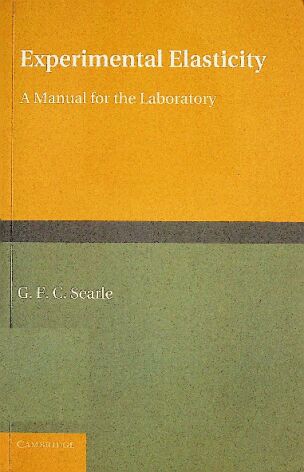
书名:Experimental elasticity
责任者:G. F. C. Searle. | Searle, G. F. C.
出版时间:2013
出版社:Cambridge University Press,
前言
G. F. C. Searle (1864–1954) was a British physicist who made notable contributions to the development of laboratory physics and theories of electromagnetic mass. First published in 1933, as the second edition of a 1908 original, this book was based on the manuscript notes prepared by Searle for the use of students attending his practical physics classes at the Cavendish Laboratory, Cambridge. The first chapter contains an account of the elements of the mathematical theory of elastics; the second chapter provides mathematical solutions for some simple elastic problems which regularly appear in experiments; the third chapter contains descriptions of a number of experiments together with such necessary mathematical discussions as are not given in the first two chapters. This book will be of value to anyone with an interest in experimental physics and the pedagogy of physics.
查看更多
目录
CHAPTER I
ELEMENTARY THEORY OF ELASTICITY
1 Introduction 1
2 Hooke'sLaw 2
3 Necessity for a theory of elasticity 2
4 Action and reaction between two parts of a body 3
5 Stress 5
6 Measurement of stresses 5
7 Hydrostatic pressure 6
8 Strain. 7
9 Expansion and compression 7
10 Shear. 8
11 Maximum shear in actual experiments 9
12 Results for infinitesimal shears 9
13 Bulk modulus or volume elasticity 10
14 Rigidity 11
15 Stresses on the diagonal planes of a sheared cube 13
16 Alternative method of producing as hear 14
17 Young's modulus 15
18 Poisson's ratio 17
19 Relations between elastic constants. 18
20 Isothermal and adiabatic elasticities 20
21 Ratio of adiabatic to isothermal elasticity 22
22 Difference between reciprocals of isothermal and adiabatic elasticities 25
CHAPTER II SOLUTIONS OF SOME SIMPLE ELASTIC PROBLEMS
23 Practical applications of the theory of elasticity 30
24 Principle of Saint-Venant. 31
25 Dr Filon's results for tension 32
26 Dr Filon's results for torsion 36
UNIFORM BENDING OF A RoD
27 Introduction 38
28 Strain and stress in a uniformly bent rod 39
29 Change of cross-section due to bending 40
30 Position of the neutral flament 46
3l Bending moment 47
32 Removal of the“body forces”. 48
33 Case of a rod 49
34 Case of a blade. 50
UNIFORM BENDING OF A BLADE
35 Introduction 52
36 Position of neutral f laments 54
37 Bending moment 56
38 Change of type of bending 57
UNIFORM TORSION OF ARoUND RoD
39 Relation between torsional couple and twist 58
40 Rods of non-circular section 60
41 Practical approximation 62
UNIFORM TORSION OF A BLADE
42 Introduction 63
43 Geometry of a heli co id 63
44 Stresses in a twisted blade 66
45 Determination of the torsional couple 68
CHAPTER III EXPERIMENTAL WORK IN ELASTICITY
46 Introduction 71
Experiment 1. Experimental investigation of Hooke'slaw for copper
47 Introduction 72
48 Apparatus 74
49 Experiments on loading and unloading a copper wire 77
50 Graphical representation of deviations from Hooke'slaw 78
51 Practical example 79
Bx periment 2.Determination of Young's modulus by stretching a vertical wire
52 Apparatus 80
53 Determination of Young's modulus 81
54 Practical example 85
Experiment 3. Determination of Young's modulus by stretching a horizontal wire
55 Apparatus 86
56 Determination of Young's modulus 87
57 Notes on the method 88
58 Practical example 89
Experiment 4. Determination of rigidity Static al method
59 Apparatus 90
60 Determination of rigidity 91
61 Practical example 94
Experiment 5. Determination of rigidity Dynamical method
62 Apparatus 95
63 Determination of rigidity 97
64 Practical example 99
Experiment 6. Determination of Young's modulus by
uniform bending of a rod. Static al method
65 Apparatus 100
66 Determination of Young's modulus. 102
67 Mirror method of determining curvature. 104
68 Practical example 106
Experiment 7. Determination of Young's modulus by uniform bending of a rod Dynamical method
69 Determination of Young's modulus. 107
70 Experimental details. 110
71 Practical example 111
E periment 8. Comparison of elastic constants Dynamical method
72 Method 112
73 Practical er ample 114
Experiment 9. Determination of Poisson's ratio by the bending of a rectangular rod
74 Introduction 114
75 Determination of Poisson's ratio 118
76 Practical example 119
Experiment 10. Determination of Young's modulus by non-uniform bending of a rod
77 Introduction 119
78 Approximate results for non-uniform bending. 121
79 Cartesian expression for curvature 124
80 Apparatus. 126
81 Depression at centre of rod 127
82 Slope at end of rod. 129
83 Determination of Young's modulus 130
84 Practical example 131
85 Introduction 132
86 Determination of rigidity 132
87 Practical exar ple 134
Experiment 12. Determination of E/(1-2) by the uniform bending of a blade
88 Introduction 135
89 Apparatus 136
90 Determination of E(1-0') 138
91 Calculation of E and of o 139
92 Practical example 139
Experiment 13. Test of Lord Rayleigh's reciprocal relations
93 Introduction 141
94 Work done by forces. 143
95 Lord Rayleigh's reciprocal relations 145
96 Apparatus 147
97 Test of first reciprocal relation. 148
98 Test of third reciprocal relation 149
99 Practical example 150
Experiment 14.Measurement of the energy dissipated through torsional hysteresis
100 Introduction 152
101 Energy dissipated per cycle 154
102 Apparatus 155
103 Experimental details 157
104 Practical example 159
Note I. Reduction of a group of forces to a single force and a couple. 162
Note II. D'Alembert's principle 162
Note III. Motion of a rigid body
1 Acceleration of the centre of gravity 163
2 Angular acceleration of a rigid body turning about afx ed axis 164
Note IV. Moments of inertia
1 Definition 165
2 Some properties of moments of inertia 165
3 Theorem of parallel axes 166
4 Moments of inertia of a thin rod 166
5 Moments of inertia of a rectangular lamina 167
6 Moments of inertia of a rectangular block 167
7 Moments of inertia of a circular lamina 167
8 Moments of inertia of an elliptical lamina 168
9 Moment of inertia of a sphere 168
10 Moments of inertia of an ellipsoid 168
11 Moments of inertia of a circular cylinder. 169
12 “Moments of inertia”of areas. 169
13 Angular momentum of a rigid body turning about afx edaxis. 170
14 Kinetic energy of a rigid body turning about an xed axis 170
Note V. Harmonic motion
1 Rectilinear motion 171
2 Motion about a fixed axis. 172
Note VI. Corrections for variations in the radius of a wire
1 Young's modulus. 172
2 Rigidity 173
Note VII. On inertia bars 174
Note VIII. Work done by a couple 175
Note IX. Trapezoidal rule for the measurement of areas 176
Not eX. Hints on practical work in physics
1 Failures 178
2 Observations 178
3 The recording of observations 179
4 Arithmetical reduction of observations 180
5 Diagram 8 182
6 Notebooks. 182
7 General remarks. 182
Note XI. Maximum elevation at centre of rodin ExPERIMENT 184
Not eXIL Theory of infinitesimal uniform bending of a rod 184
INDEX 187
查看更多
馆藏单位
中科院文献情报中心