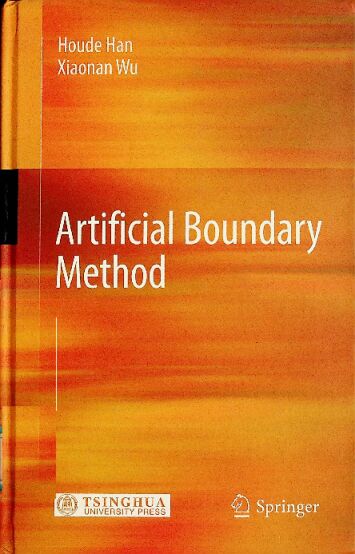
书名:Artificial boundary method
责任者:Houde Han | Xiaonan Wu.
ISBN\ISSN:9783642354632,9787302303909
出版时间:2013
出版社:Tsinghua University Press ;,Springer ;
前言
The artificial boundary method is an effective numerical method for solving partial differential equations on unbounded domains by applying artificial boundary conditions (ABCs) on the boundaries of the reduced bounded domains. With more than 30 years development, the artificial boundary method has reached maturity in recent years. It has been applied to various problems in scientific and engineering computations, and theoretical issues such as the convergence and error estimates of the artificial boundary method have been solved gradually. Based on the research works by the authors over many years and the works by other researchers, we have collected the methods and theories of the artificial boundary method and have presented them in this book.
The partial contents of this book were taught in the fall, 2005 and the spring, 2007 in the Department of Mathematical Sciences of Tsinghua University and the Department of Mathematics of University of Science and Technology of China, respectively.
This book has nine chapters, as listed below.
Chapter 1: Global ABCs for the Exterior Problem of Second Order Elliptic Equations
Chapter 2: Global ABCs for the Navier System and Stokes System
Chapter 3: Global ABCs for Heat and Schrödinger Equations
Chapter 4: Absorbing Boundary Conditions for Wave Equation, Klein-Gordon Equation, and Linear KdV Equation
Chapter 5: Local ABCs
Chapter 6: Discrete ABCs
Chapter 7: Implicit ABCs
Chapter 8: Nonlinear ABCs
Chapter 9: Applications to Problems with Singularity
We have striven for accuracy and elegance in writing the book. However, errors are inevitable. We would be most grateful to learn of any errors in the book for the revision of future printing.
This book has benefited from works of other researchers, including our co-authors: Long-An Ying, Weizhu Bao, Zhongyi Huang, Chunxiong Zheng, Zhizhong Sun, Jicheng Jin, Dongsheng Yin, and Zhenli Xu. Professor Hermann Brunner has read through all the chapters of this book, and made numerous suggestions for improving the manuscript. We wish to express our appreciation afor his kind help.
查看更多
目录
Introduction 1
References 5
Chapter 1 Global ABCs for Second Order Elliptic Equations 9
1.1 Exterior Problem of Second Order Elliptic Equations 9
1.2 Global ABCs for the Exterior Problem of 2-D Poisson Equation 13
1.2.1 Steklov-Poincaré Mapping for the Exterior Problem of Laplace Equation 14
1.2.2 The Reduced Boundary Value Problem on 17
1.2.3 Finite Element Approximation of the Reduced Boundary Value Problem (1.2.30)~(1.2.32) 21
1.3 Global ABCs for the Exterior Problems of 3-D Poisson Equation 26
1.3.1 Exact and Approximate ABCs on the Spherical Artificial Boundary 26
1.3.2 Equivalent and Approximate Boundary Value Problems on the Bounded Computational Domain 30
1.3.3 Finite Element Approximation of the Variational Problem (1.3.30) 34
1.4 Exterior Problem of the Modified Helmholtz Equation 37
1.4.1 Global Boundary Condition of the Exterior Problem for the 2-D Modified Helmholtz Equation 37
1.4.2 The Reduced Boundary Value Problem on the Computational Domain 39
1.4.3 Finite Element Approximation of the Reduced Boundary Value Problem 45
1.4.4 Global Boundary Condition of the Exterior Problem for the 3-D Modified Helmholtz Equation 47
1.5 Global ABCs for the Exterior Problems of the Helmholtz Equation 49
1.5.1 Dirichlet to Sommerfeld Mapping of the Exterior Problem of the 2-D Helmholtz Equation 49
1.5.2 Dirichlet to Sommerfeld Mapping of the Exterior Problem of the 3-D Helmholtz Equation 55
References 58
Chapter 2 Global ABCs for the Navier System and Stokes System 61
2.1 Navier System and Stokes System 61
2.2 The Exterior Problem of the 2-D Navier System 64
2.2.1 The Global Boundary Condition on the Artificial Boundary 65
2.2.2 The Reduced Problem on the Bounded Domain 71
2.2.3 The Finite Element Approximation for the Reduced Problem (2.2.59) 77
2.3 Exterior Problem of the 2-D Stokes System 79
2.3.1 Highly Accurate Approximate Artificial Boundary Condition 80
2.3.2 Finite Element Approximation on the Computational Domain for the Reduced Problem 84
2.4 Vector Fields on the Spherical Surface 91
2.5 Global ABCs for the Exterior Problem of 3-D Navier System 96
2.5.1 Highly Accurate Approximate ABCs 96
2.5.2 Finite Element Approximation of the Variational Problem on the Bounded Computational Domain 100
References 111
Chapter 3 Global ABCs for Heat and Schrödinger Equations 115
3.1 Heat Equations on Unbounded Domains 115
3.2 1-D Heat Equations on Unbounded Domains 117
3.2.1 Exact Boundary Conditions on the Artificial Boundary 117
3.2.2 Finite Difference Approximation for the Reduced Problem (3.2.7)~(3.2.10) 119
3.2.3 Stability Analysis of Scheme (3.2.29)~(3.2.33) 126
3.3 Global Boundary Conditions for Exterior Problems of 2-D Heat Equations 131
3.3.1 Exact and Approximate Conditions on the Artificial Boundary 132
3.3.2 Finite Difference Approximation of the Reduced Problem (3.3.37)~(3.3.40) 138
3.4 Global Boundary Conditions for Exterior Problems of 3-D Heat Equations 140
3.4.1 Exact and Approximate Conditions on the Artificial Boundary 140
3.4.2 Stability Analysis for the Reduced Initial Boundary Value Problem 147
3.4.3 The Finite Element Approximation for the Reduced Initial Boundary Value Problem (3.4.38)~(3.4.41) 150
3.5 Schrödinger Equation on Unbounded Domains 151
3.6 1-D Schrödinger Equation on Unbounded Domains 152
3.6.1 The Reduced Initial Value Problem and its Finite Difference Approximation 153
3.6.2 Stability and Convergence Analysis of Scheme (3.6.19)~(3.6.22) 158
3.7 The Global Boundary Condition for the Exterior Problem of the 2-D Linear Schrödinger Equation 166
3.7.1 Exact and Approximate Boundary Conditions on the Artificial Boundary 167
3.7.2 Stability Analysis of the Reduced Approximate Initial Boundary Value Problem 172
3.8 The Global Boundary Condition for the Exterior Problem of the 3-D Linear Schrödinger Equation 175
3.8.1 Exact and Approximate Boundary Conditions on the Artificial Boundary R 176
3.8.2 Stability Analysis of the Reduced Approximate Initial Boundary Value Problem 183
References 187
Chapter 4 ABCs for Wave Equation, Klein-Gordon Equation, and Linear KdV Equations 189
4.1 1-D Wave Equation 189
4.1.1 Transparent Boundary Conditions on the Artificial Boundaries and 190
4.2 2-D Wave Equation 192
4.2.1 Absorbing Boundary Conditions 193
4.2.2 The Initial Boundary Value Problem on the Bounded Computational Domain D i 200
4.3 3-D Wave Equation 203
4.3.1 Absorbing Boundary Condition on the Artificial Boundary 204
4.3.2 The Equivalent and Approximate Initial Boundary Value Problem on the Bounded Computational Domain D_i 208
4.4 1-D Klein-Gordon Equation 209
4.4.1 Absorbing Boundary Conditions on the Artificial Boundary 210
4.4.2 The Initial Boundary Value Problem on the Bounded Computational Domain D_i 212
4.5 2- and 3-D Klein-Gordon Equations 214
4.5.1 Absorbing Boundary Conditions on the Artificial Boundary R (2-D case) 215
4.5.2 Absorbing Boundary Conditions on the Artificial Boundary R (3-D case) 220
4.5.3 The Initial Boundary Value Problem on the Bounded Computational Domain D i 223
4.6 Linear KdV Equation 224
4.6.1 Absorbing Boundary Condition on the Artificial Boundaries Σ-a and Σ-b 225
4.6.2 The Equivalent Initial Boundary Value Problem on the Bounded Computational Domain 227
4.7 Appendix: Three Integration Formulas 228
References 232
Chapter 5 Local Artificial Boundary Conditions 233
5.1 Local Boundary Conditions for Exterior Problems of the 2-D Poisson Equation 234
5.1.1 Local Boundary Condition on the Artificial Boundary 234
5.1.2 Finite Element Approximation Using the Local Boundary Condition and its Error Estimate 236
5.2 Local Boundary Conditions for the 3-D Poisson Equation 241
5.2.1 The Local Boundary Condition on the Artificial Boundary for Problem (I) 242
5.2.2 Local Boundary Conditions on the Artificial Boundary for Problem (II) 250
5.3 Local ABCs for Wave Equations on Unbounded Domains 254
References 257
Chapter 6 Discrete Artificial Boundary Conditions 259
6.1 Boundary Condition on a Polygon Boundary for the 2-D Poisson Equation—The Method of Lines 260
6.1.1 Discrete Boundary Conditions on Polygonal Boundaries 260
6.1.2 Numerical Approximation of the Exterior Problem (6.1.1)~(6.1.3) 268
6.2 2-D Viscous Incompressible Flow in a Channel—Infinite Difference Method 270
6.2.1 2-D Viscous Incompressible Flow in a Channel 270
6.2.2 Discrete ABCs 272
6.3 Numerical Simulation of Infinite Elastic Foundation—Infinite Element Method 278
6.3.1 The Steklov-Poincarè on an Artificial Boundary of Line Segments 279
6.3.2 Numerical Approximation for the Bilinear Form B(u, v) 281
6.3.3 A Direct Method for Solving the Infinite System of Algebraic Equations (6.3.25) 284
6.3.4 A Fast Iteration Method for Computing the Combined Stiffness Matrix K Z 289
6.4 Discrete Absorbing Boundary Condition for the 1-D Klein-Gordon Equation—Z transform method 292
6.4.1 Z Transform 292
6.4.2 Discrete Absorbing ABC 294
6.4.3 Finite Difference Approximation for the 1-D Klein-Gordon Equation on the Bounded Domain 296
References 297
Chapter 7 Implicit Artificial Boundary Conditions 299
7.1 Implicit Boundary Condition for the Exterior Problem of the 2-D Poisson Equation 300
7.1.1 The Single and Double Layer Potential, and Their Derivative for the 2-D Laplace Equation 300
7.1.2 The Derivation of the Implicit ABC for the Exterior Problem of the 2-D Poisson Equation 305
7.1.3 The Finite Element Approximation and Error Estimate for the Variational Problem (7.1.37) 309
7.2 Implicit Boundary Condition for the Exterior Problem of the 3-D Poisson Equation 310
7.3 ABC for the Exterior Problem of the Helmholtz Equation 316
7.3.1 The Normal Derivative on A for the Double Layer Potential of the Helmholtz Equation 318
7.4 Implicit ABCs for the Exterior Problems of the Navier System 321
7.4.1 Fundamental Solution, Stress Operator, Single and Double Layer Potentials 321
7.4.2 New Forms of T(s x , n x )v II (x) on A (n = 2) 323
7.4.3 New Forms of T(s x , n x )v II (x) on A (n = 3) 328
7.4.4 Implicit ABC for the Exterior Problem 333
7.5 Implicit ABCs for the Sound Wave Equation 336
7.5.1 The Kirchhoff Formula for the 3-D Sound Wave Equation 337
References 338
Chapter 8 Nonlinear Artificial Boundary Conditions 341
8.1 The Burgers Equation 342
8.1.1 Nonlinear ABCs for the Burgers Equation 343
8.1.2 The Equivalent Initial Boundary Value Problem on the Bounded Computational Domain D_i 346
8.2 The Kardar-Parisi-Zhang Equation 348
8.2.1 Nonlinear ABC for the K-P-Z Equation (D = 1) 349
8.2.2 Nonlinear ABC for the K-P-Z Equation (D = 2) 350
8.2.3 Nonlinear ABC for the K-P-Z Equation (D = 3) 353
8.3 The Cubic Nonlinear Schrödinger Equation 354
8.3.1 Nonlinear Boundary Conditions on the Artificial Boundaries Σ_0 and Σ_-1 355
8.3.2 The Equivalent Initial Boundary Value Problem on the Bounded Domain [–1, 0] × [0, T] 356
8.4 Operator Splitting Method for Constructing Approximate Nonlinear ABCs 358
8.4.1 The Local Absorbing ABC for the Linear Schrödinger Equation 359
8.4.2 Finite Difference Approximation on the Bounded Computational Domain 360
References 362
Chapter 9 Applications to Problems with Singularity 365
9.1 The Modified Helmholtz Equation with a Singularity 366
9.1.1 ABC Near Singular Points 367
9.1.2 An Iteration Method Based on the ABC 368
9.2 The Interface Problem with a Singularity 373
9.2.1 A Discrete Boundary Condition on the Artificial Boundary 374
9.2.2 Finite Element Approximation 379
9.3 The Linear Elastic Problem with a Singularity 380
9.3.1 Discrete Boundary Condition on the Artificial Boundary 382
9.3.2 An Iteration Method Based on the ABC 390
9.4 The Stokes Equations with a Singularity 393
9.4.1 The Discrete Boundary Condition on the Artificial Boundary 394
9.4.2 Singular Finite Element Approximation 403
References 406
Bibliography 409
查看更多
馆藏单位
中科院文献情报中心