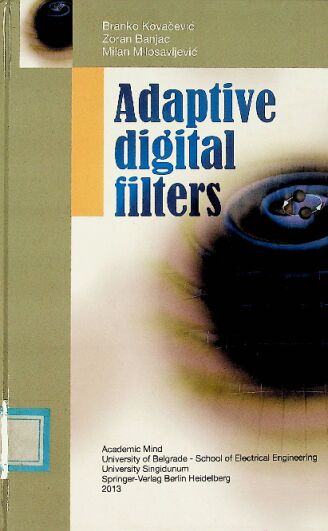
书名:Adaptive digital filters
责任者:Branko Kovaevi | Zoran Banjac | Milan Milosavljevi.
ISBN\ISSN:9783642335600,9788674664346
出版时间:2013
出版社:Springer ;,Academic Mind,
摘要
"Adaptive Digital Filters" presents an important discipline applied to the domain of speech processing. The book first makes the reader acquainted with the basic terms of filtering and adaptive filtering, before introducing the field of advanced modern algorithms, some of which are contributed by the authors themselves. Working in the field of adaptive signal processing requires the use of complex mathematical tools. The book offers a detailed presentation of the mathematical models that is clear and consistent, an approach that allows everyone with a college level of mathematics knowledge to successfully follow the mathematical derivations and descriptions of algorithms.
The algorithms are presented in flow charts, which facilitates their practical implementation. The book presents many experimental results and treats the aspects of practical application of adaptive filtering in real systems, making it a valuable resource for both undergraduate and graduate students, and for all others interested in mastering this important field.
查看更多
前言
The book Adaptive Digital Filters appeared as a result of years of cooperation between the Department for Signal Processing within the Institute of Applied Mathematic and Electronics, Belgrade, Serbia and the Division for Automation that has later evolved to the present Department for Signals and Systems within the School of Electrical Engineering, University of Belgrade. This cooperation started back in mid-1970s, with a goal to research the phenomenon of speech and has continued up until present days. Among important results of joint science research in the fields of modeling, analysis, processing, recognition, and transmission of speech signals are, besides mathematical algorithms, program packages, technical solutions, and electronic instruments, also numerous research papers, either pub-lished in leading international science journals or presented in proceedings of prestigious international science conferences. Since the very inception of their cooperation the Institute and the School introduced a custom to inform a wider circle of domestic researchers and experts, as well as the students of mathematics, electrical engineering, computing, and related areas about the most important results of their joint projects. This goal was usually achieved by publishing science monographs in Serbian language, and this was the way two science monographs appeared, "Speech signal processing and recognition" (a group of authors from the Institute and the School, published by the Center of High Military Schools, Bel-grade, 1993) and "Robust digital processing of speech signals" (published by Academic Mind, Belgrade, 2000). It is important to mention here that the quoted publications were preceded by a number of master theses and doctoral disserta-tions. In this way, this book represents a continuation of the good practice intro-duced by the Institute and the School and presents the results of joint research within the past decade. The youngest author of this book, Dr. Zoran Banjac, finished his master's thesis and doctoral dissertation in the course of his work within these projects. The aim and the stance of this book was maybe best defined by its reviewers, professors at the School of Electrical Engineering, the University of Belgrade, professors Ljiljana Milić and Dušan Drajić, who wrote in the con-clusion of their review: "The monograph Adaptive Digital Filters presents to our scientific and expert community an important discipline which has been under-represented prior to the appearance of this book. The book first makes the reader acquainted with the basic terms of filtering and adaptive filtering, to further introduce the reader into the field of advanced modern algorithms, some of which represent a contribution of the authors of the book. The work in the field of adaptive signal processing requires the use of a complex mathematical apparatus. The manner of exposition in this book presumes a detailed presentation of the mathematical models, a task done by the authors in a clear and consistent way. The chosen approach enables everyone with a college level of mathematics knowledge to successfully follow the mathematical derivations and descriptions of algorithms in the book. The algorithms a represented by flowcharts, which facilitates their practical implementation. The book gives many experimental results and treats the aspects of practical application of adaptive filtering in real systems. The book will be useful both to students of undergraduate and graduate studies, and to all of those who did not have an opportunity to master this important science field during their formal education".
The authors would like to express their gratitude to the referees for their useful suggestions and advices which contributed significantly to the quality of the book.
The text of the book is divided into six chapters.
The first, introductory chapter, considers generally three most often used theoretical approaches to the design of linear filters—the conventional approach, the optimal filtration, and the adaptive filtration. The further text analyzes only the third approach, i.e., the adaptive filtration.
Chapter 2 presents the basic structures of adaptive filters. It also considers the criterion function for the optimization of the parameters of adaptive filters and analyzes the two basic numerical methods for the determination of the minimum of the criterion function: the Newton method and the method of steepest descent. After presenting the basic concept of adaptive filtering, it overviews the standard and the derived adaptive algorithms of the Least Mean Square Error—LMS type and Recursive Least Square—RLS algorithm, for the sake of further analysis and estimation of the possibilities to modify them in order to improve the character-istics of the mentioned adaptive algorithms. Also, potential advantages of the Infinite Impulse Response—IIR filters impose a need for their more intensive use, as well as for the analysis of the adaptation of the proposed solution for the systems with Finite Impulse Response—FIR systems, as well as for the IIR sys-tems. This is the reason why in the second chapter care has been given to this problem too.
An analysis of the ability of adaptive algorithms to follow nonstationary changes in the system, together with the synthesis of efficient algorithms based on variable forgetting factor, is presented in Chap. 3. A comparison has been made among a number of strategies for the choice of forgetting factor (extended pre-diction error, parallel adaptation, and Fortecue-Kershenbaum-Ydstie algorithm) against their ability to follow nonstationary changes and the complexity of the implementation of algorithms. The most convenient strategies for the choice of variable forgetting factor from the practical point of view were emphasized.
Chapter 4 presents an original approach to the design of an FIR-type adaptive algorithm with a goal to increase the convergence speed in the parameter esti-mation process. The approach is based on an optimum approach to the construction of input signal, which belongs to the D-class of optimal experiment planning. The properties of the proposed algorithm were subsequently analyzed through the practical problem of local echo cancellation in scrambling systems. Besides that, a possibility has been shown to apply this approach in nonstationary environments through the application of a convenient strategy for the choice of variable forgetting factor.
Robustification of adaptive algorithms against impulsive nonstationary noise in the desired response is considered in Chap. 5. An original robust algorithm based on the LMS approach is presented and an analysis is given of the possibility to apply D-optimal input to the robust recursive least squares algorithm in order to improve the convergence speed. After that a robust RLS algorithm is introduced with a recursive estimation of scaling factors for the case when besides the impulsive noise sudden changes of the system dynamics also occur. Besides that, another novel algorithm is presented which besides its robust properties against impulse noise also has the ability to track nonstationary changes of the values of estimated parameters. Contrary to the previous algorithm, the proposed approach is based on the design of robust detector of impulse noise, based on the design of robust median filter and the application of either robust or standard RLS-type procedure to the estimation of filter parameters, depending on the detection result.
Chapter 6 is dedicated to the analysis of the possibility to apply the proposed adaptive digital filters for signal echo cancellation in telecommunication networks.
Let us notice at the end that the algorithms and solutions considered in this book may find application in the wider area of adaptive signal processing, like adaptive cancellation of echo signal, adaptive noise cancellation, adaptive equalization, as well as in processing of signals with various physical nature (speech and image signals, biomedical signals, signals from radars, sonars, satellites, and other intelligent sensors.
Belgrade, May 2012 The Authors
查看更多
目录
1 Introduction 1
1.1 Conventional Approach to the Design of Digital Filters 1
1.2 Optimal Filters 9
1.2.1 Wiener Filter 9
1.2.2 Kalman Filter 16
1.3 Adaptive Filters 27
2 Adaptive Filtering 31
2.1 Introduction 31
2.2 Structures of Digital Filters 31
2.2.1 Filters with Infinite Impulse Response (IIR Filters) 32
2.2.2 Filters with Finite Impulse Response (FIR Filters) 34
2.3 Criterion Function for the Estimation of FIR Filter Parameters 36
2.3.1 Mean Square Error (Risk) Criterion:MSE Criterion 37
2.3.2 Minimization of the Criterion of Mean Square Error (Risk) 39
2.4 Adaptive Algorithms for the Estimation of Parameters of FIR Filters 45
2.4.1 Least Mean Square (LMS) Algorithm 46
2.4.2 Least Squares Algorithm (LS Algorithm) 49
2.4.3 Recursive Least Squares (RLS) Algorithm 51
2.4.4 Weighted Recursive Least Squares (WRLS) Algorithm with Exponential Forgetting Factor 53
2.5 Adaptive Algorithms for the Estimation of the Parameters of IIR Filters 59
2.5.1 Recursive Prediction Error Algorithm (RPE Algorithm) 67
2.5.2 Pseudo-Linear Regression (PLR) Algorithm 72
3 Finite Impulse Response Adaptive Filters with Variable Forgetting Factor 75
3.1 Choice of Variable Forgetting Factor 75
3.1.1 Choice of Forgetting Factor Based on the Extended Prediction Error 76
3.1.2 Fortescue-Kershenbaum-Yds tie Algorithm 78
3.1.3 Parallel Adaptation Algorithm (PA-RLS Algorithm) 86
3.1.4 Generalized Weighted Least Squares Algorithm with Variable Forgetting Factor 93
3.1.5Modified Generalized Likelihood Ratio: MGLR Algorithm 96
3.2 Experimental Analysis 101
3.2.1 Comparative Analysis of Recursive Algorithms for the Estimation of Variable Forgetting Factor (Analysis of RLS Algorithm with EGP, FKY and PA Strategy for the Calculation of Variable Forgetting Factor) 101
4 Finite Impulse Response Adaptive Filters with Increased Convergence Speed 109
4.1 Definition of the Parameter Identification Problem 110
4.2 Finite Impulse Response Adaptive Filters with Optimal Input 112
4.3 Convergence Analysis of Adaptive Algorithms 115
4.4 Application of Recursive Least Squares Algorithm with Optimal Input for Local Echo Cancellation in Scrambling Systems 131
4.4.1 Definition of the Local Echo Cancellation Problem in Scrambling Systems 133
4.4.2 Experimental Analysis 134
4.5 Application of Variable Forgetting Factor to Finite Impulse Response Adaptive Filter with Optimal Input 139
5 Robustification of Finite Impulse Response Adaptive Filters 147
5.1 Robust Least Mean Square Algorithm 149
5.1.1 Robustification of Least Mean Square Algorithm: Robust LMS Algorithm 152
5.1.2 Stability Analysis of Robust Estimators 155
5.1.3 Simulation-Based Experimental Analysis 158
5.2 Robust Recursive Least Squares Algorithm with Optimal Output 162
5.2.1 Experimental Analysis 168
5.3 Adaptive Estimation of the Scaling Factor in Robust Algorithms 170
5.3.1 Experimental Analysis 177
5.4 Robust Recursive Least Squares Algorithm with Variable Forgetting Factor and with Detection of Impulse Noise 180
5.4.1 Experimental Analysis 184
6 Application of Adaptive Digital Filters for Echo Cancellation in Telecommunication Networks 187
6.1 Echo: Causes and Origins 189
6.1.1 Echo in Speech Transmission 189
6.1.2 Acoustic Echo 191
6.1.3 Echo in Data Transfer 192
6.1.4 Basic Principles of Adaptive Echo Cancellation 193
6.2 Mathematical Model of an Echo Cancellation System 196
6.3 Analysis of the Influence of Excitation Signal to the Performance of Echo Cancellation System for Speech Signal Transmission 197
References 205
Index 209
查看更多
作者简介
Milan Milosavljević: University of Belgrade, Belgrade, Serbia
查看更多
馆藏单位
中科院文献情报中心