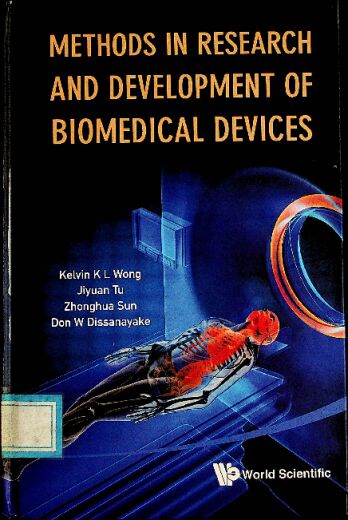
书名:Methods in research and development of biomedical devices
责任者:Kelvin K.L. Wong ... [et al.].
ISBN\ISSN:9789814434997,981443499X
出版时间:2013
出版社:World Scientific,
摘要
This book presents a road map for applying the stages in conceptualization, evaluation, and testing of biomedical devices in a systematic order of approach, leading to solutions for medical problems within a well-deserved safety limit. The issues discussed will pave the way for understanding the preliminary concepts used in modern biomedical device engineering, which include medical imaging, computational fluid dynamics, finite element analysis, particle image velocimetry, and rapid prototyping. This book would undoubtedly be of use to biomedical engineers, medical doctors, radiologists, and any other professionals related to the research and development of devices for health care.
查看更多
目录
Foreword v
Preface ix
Acknowledgments xi
1 Introduction 1
1.1 Overview of Research and Development Processes 1
1.2 Questions 6
2 Overview of Biomedical Technologies 7
2.1 Classification of Biomedical Devices 7
2.2 Description of Biomedical Devices 7
2.2.1 Aneurysmal Stents 9
2.2.2 Endovascular Stents 10
2.2.3 Biomedical MEMS Micropump 11
2.2.4 Drug Delivery Devices 13
2.3 Summary 15
2.4 Questions 15
3 Conceptualisation and Medical Image-Based Modelling 17
3.1 CAD Modelling and Design Realisation 17
3.1.1 Prosthetic Heart Valve 17
3.1.2 Endovascular Stent Grafts 18
3.1.3 Biomedical MEMS Micropump 19
3.2 Medical Imaging and Reconstruction 23
3.2.1 Computed Tomography 24
3.2.2 Virtual Intravascular Endoscopy 25
3.2.3 CT Reconstruction of the Nasal Cavity, Pharynx and Larynx 26
3.2.4 Magnetic Resonance Imaging 28
3.3 Mechanical Prototyping 29
3.3.1 Rapid Prototyping by Stereolithography 30
3.3.2 Technical Limitations 32
3.4 Summary 34
3.5 Questions 35
4 Medical Imaging and Visualisation 37
4.1 Computed Tomography 37
4.2 VJ.rtual Intravascular Endoscopy 38
4.2.1 Generation and Presentation of VIE 41
4.2.2 Generation of VIE lmages 42
4.2.3 Threshold Range Along the Abdominal Aorta 42
4.2.4 Optimal Threshold Selection 43
4.2.5 Generation of VIE Images with Aortic Stent and Artery Lumen Together 44
4.2.6 Aortic Stent Wire Thickness on VIE Images 47
4.2.7 lmage Display and Interpretation 47
4.3 Optimal CT Scanning Protocols for VIE Visualisation 51
4.4 Summary 54
4.5 Questions 54
5 Treatment or Aneurysms 55
5.1 Introduction 55
5.2 Open Surgery 56
5.3 Minimally Invasive Techniques 57
5.4 Medical lmage Visualisation 58
5.5 Technical Limitations 60
5.6 Medical lmaging and Geometrical Reconstruction 60
5.7 Conformance with Preliminary Concept 65
5.8 Summary 66
5.9 Questions 67
6 Endovascular Stent Grafts 69
6.1 Review of Device 69
6.1.1 What Is a Stent Graft? 70
6.1.2 Why Endovascular Repair? 71
6.2 Technical Developments 71
6.2.1 Suprarenal Stent Grafts 72
6.2.2 Fenestrated Stent Grafts 73
6.3 Technical Success 76
6.4 Long-term Outcomes 76
6.5 Computational Modelling 78
6.5.1 CFD of Suprarenal Stent Grafts 78
6.5.1.1 Configuration of Stent Wires Crossing the Renal Artery Ostium 79
6.5.1.2 Segmentation of CT Volume Data 79
6.5.1.3 Generation of Aorta Mesh Models 80
6.5.1.4 Simulation of Suprarenal Slent Wires Crossing the Renal Artery Ostium 81
6.5.1.5 Compulational Two-Way Fluid Solid Dynamics 83
6.5.1.6 CFO Analysis 84
6.5.2 CFO of Fenestrated Stenl Grafls 84
6.5.2.1 Simulation of Fenestrated Renal Stents 86
6.5.2.2 Numerical Verification 86
6.5.2.3 Computational Two-Way Fluid Solid Dynamics and Analysis 86
6.6 Summary 87
6.7 Questions 88
7 Nasal Drug Delivery 89
7.1 Review of Device 89
7.2 Computational Modelling 93
7.2.1 Geometrical Meshing . 93
7.2.2 Physiological Boundary Conditions 95
7.2.3 Simulating Flow in the Nasal Cavity . 97
7.3 Assessment of Modelling and Optimjsation 101
7.3.1 Insertion Angle 101
7.3.2 Full Spray Cone Angle 103
7.3.3 Implications for Nasal Drug Delivery 107
7.4 Summary 107
7.5 Questions 110
8 Biomedical MEMS Micropump 111
8.1 Review of Device 111
8.2 Biomedical Applications of MEMS Micropumps 112
8.2.1 Potential Drug Delivery Applications 112
8.2.2 Other Potential Applications 113
8.3 Numerical Modelling of Micropumps 114
8.4 Operating Principle of an Example Micropump 115
8.5 Theoretical Analysis 115
8.5.1 Actuation Force 117
8.5.2 Microfluidic Pressure Variation 117
8.6 Model Development of an Example Micropump 118
8.7 Modelling and Simulation 119
8.8 FEA-based CFD Simulations 121
8.8.1 Inlet and Outlet Flow Characteristics 123
8.8.2 Flow Rate Estimation 124
8.9 Summary 126
8.10 Questions 126
9 Engineering and Production Management for Biomedical Devices 127
9.1 Overview of Product Development Strategy 127
9.1.1 Product Conceptualisation 129
9.1.2 Market Survey and Strategic Alliances 129
9.1.3 Design, Prototyping and Product Development 130
9.1.4 Testing and Commissioning 132
9.1.5 Technology Protection 132
9.1.6 Marketing and Sales 133
9.2 Product Development Management System 134
9.2.1 Systematic Management 134
9.2.2 Standard Operation Procedures 134
9.2.3 Material Resource Planning 135
9.3 Organisation Charts 135
9.4 Project Management 139
9.4.1 Fundamentals of Project Management 140
9.4.2 Project Life Cycle 142
9.4.3 Project Management Team 1 43
9.5 Summary 146
9.6 Questions 147
Bibliography 149
Answers to Chapter Questions 169
Index 175
查看更多
馆藏单位
中科院文献情报中心