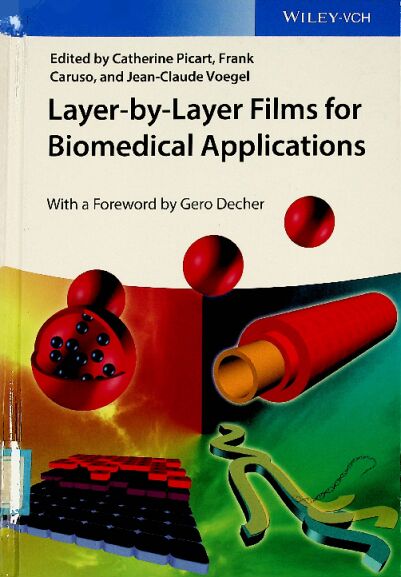
书名:Layer-by-layer films for biomedical applications
责任者:Catherine Picart | Frank Caruso | and Jean-Claude Voegel. | Voegel, Jean-Claude,
ISBN\ISSN:9783527335893,3527335897
摘要
The layer-by-layer (LbL) deposition technique is a versatile approach for preparing nanoscale multimaterial films: the fabrication of multicomposite films by the LbL procedure allows the combination of literally hundreds of different materials with nanometer thickness in a single device to obtain novel or superior performance. In the last 15 years the LbL technique has seen considerable developments and has now reached a point where it is beginning to find applications in bioengineering and biomedical engineering.
The book gives a thorough overview of applications of the LbL technique in the context of bioengineering and biomedical engineering where the last years have witnessed tremendous progress. The first part familiarizes the reader with the specifics of cell-film interactions that need to be taken into account for successful application of the LbL method in biological environments. The second part focuses on LbL-derived small drug delivery systems and antibacterial agents, and the third part covers nano- and microcapsules as drug carriers and biosensors. The fourth and last part focuses on larger-scale biomedical applications of the LbL method such as engineered tissues and implant coatings.
查看更多
前言
The layer-by-layer field has been exponentially growing since its beginning in the early 1990s as judged by the number of publications, communications at international conferences, and groups from around the world who are now contributing to developments in the field.Thanks to the enthusiasm and energy of Gero Decher and Joe Schlenoff, a first book on Multilayer Thin Films: Sequential Assembly of Composite Materials was published in 2006. In view of the great success of this book, the second edition of the book was edited in 2011, with a revision and extension to two volumes. As described in the online version, this book is “a comprehensive summary of layer-by-layer assembled, truly hybrid nanomaterials and thin films, covering organic, inorganic, colloidal, macromolecular, and biological components, as well as the assembly of nanoscale films derived from them on surfaces.” Today, the layer-by-layer field has spread to a large number of subfields, from the fundamental understanding of film growth and properties to applications in specific areas such as energy, functional coatings, and liquid and gas filtration. The idea for a complementary book specifically focused on biomedical applications arose in 2010, after several important developments in films, capsules, and free-standing membranes in relation to bioactive molecules, drug delivery, and tissue engineering. Several successful reviews were published during this period, which highlighted the possibilities of layer-by-layer films for biomedical applications.
In March 2011, a layer-by-layer symposium organized by Gero Decher and colleagues was held in Strasbourg, France, where it was highlighted that the biological applications of layer-by-layer materials were rapidly growing. In June 2014, a new symposium organized by Svetlana Sukhisvili and Mike Rubner gathered the community in Hoboken near New York. This meeting again highlighted the important developments in the biomedical field.
In this book, our aim is to show the wide potential of multilayers in the biomedical field and also to promote the potential of the technology among biomedical students, teachers, and researchers. We believe that this book may become a textbook for biomedical students and attract new groups to work in the field and to develop the field further. Future advancements in this area are to develop multilayers that can be effectively translated into the clinic and ultimately used to treat patients.
We are pleased to have edited this book. We are honored that so many contributors from all over the world have accepted our invitation and took time to write significant contributions.
We look forward to future exciting and fruitful developments of layer-by-layer assembled materials in the biomedical fields. We also believe that layer-by-layer assembly will complement the range of model materials for fundamental studies on cellular processes and will provide new and well-defined systems to contribute to the development of new therapeutic and imaging systems.
查看更多
目录
Foreword XVII
Preface XIX
About the Editors XXI
List of Contributors XXIII
Part I: Control of Cell/Film Interactions 1
1 Controlling Cell Adhesion Using pH-Modified Polyelectrolyte Multilayer Films 3
Marcus S. Niepel, Kristin Kirchhof, Matthias Menzel, Andreas Heilmann, and Thomas Groth
1.1 Introduction 3
1.2 Influence of pH-Modified PEM Films on Cell Adhesion and Growth 5
1.2.1 HEP/CHI Multilayers 5
1.2.2 PEI/HEP Multilayers 16
1.3 Summary and Outlook 24
Acknowledgments 25
References 25
2 The Interplay of Surface and Bulk Properties of Polyelectrolyte Multilayers in Determining Cell Adhesion 31
Joseph B. Schlenoff and Thomas C.S. Keller
2.1 Surface Properties 33
2.2 Bulk Modulus 38
References 42
3 Photocrosslinked Polyelectrolyte Films of Controlled Stiffness to Direct Cell Behavior 45
Naresh Saha, Claire Monge, Thomas Boudou, Catherine Picart, and Karine Glinel
3.1 Introduction 45
3.2 Elaboration of Homogeneous Films of Varying Rigidity 48
3.3 Elaboration of Rigidity Patterns 52
3.4 Behavior of Mammalian Cells on Homogeneous and Photopatterned Films 54
3.5 Influence of Film Rigidity on Bacterial Behavior 58
3.6 Conclusion 61
Acknowledgments 61
References 62
4 Nanofilm Biomaterials: Dual Control of Mechanical and Bioactive Properties 65
Emmanuel Pauthe and Paul R. Van Tassel
4.1 Introduction 65
4.2 Surface Cross-Linking 67
4.3 NP Templating 69
4.4 Discussion 73
4.5 Conclusions 75
Acknowledgments 75
References 75
5 Bioactive and Spatially Organized LbL Films 79
Zhengwei Mao, Shan Yu, and Changyou Gao
5.1 Introduction 79
5.2 Role of Chemical Properties 80
5.2.1 Bulk Composition 80
5.2.1.1 Introducing Natural Polyelectrolytes as Building Blocks 80
5.2.1.2 Incorporating Hormones and Growth Factors 81
5.2.2 Surface Chemistry 83
5.2.2.1 Role of the Final Layer 83
5.2.2.2 Surface Modification with Cell Binding Molecules 83
5.3 Role of Physical Properties 85
5.3.1 Mechanical Property 85
5.3.1.1 Chemical Cross-linking 86
5.3.1.2 Incorporating Stiff Building Blocks 86
5.3.1.3 Control Environmental pH or Salt Concentration 87
5.3.2 Topography 89
5.4 Spatially Organized PEMs 89
5.4.1 Patterned PEMs 89
5.4.2 Gradient PEMs 91
5.5 Conclusions and Future Perspectives 92
Acknowledgments 94
References 94
6 Controlling Stem Cell Adhesion, Proliferation, and Differentiation with Layer-by-Layer Films 103
Stewart Wales, Guak-Kim Tan, and Justin J. Cooper-White
6.1 Introduction 103
6.1.1 Types of Stem Cells 103
6.1.2 Stem Cell Fate Choices 104
6.1.3 The Stem Cell “Niche” 104
6.1.3.1 Soluble Factors 105
6.1.3.2 Cell–Cell Interactions 105
6.1.3.3 Cell–ECM Interactions 106
6.1.4 Influencing Stem Cell Fate Choice 106
6.2 Mesenchymal Stem Cells and Layer-by-Layer Films 107
6.2.1 Human MSC Adhesion, Proliferation, and Differentiation 107
6.2.2 Murine MSC Adhesion, Proliferation, and Differentiation 114
6.3 Pluripotent Stem Cells and Layer-by-Layer Films 116
6.3.1 Murine ESC Adhesion, Proliferation, and Maintenance of Potency 117
6.3.2 Murine ESC Differentiation 120
6.3.3 Human ESC Adhesion, Proliferation, and Differentiation 122
6.4 Future Directions and Trends 123
References 124
Part II: Delivery of Small Drugs, DNA and siRNA 131
7 Engineering Layer-by-Layer Thin Films for Multiscale and Multidrug Delivery Applications 133
Nisarg J. Shah, Bryan B. Hsu, Erik C. Dreaden, and Paula T. Hammond
7.1 Introduction 133
7.1.1 The Promise of LbL Delivery 133
7.1.1.1 High Drug Density and Scalability 133
7.1.1.2 Translatable to 2D and 3D Geometries 133
7.1.1.3 Facile Encapsulation of Active Biologics 134
7.1.1.4 Multiple Drug Combinations 134
7.1.1.5 Controlled Time-Dependent Release and Opportunity for Multisequence Release 134
7.1.2 Growth in the LbL Delivery Field 135
7.1.3 Brief Outline of Chapter 135
7.2 Engineering LbL Release Mechanisms – from Fast to Slow Release 136
7.2.1 Overview 136
7.2.2 Tuning Hydrolytic Release 137
7.2.3 Small Molecule Release 139
7.2.3.1 Direct Adsorption of Charged Molecules 139
7.2.3.2 Complexation with Charged Polymer 139
7.2.3.3 Pre-encapsulation in Carrier 141
7.2.4 H-Bond-Based Release of Molecules 141
7.2.5 Impact of Assembly Approach and Spray-LbL 142
7.2.6 Other Mechanisms of Release 143
7.2.7 Controlling Release Kinetics and Manipulating Sequential Release 144
7.3 LbL Biologic Release for Directing Cell Behavior 145
7.3.1 Overview 145
7.3.2 Controlled Growth Factor Delivery for Tissue Engineering 146
7.3.2.1 Release of Therapeutic Growth Factors from LbL Films 146
7.3.3 Growth Factor Delivery with Synergistic Impact 148
7.3.3.1 BMP-2 and VEGF 148
7.3.3.2 Implant Osseointegration: The Synergistic Effect of BMP-2 and Hydroxyapatite 149
7.3.4 Staggering Release of Drugs from LbL Films with “Barrier” Layers 151
7.3.5 Nucleic Acid Delivery as a Modulator of Cell Response 152
7.3.5.1 Challenges of DNA/siRNA Release for Localized Delivery 152
7.3.5.2 Multilayer Polymer “Tattoos” for DNA-Based Vaccination 153
7.3.5.3 Wound Healing Mediated by siRNA for Sustained Localized Knockdown 154
7.4 Moving LbL Release Technologies to the Nanoscale: LbL Nanoparticles 156
7.4.1 Overview – Nanoparticle Delivery Challenges 156
7.4.2 Tuning LbL Systems for Systemic Delivery – Stability, Blood Half-life 156
7.4.3 Adapting LbL Nanoparticles for Targeting 158
7.4.3.1 Tumor Microenvironment, Hypoxic Response 159
7.4.3.2 Molecular Targeting 160
7.4.4 Dual Drug Combinations 160
7.4.4.1 siRNA Chemotherapy Combination Nanoparticle Systems 161
7.4.4.2 Future Potential 162
7.5 Conclusions and Perspective on Future Directions 162
7.5.1 Translation of Technologies 163
Acknowledgments 165
References 165
8 Polyelectrolyte Multilayer Coatings for the Release and Transfer of Plasmid DNA 171
David M. Lynn
8.1 Introduction 171
8.2 Fabrication of Multilayers Using Plasmid DNA and Hydrolytically Degradable Polyamines 173
8.3 Toward Therapeutic Applications In vivo Contact-Mediated Approaches to Vascular Gene Delivery 178
8.3.1 Transfer of DNA to Arterial Tissue Using Film-Coated Intravascular Stents 178
8.3.2 Transfer of DNA to Arterial Tissue Using Film-Coated Balloon Catheters 180
8.3.3 Beyond Reporter Genes: Approaches to the Reduction of Intimal Hyperplasia in Injured Arteries 182
8.3.4 Other Potential Applications 184
8.4 Exerting Temporal Control over the Release of DNA 184
8.4.1 New Polymers and Principles: Degradable Polyamines and “Charge Shifting” Cationic Polymers 185
8.4.2 Multicomponent Multilayers for the Release of Multiple DNA Constructs 187
8.4.2.1 Approaches to Promoting the Rapid Release of DNA 188
8.5 Concluding Remarks 190
Acknowledgments 190
References 191
9 LbL-Based Gene Delivery: Challenges and Promises 195
Joelle Ogier
9.1 LbL-DNA Delivery 195
9.1.1 Pioneer Designs 196
9.1.2 DNA Spatial and Temporal Scheduled Delivery 199
9.1.3 Pending Challenges: From In Vitro Substrate-Mediated Gene Delivery to In Vivo Formulations 201
9.2 LbL-siRNA Delivery 202
9.3 Concluding Remarks 204
References 205
10 Subcompartmentalized Surface-Adhering Polymer Thin Films Toward Drug Delivery Applications 207
Boon M. Teo, Martin E. Lynge, Leticia Hosta-Rigau, and Brigitte Städler
10.1 Introduction 207
10.2 Cyclodextrin (CD)-Containing LbL Films 208
10.2.1 Assembly 209
10.2.2 Drug Delivery Applications 209
10.3 Block Copolymer Micelle (BCM)-Containing LbL Films 212
10.3.1 Assembly 213
10.3.1.1 Glassy BCMs within LbL Films 213
10.3.1.2 Temperature and pH Responsive BCMs within LbL Films 213
10.3.2 Drug Delivery Applications 215
10.4 Liposome-Containing LbL Films 215
10.4.1 Assembly 216
10.4.2 Cargo Release Capability from Liposomes within LbL Films 219
10.4.3 Drug Delivery Applications 219
10.5 LbL Films Containing Miscellaneous Drug Deposits 222
10.6 Conclusion/Outlook 224
References 225
Part III: Nano- and Microcapsules as Drug Carriers 233
11 Multilayer Capsules for In vivo Biomedical Applications 235
Bruno G. De Geest and Stefaan De Koker
11.1 Introduction 235
11.2 A Rationale for Functionally Engineered Multilayer Capsules 236
11.2.1 General Considerations 236
11.2.2 Multilayer Capsules Responding to Physicochemical and Physiological Stimuli 238
11.3 In vivo Fate of Multilayer Capsules 241
11.3.1 Tissue Response 241
11.3.2 In vivo Uptake and Degradation 243
11.3.3 Blood Circulation 245
11.4 Vaccine Delivery via Multilayer Capsules 246
11.5 Tumor Targeting via Multilayer Capsules 252
11.6 Concluding Remarks 253
References 254
12 Light-Addressable Microcapsules 257
Markus Ochs, Wolfgang J. Parak, Joanna Rejman, and Susana Carregal-Romero
12.1 Introduction 257
12.2 Light-Responsive Components 258
12.2.1 Light-Responsive Polyelectrolytes and Molecules 258
12.2.2 Light-Responsive Shells 259
12.2.3 Light-Responsive Nanoparticles 259
12.3 Capsule Synthesis and Loading 261
12.4 Gold-Modified Layer-by-Layer Capsules 264
12.5 Morphological Changes of Capsules and Nanoparticles 267
12.6 Bubble Formation 267
12.7 Cytosolic Release 269
12.8 Triggering Cytosolic Reactions 272
12.9 Conclusions and Perspectives 274
Acknowledgments 275
References 275
13 Nanoparticle Functionalized Surfaces 279
Mihaela Delcea, Helmuth Moehwald, and Andre G. Skirtach
13.1 Introduction 279
13.2 Nanoparticles on Polyelectrolyte Multilayer LbL Capsules 281
13.2.1 Adsorption of Nanoparticles onto Polyelectrolyte Multilayer Capsules 281
13.2.2 Light- and Magnetic-Field-Induced Permeability Control 282
13.2.3 Fluorescence Imaging Using Quantum Dots 284
13.2.4 Magnetic Nanoparticles: Activation and Targeting 284
13.2.5 Catalysis Using Nanoparticles 285
13.2.6 Enhancement of Mechanical Properties of Capsules 285
13.2.7 Anisotropic Capsules 286
13.3 Nanoparticles on Polyelectrolyte LbL Films 287
13.3.1 LbL Films and Adsorption of Nanoparticles onto Films 287
13.3.2 Laser Activation 287
13.3.3 Fluorescent Labeling of Films 289
13.3.4 Increasing the Stiffness of Films for Cell Adhesion and Control over Asymmetric Particle Fabrication 289
13.3.5 Additional Functionalities through Addition of Nanoparticles 290
13.4 Conclusions 290
References 292
14 Layer-by-Layer Microcapsules Based on Functional Polysaccharides 295
Anna Szarpak-Jankowska, Jing Jing, and Rachel Auzély-Velty
14.1 Introduction 295
14.2 Fabrication of Polysaccharide Capsules by the LbL Technique 296
14.2.1 Natural Charged Polysaccharides Used in LbL Capsules 296
14.2.2 General Methods for the Assembly of Polysaccharides into LbL Capsules 297
14.2.3 Cross-Linking of the Polysaccharide Shells 298
14.2.4 Functional Multilayer Shells Based on Chemically Modified Polysaccharides 300
14.2.4.1 Multilayer Shells Made of Alkylated Hyaluronic Acid 300
14.2.4.2 Multilayer Shells Made of Hyaluronic Acid and Dextran Bearing Pendant Cyclodextrins Along the Chain 300
14.2.4.3 Multilayer Shells Made of Quaternized Chitosan 301
14.3 Biomedical Applications 302
14.4 Interactions with Living Cells 305
14.5 Conclusion 306
References 307
15 Nanoengineered Polymer Capsules: Moving into the Biological Realm 309
Katelyn T. Gause, Yan Yan, and Frank Caruso
15.1 Introduction 309
15.2 Capsule Design and Assembly 310
15.2.1 Templates 310
15.2.2 Materials and Assembly Interactions 312
15.2.2.1 Electrostatic Assembly 312
15.2.2.2 Hydrogen Bonding-Facilitated Assembly 312
15.2.2.3 DNA Base Pairing 313
15.2.2.4 “Click” Assembly and Cross-linking 314
15.2.3 Cargo Encapsulation 315
15.2.3.1 Preloading 316
15.2.3.2 Postloading 317
15.2.3.3 Cargo within Capsule Shells 317
15.2.4 Biological Stimuli-Responsive Cargo Release 318
15.2.4.1 Enzymatically Responsive Cargo Release 318
15.2.4.2 pH-Responsive Cargo Release 319
15.2.4.3 Redox-Responsive Cargo Release 320
15.3 Capsules at the Biological Interface 321
15.3.1 Circulation and Biodistribution 322
15.3.2 Cellular Interactions 323
15.3.3 Intracellular Trafficking 324
15.4 Biological Applications 326
15.4.1 Anticancer Drug Delivery 326
15.4.1.1 Targeting 326
15.4.2 Vaccine Delivery 329
15.4.3 Biosensors and Bioreactors 331
15.5 Conclusion and Outlook 335
References 336
16 Biocompatible and Biogenic Microcapsules 343
Jie Zhao, Jinbo Fei, and Junbai Li
16.1 Introduction 343
16.2 LbL Assembly of Biocompatible and Biogenic Microcapsules 344
16.2.1 Lipid-Based Microcapsules 344
16.2.2 Polysaccharide-Based Microcapsules 346
16.2.3 Protein-Based Microcapsules 348
16.3 Applications 349
16.3.1 Drug Carriers for Cancer Treatment 350
16.3.1.1 Methods for Drug Loading 350
16.3.1.2 Thermotherapy 352
16.3.1.3 Photodynamic Therapy 354
16.3.2 Blood Substitutes 356
16.4 Conclusions and Perspectives 358
Acknowledgments 358
References 358
17 Three-Dimensional Multilayered Devices for Biomedical Applications 363
Rui R. Costa and João F. Mano
17.1 Introduction 363
17.2 Freestanding Multilayer Films 364
17.2.1 Pure Freestanding Membranes 364
17.2.2 Hybrid LbL-Assisted Techniques 366
17.3 Tubular Structures 366
17.4 Spherical Coated Shapes 368
17.4.1 Drug Carriers 369
17.4.2 Biosensors 371
17.5 Complex LbL Devices with Compartmentalization and Hierarchical Components 372
17.5.1 Confined Chemical Reactions 373
17.5.2 Customized Multifunctional Reactors 374
17.6 Porous Structures 376
17.7 Conclusions 377
Acknowledgments 378
References 378
Part IV: Engineered Tissues and Coatings of Implants 385
18 Polyelectrolyte Multilayer Film – A Smart Polymer for Vascular Tissue Engineering 387
Patrick Menu and Halima Kerdjoudj
18.1 Layer by Layer Coating 388
18.2 Anti-Adhesive Properties of PEMs 388
18.3 Adhesion Properties of PEMs and Their Use in Vascular Tissue Engineering 389
18.4 Polyelectrolyte Multilayer Films and Stem Cell Behavior 390
18.5 PEM Coating of Vascular Prosthesis 391
18.6 Functional PEMs Mimicking Endothelial Cell Function 391
18.7 Conclusion 392
References 392
19 Polyelectrolyte Multilayers as Robust Coating for Cardiovascular Biomaterials 399
Kefeng Ren and Jian Ji
19.1 Introduction 399
19.2 The Basement Membrane: The Bioinspired Cue for Cardiovascular Regeneration 400
19.3 PEMs as a Feasible Method for Immobilization: From Antithrombosis to the Synergistic Interaction 401
19.4 Controlled Delivery from PEMs: From Small Molecule Drugs and Bioactive Molecules to Genes 403
19.5 Effects of Mechanical Properties of PEMs on Cellular Events 406
19.6 PEM as a Coating for Cardiovascular Device: From In vitro to In vivo 407
19.7 Conclusion and Perspectives 412
References 412
20 LbL Nanofilms Through Biological Recognition for 3D Tissue Engineering 419
Michiya Matsusaki and Mitsuru Akashi
20.1 Introduction 419
20.2 A Bottom-Up Approach for 3D Tissue Construction 421
20.2.1 Hierarchical Cell Manipulation Technique 422
20.2.1.1 Fabrication of Multilayered Structure by Nano-ECM Coating 423
20.2.1.2 Effect of Nanofilms on Cellular Function 426
20.2.1.3 Control of Cellular Function and Activity in 3D Environments 426
20.2.1.4 Permeability Assay of Multilayered Fibrous Tissues 431
20.2.2 Blood Vessel Wall Model 432
20.2.2.1 Construction of Blood Vessel Wall Model 433
20.2.2.2 Quantitative 3D Analysis of Nitric Oxide Using Blood Vessel Wall Model 433
20.2.3 Blood Capillary Model 436
20.2.3.1 Fabrication of Blood Capillary Model by Cell-Accumulation Technique 436
20.2.3.2 Application for the Evaluation of the Interaction with Tissues 438
20.2.4 Perfusable Blood Vessel Channel Model 439
20.2.4.1 Construction of Blood Vessel Channel Model in Hydrogel 441
20.2.4.2 In vitro Permeability Assay 442
20.2.5 Engineering 3D Tissue Chips by Inkjet Cell Printing 442
20.2.5.1 Cell and ECM Printing 445
20.2.5.2 Human Liver Tissue Chips and Liver Function Assay 445
20.3 Conclusions 447
Acknowledgments 447
References 447
21 Matrix-Bound Presentation of Bone Morphogenetic Protein 2 by Multilayer Films: Fundamental Studies and Applications to Orthopedics 453
Flora Gilde, Raphael Guillot, Laure Fourel, Jorge Almodovar, Thomas Crouzier, Thomas Boudou, and Catherine Picart
21.1 Introduction 453
21.2 BMP-2 Loading: Physico-Chemistry and Secondary Structure 455
21.2.1 Tunable Parameters for BMP-2 Loading 455
21.2.2 Secondary Structure of BMP-2 in Hydrated and Dry Films 458
21.2.2.1 Secondary Structure of BMP-2 in Solution 458
21.2.2.2 Structure of BMP-2 Trapped in Hydrated or Dry (PLL/HA) Films 459
21.3 Osteoinductive Properties of Matrix-Bound BMP-2 In vitro 461
21.4 Early Cytoskeletal Effects of BMP-2 463
21.5 Toward In vivo Applications for Bone Repair 467
21.5.1 Characterization of PEM Film Deposition on TCP/HAP Granules and on Porous Titanium 467
21.5.2 Sterilization by γ-Irradiation 469
21.5.3 Osteoinduction In vivo 471
21.6 Toward Spatial Control of Differentiation 475
21.7 Conclusions 477
Acknowledgments 478
List of Abbreviations 478
References 479
22 Polyelectrolyte Multilayers for Applications in Hepatic Tissue Engineering 487
Margaret E. Cassin and Padmavathy Rajagopalan
22.1 Introduction 487
22.1.1 The Liver 489
22.1.2 Hepatic Tissue Engineering 491
22.1.3 PEMs and Hepatic Tissue Engineering 491
22.2 PEMs for 2D Hepatic Cell Cultures 492
22.2.1 Tuning Mechanical and Chemical Properties of PEMs 492
22.3 PEMs for 3D Hepatic Cell Cultures 495
22.3.1 PEMs that Mimic the Space of Disse 495
22.3.2 Porous Scaffolds for Hepatic Cell Cultures 496
22.3.3 3D PEM Stamping for Primary Hepatocyte Co-cultures 498
22.4 Conclusions 498
Acknowledgments 498
References 499
23 Polyelectrolyte Multilayer Film for the Regulation of Stem Cells in Orthopedic Field 507
Yan Hu and Kaiyong Cai
23.1 Introduction 507
23.2 Layer-by-Layer Assembly and Classification 508
23.3 Classic Polyelectrolyte Multilayer Films (Intermediate Layer) 509
23.3.1 Bioactive Multilayer Films 509
23.3.1.1 Compositions of Polyelectrolyte Multilayer Films 510
23.3.1.2 Stiffness of Polyelectrolyte Multilayer Films 511
23.3.1.3 Cell Specific Recognition of Polyelectrolyte Multilayer Films 511
23.3.2 Gene-Activating Multilayer Film 512
23.4 Hybrid Polyelectrolyte Multilayer Film 514
23.4.1 Growth Factors or Cytokines Embedding Hybrid Layer 515
23.4.2 Drug Embedding Hybrid Layer 516
23.4.3 Nanoparticles Embedding Hybrid Layer 518
23.5 “Protecting” Polyelectrolyte Multilayer Film (Cover Layer) 518
23.6 Conclusion and Perspective 521
References 521
24 Axonal Regeneration and Myelination: Applicability of the Layer-by-Layer Technology 525
Chun Liu, Ryan Pyne, Seungik Baek, Jeffrey Sakamoto, Mark H. Tuszynski, and Christina Chan
24.1 Current Challenges of Spinal Cord Injury: Inflammation, Axonal Regeneration, and Remyelination 525
24.1.1 Spinal Cord Injury 525
24.1.2 Potential of Tissue Engineering for Treating SCI 527
24.2 PEM Film–Cell Interactions and Adhesion 530
24.2.1 Polyelectrolyte Multilayers in Tissue Engineering 531
24.2.2 Components of the Multilayers 532
24.2.3 LbL as an Adhesive Coating for Neural Cell Attachment 533
24.2.4 Patterned Co-cultures Using LbL Technique 534
24.3 Controlled Drug Delivery for Nerve Regeneration 536
24.3.1 Drug Release from LbL Films 536
24.3.2 Local Drug Release for Neural Regeneration 537
24.4 Future Perspective 538
Acknowledgments 539
References 539
Index 547
查看更多
馆藏单位
中科院文献情报中心