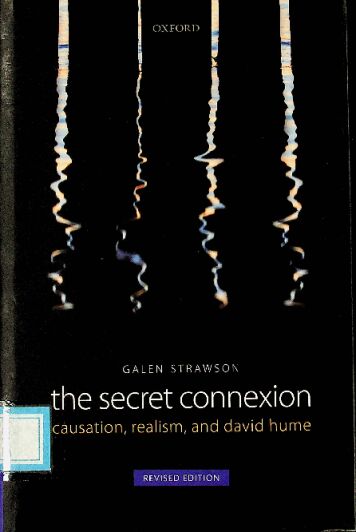
书名:The secret connexion
ISBN\ISSN:9780199605842,9780199605859
出版时间:2014
出版社:Oxford University Press,
分类号:哲学、宗教
版次:Revised edition.
摘要
In this revised and updated edition of The Secret Connexion, Galen Strawson explores one of the most discussed subjects in all philosophy: David Hume's work on causation. Strawson challenges the standard view of Hume, according to which he thinks that there is no such thing as causal influence, and that there is nothing more to causation than things of one kind regularly following things of another kind. He argues that Hume does believe in causal influence, but insists that we cannot know its nature. The regularity theory of causation is indefensible, and Hume never adopted it in any case.
查看更多
前言
In this new edition of The Secret Connexion I've made almost no substantive alterations to the book's original content, because I haven't read anything that has given me reason to doubt its main arguments and conclusions. I have, however, thinned the text throughout, reworked Chapters 14 and 15 on the Treatise, and added quite a number of further thoughts and quotations. The original Appendix A is now an appendix to Chapter 6. Appendix B is now an appendix to Chapter 7 (reproduced essentially unchanged, although it later grew into a separate paper (Strawson 2002)). The original Appendix C, a summary of the overall position, has been dropped. It was superseded in 2000 by a paper, 'David Hume: Objects and Power', from which I've here incorporated some considerations about the relative importance of the Treatise and the Enquiry in assessing Hume's considered view (pp. 000-0). I've also included as an appendix to Chapter 22 a reply to a helpful objection to The Secret Connexion raised by Nicholas Everitt in 1991.
Many now talk of 'Old Hume' as opposed to 'New Hume'.1 According to the supporters of Old Hume, Hume holds that 'even if God were to look at [two causally related] events, he would discern nothing relating them other than that one succeeds the other'.2 On this view, Hume holds a metaphysical regularity theory of causation, according to which things in reality succeed each other in a regular fashion, but nothing ever really causally influences anything else in any way at all. All supporters of New Hume deny that he holds this view. Some go further and follow John Wright, as I do, in holding that Hume is a 'sceptical realist'.
The question of what it means to say that Hume is a realist about causal power is part of the subject of this book, but one thing that is clear is that to be a realist about causal power is to hold that there really is such a thing as causal influence. That is, there is something more in reality, causally speaking, than one thing's just following another, even if all we can ever actually empirically detect, strictly speaking, is one thing regularly following another.
According to the sceptical realist view of Hume, he's not only a sceptical realist about causal power, but also about physical objects like tables and chairs. He's not concerned to deny categorically that things that we ordinarily suppose to exist don't exist. Real sceptics don't do that. His general, sceptical, empiricist, philosophical point is simply that we can form no empirically respectable, clear, and distinct conception of the 'real nature' of concrete reality (other than the concrete reality that consists in the existence of our experiences). We can't hope to have insight into its 'real nature and operations' (63, 638/1.2.5.25, 1.2.5.26), its 'ultimate original qualities' (xvii/Int§8), its 'ultimate principles' (xviii/Int§10). We can't hope to have insight into the 'internal structure or operating principle of objects' (169/1.3.14.29), 'the nature of bodies' (64/1.2.5.26), 'the essence and construction of bodies' (660/ Abs§32). And 'the essence of the mind [is] equally unknown to us with that of external bodies' (xvii/Int§8).
The terms 'Old' and 'New' are unfortunate, for 'New Hume' is simply Hume—but also because the 'New Hume' interpretation isn't new. As Helen Beebee observes, Norman Kemp Smith classifies as a supporter of 'New Hume' in his 1941 book The Philosophy of David Hume (Beebee 2006: 173). Kant was equally clear in 1783 that Hume didn't deny the existence of causal power (Kant 1783: Preface).
Even if this were not so, the terms would be obsolescent. Don Garrett has recently argued that so far as the textual evidence is concerned, there's nothing to favour one of the views decisively over the other (Garrett 2009). It may be that supporters of the old Hume are now in the minority (at least outside Canada). It's hard to be sure, for many who take themselves to support 'Old Hume' have shifted their ground con-siderably over the last thirty years. P\One of the ironies of the debate has been that some 'Old Hume' supporters have suggested that 'New Hume' supporters, being themselves realists about things like objects and causation, have been motivated to interpret Hume in such a way that he agrees with them. The irony is that almost all those who have argued in this way have tended to be 'anti-realists' of some stripe or other, determined to maintain an interpretation of Hume that agrees with their anti-realism.
'Old Humeans' have also charged that 'New Humeans' (like myself) rely on isolated quotations to support their view. Again this seems back to front, although it's true that the three quotations on p. v that form the epigraph to this book suffice, in effect, to establish the 'New Hume' case. The 'Old Hume' interpretation relies principally on overliteral readings of a relatively small number of passages from the Treatise, whose publication Hume later regretted (see p. 10); the deep drift of Hume's epistemology and metaphysics is 'New Humean' to the core.
I'm very grateful to Peter Momtchiloff for encouraging me to produce this new edition, and to Keith Turausky for reading through the whole text with care and insight.
查看更多
目录
Abbreviations and Conventions xvi
Part 1. Meaning, Scepticism, and Reality
1. Introduction 3
2. The 'Humean' view of causation; and an exegetical principle 9
3. A summary of the argument 14
4. 'Objects': preliminaries 19
5. The untenability of the realist regularity theory of causation 22
6. 'Objects': complications 32
6.1 Strict idealism 32
6.2 Perception-constituted objects and perception-content-constituted objects 35
6.3 A viable regularity theory of causation 40
6.4 Hume uncommitted 41
6.5 Supposing and conceiving 44
6.6 Basic realism 52
6.7 Bundles and fiction 57
6.8 Hume in metaphysical space 58
6.9 Writing as a realist 59
Appendix Cartoon-film causation: idealism and the regularity theory of causation 60
7. The notion of the ultimate nature of reality 65
Appendix Reality and truth 75
8. 'Causation' 87
9. Hume's strict scepticism 95
10. Hume's theory of ideas as applied to the idea of causation 102
11. The 'AP' property 108
11.1 The curious idea of a priori causal inference 108
11.2 An objection 110
11.3 The objection varied 112
12. The problem of meaning 115
12.1 The 'Meaning Tension' 115
12.2 Experience-transcendent reference: E-intelligibility and R-intelligibility 120
12.3 Example: Hume on the mind 123
12.4 Conclusion 125
13. 'External objects' and Causation 128
13.1 The parallel 128
13.2 A possible disanalogy 129
13.3 An objection 131
Part 2. Causation in the Treatise
14. Causation in the Treatise: 1 137
14.1 Introduction 137
14.2 Referring uses of Causation terms 138
15. Causation in the Treatise: 2 142
15.1 Three stratagems 142
15.2 Ignorance, irony, and reality 144
15.3 Hume's global subjectivism about necessity 147
15.4 The 'necessity, which we ascribe'; the 'necessity, which we conceive' 150
15.5 'So far as we have any notion of it' 153
15.6 Conclusion 158
Part 3. Causation in the Enquiry
16. Enquiry Section 4: the question of irony 165
17. Enquiry Section 4: Causation and inductive scepticism 169
18. Enquiry Sections 5-6: undiscovered and undiscoverable 171
19. Enquiry Section 7: Causation and human beings 176
19.1 Will and force: a last look at irony 176
19.2 Resemblance, solidity, and force 180
19.3 A rhetorical question 181
20. Enquiry Section 7: the Occasionalists 183
21. Enquiry Section 7: the two definitions of cause 188
21.1 Extraordinary ignorance 188
21.2 The two definitions 190
21.3 Conclusion 197
Part 4. Reason, Reality, and Regularity
22. Reason, Reality, and Regularity 201
22.1 A summary of Hume's position 201
22.2 The general form of the argument for Causation 203
Appendix The Contingent Reality of Natural Necessity 210
23. The meaning of 'cause' 215
23.1 Content: experience and concepts 215
23.2 The 'Anscombean' approach 220
23.3 The wisdom of nature 223
23.4 Causation: a non-sensory property 230
References 236
Index 241
Index of Passages from Hume 244
查看PDF
查看更多
作者简介
Galen Strawson is Professor of Philosophy at Reading University, UK, and the University of Texas at Austin. Prior to that he was Fellow and Tutor in Philosophy at Jesus College, Oxford (1987-2000). From 2004 to 2007 he was also Distinguished Professor of Philosophy at CUNY Graduate Center in New York. He has held visiting positions at the Research School of Social Sciences at Australian National University (1993 and 2012), New York University (1997), Rutgers University (2000), and Massachusetts Institute of Technology (2010). Strawson received his degrees from the universities of Cambridge and Oxford and studied at the Ecole normale supérieure and the Sorbonne in Paris (1977-8).
查看更多
馆藏单位
中科院文献情报中心