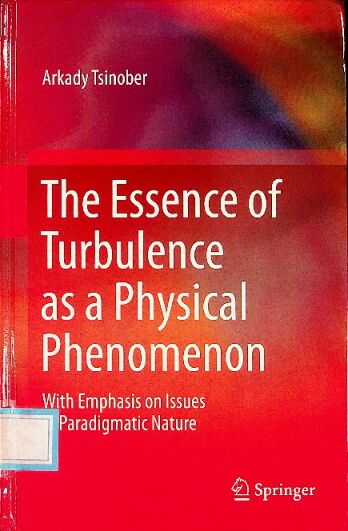
书名:The essence of turbulence as a physical phenomenon
责任者:Arkady Tsinober. | Tsinober, A.
前言
One of my hopes is that this small book will aid the readers, especially the young ones, to develop their own judgment on the huge literature in the field and to make some distinction between the "essence" and "the water". It is also among the reasons that the main themes of this small book are about fundamental issues of paradig�matic nature. The reasons for using the term "issues of paradigmatic nature" instead of, say, just "paradigms in turbulence" is due to the question on the very existence of the latter (so far).
The main premises and the reasons/causes that it was possible to make this book short are the absence of theory based on first principles and inadequate tools to han�dle both the problem and the phenomenon of turbulence. Obviously, for this reason the "essence" appears implicatively rather than explicitly. This state of matters was and is continuously stressed in the community including many prominent scientists and among them by Batchelor (1962), Kolmogorov (1985), Liepmann (1979), Lum�ley and Yaglom (2001), von Neumann (1949), Ruelle (1990), Saffman (1978, 1991), Wiener (1938), see Appendix for essential quotations.
Indeed, the heaviest and the most ambitious armory from theoretical physics and mathematics was tried for more than fifty years, but without much success: genuine turbulence, the big T-problem, as a physical and mathematical problem remains unsolved.
It is not a trivial task to address things like paradigmatic issues (as, in fact, there are no real paradigms in fundamental research of turbulence) in a field which—in words of Liepmann is the graveyard of theories, so that one has to relay mainly on the empirical evidence. The task is not made easier in view of no consensus on what is (are) the problem(s) of turbulence, neither is there an agreement on what are/should be the aims/goals of turbulence research/theories and what would consti�tute its (their) solution.
查看更多
目录
Part I The Phenomenon and the Problem of Ihrbulence
1 The Phenomenon of TXirbulence as Distinct from the Problem of Thrbulence 3
1.1 Major Qualitative Universal Features of Turbulent Flows 6
2 The Problem of Thrbulence as Distinct from the Phenomenon of Turbulence 9
2.1 On Physics and Mathematics of Turbulence 12
3 What Equations Describe Turbulence Adequately? 15
3.1 Navier-Stokes Equations 16
3.1.1 On Boundary Conditions 18
3.2 Large Re, Zero Viscosity Limit and Relevance of Euler Equations 18
3.3 Averaged Equations, Filtering, Decompositions and Similar Approaches/Issues 19
3.3.1 On the Utility of Various Decompositions 22
3.4 Eulerian Versus Lagrangian Representations 24
3.5 Final Remarks 26
Part II Issues of Paradigmatic Nature I: Origins and Nature of Turbulence
4 Origins of Turbulence 31
4.1Instability 32
4.2 Transition to Turbulence Versus Routes to Chaos 33
4.3 Many Ways of Creating (Arising/Emerging) Turbulent Flows 34
5 Nature of TUrbulence 37
5.1 Turbulence is Only Apparently Random 39
5.2 Limitations of Statistical Methods 41
5.2.1 Statistical Theories 42
5.2.2 Statistical Methods of Description and Interpretation of the Data from Laboratory, Field and Numerical Experiments 45
5.2.3 On Particular Tools—Examples 47
6 Additional Issues of Importance Related to the Use of Statistical Methods 53
6.1 Interpretation and Validation or What About the Right Results for the Right Reasons or Theories Versus Hard Evidence 54
6.1.1 Interpretation 54
6.1.2 Validation or Theories Versus Hard Evidence 57
6.2Ergodicity and Related 61
Part III Issues of Paradigmatic Nature II: Specific Features
7 The NJs of TUrbulence 67
7.1 Non-integrability 67
7.2 Nonlinearity 68
7.2.1 Nonlinearity Plus Decompositions Gives Birth to "Cascades" 69
7.2.2 Turbulence Is Essentially Rotational and Strongly Dissipative Phenomenon 70
7.3 Nonlocality 74
7.3.1 Introductory/General Remarks 74
7.3.2 A Simple Example 77
7.3.3 Direct and Bidirectional Coupling Between Large and Small Scales 78
8 Large Reynolds Number Behavior, Symmetries, Universality 85
8.1 Inertial Range, the Roles of Viscosity/Dissipation and Related Issues 86
8.2 Reynolds Number Dependence and Behavior of Turbulent Flows at Large Reynolds Numbers 91
8.3 Symmetries 94
8.4 Universality 98
8.4.1 Quantitative Universality 99
8.4.2 Qualitative Universality 101
9 Intermittency and Structure(s) of and/in Turbulence 105
9.1 Intermittency 107
9.1.1 The External Intermittency and Entrainment 108
9.1.2 The Small Scale, Internal or Intrinsic Intermittency 108
9.1.3 Measures/Manifestations of Intermittency 111
9.1.4 On Possible Origins of Small Scale Intermittency 115
9.2 What Is(Are) Structure(s) of Turbulent Flows? What We See Is Real. The Problem Is Interpretation 118
9.2.1 On the Origins of Structure(s) of7in Turbulence 119
9.2.2 How Does the Structure of Turbulence 'Look'? 120
9.2.3 Structure Versus Statistics 124
9.2.4 What Kinds of Statistics Are Most Appropriate to Characterize at Least Some Aspects for Turbulence Structure 126
9.2.5 Structure(s) Versus Scales and Decompositions 129
Part IV Epilogue
10 On the Status 135
10.1What Next 138
10.2 What to Do 140
11 Appendix. Essentia! Quotations 143
11.1 To Preface 143
11.1.1 On Absence of Genuine Theory 143
11.2 To Chap. I 146
11.2.1 On Multitude of "Approaches"; for More See Also Chaps. 3 and 9 in Tsinober (2009) 146
11.3 To Eilogue 148
11.3.1 On the Continuing Diversity of Opinions on What Is Important, What Are the Main Questions andRelated 148
References 151
Author Index 161
Subject Index 167
查看更多
馆藏单位
中科院文献情报中心