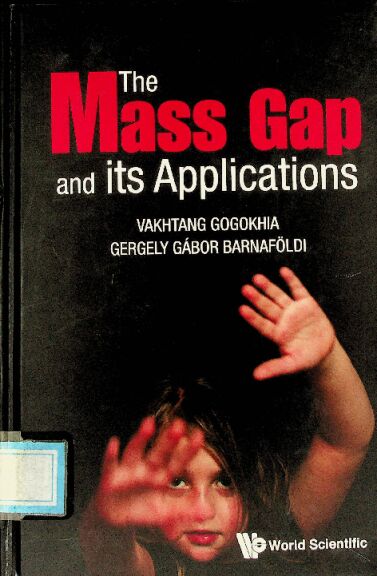
书名:The mass gap and its applications
责任者:Gogokhia Vakhtang and Barnafoldi Gergely Gabor.
出版时间:2013
出版社:World Scientific,
摘要
Quantum Chromodynamics (QCD) is the most up-to-date theory of the strong interaction. Its predictions have been verified experimentally, and it is a cornerstone of the Standard Model of particle physics. However, standard perturbative procedures fail if applied to low-energy QCD. Even the discovery of the Higgs Boson will not solve the problem of masses originating from the non-perturbative behavior of QCD. This book presents a new method, the introduction of the 'mass gap', first suggested by Arthur Jaffe and Edward Witten at the turn of the millennium. It attempts to show that, to explain the mass-spectrum of QCD, one needs the mass scale parameter (the mass gap) instead of other massive particles. The energy difference between the lowest order and the vacuum state in Yang-Mills quantum field theory, the mass gap is in principle responsible for the large-scale structure of the QCD ground state, and thus also for its non-perturbative phenomena at low energies. This book not only presents the mass gap, but also details the applications and outlook of the mass gap method. A detailed summary of references and problems are included as well.This book is best for scientists and highly advanced students interested in non-perturbative effects and methods in QCD.
查看更多
前言
We should always keep in mind: Nature is tricky! This saying is multiply true for the Standard Model of particle physics. The properties of the strongly interacting matter, the neutrinos or the Higgs particle still remain unsolved parts of a great puzzle in this consistent, well-built, unified theory. Furthermore, recently it has become clear that such an important thing as the vacuum is one of the most complex objects in Nature.
In this book we focus on the most up-to-date theory of the strong in-teraction: Quantum Chromodynamics (QCD), which has been developed during the last decades of the 20thcentury. In high-energy collisions QCD has been proved by experimental tests, using perturbative treatments be-cause of its asymptotic freedom behavior. It is the flip of Nature that these perturbative procedures become problematic if one tries to apply them to low-energy QCD -since the running coupling constant goes beyond 1. Due to color confinement the description of the well-known bound states like mesons, baryons (e.g. proton or neutron), and the vacuum are not yet available from first principles -the ultimate goal of any fundamental theory.
While we were finishing this book, the European Laboratory for Particle and Nuclear Physics (CERN, Geneva, Switzerland) made a statement on a Higgs-like particle. The missing puzzle of the Standard Model has been recognized at almost 5σ. This is a historical event, since by this discovery, the most wanted 'God's particle' might complete the best field theory we have for particle physics. On the other hand, finding the Higgs will not solve the problem of masses originating from the non-perturbative behavior of Quantum Chromodynamics.
Here, we present a new method to investigate non-perturbative QCD by the introduction of the 'mass gap into the theory, suggested first by Arthur Jaffe and Edward Witten at the turn of this century. Our book is about this way of handling the mass problem in QCD. To explain the mass-spectrum of QCD we are going to show in this book that, for this aim one needs rather the mass scale parameter (the mass gap) than other massive particles. The mass gap is in principle responsible for the large-scale structure of the QCD ground state, and thus for its non-perturbative phenomena at low energies.
Simply speaking, the mass gap is the energy difference between the lowest order and the vacuum state in the Yang-Mills quantum field theory. In this book, we not only introduce and present the mass gap, but we give some applications and the outlook of the mass gap method. At some points we look ahead to the far future, thinking on the possible everyday use of the calculated results. In addition a detailed summary of references and problems are included.
We recommend this book for scientists and very advanced students who want to be familiar in more detail with non-perturbative effects and meth-ods in QCD. This work starts there, where textbooks on Quantum Chro-modynamics usually end, describing the strong interaction at high energies. However, we give a short introduction of QCD and its general features in Section 1.1. Readers are kindly advised to have a knowledge of the basics of the Quantum Chromodynamics. Readers, especially students, who would like to deal with this book in a more detailed way are suggested to study some of the articles and textbooks referred within the introductory section. Let us remark that problems were added to this book at the end of each chapter in order to help deepen the knowledge and techniques of the mass gap. We encourage students to work them out as a general feedback of the understanding.
Finally, the authors wish you an interesting journey to the interesting world of 'The Mass Gap and its Applications' on the following pages!
Vakhtang Gogokhia Gergely Gabor Barnaföldi
Wigner Research Centre for Physics
Hungarian Academy of Science
Budapest, Hungary,2012
查看更多
目录
Preface vii
Acknowledgments ix
Theory of the Mass Gap 1
1. Quantum Chromodynamics and the Mass Gap 3
1.1 Quantum Chromodynamics 3
1.2 The Jaffe-Witten theorem on the Mass Gap 5
2. Color Gauge Invariance and the Origin of the Mass Gap 9
2.1 Introduction 9
2.2 The gluon Schwinger-Dyson equation 11
2.3 Transversality of the full gluon self-energy 14
2.4 Slavnov-Taylor identity for the full gluon propagator 19
2.5 The general structure of the full gluon propagator 21
2.6 Non-perturbative vs. Perturbative QCD 24
2.7 The Mass Gap 26
2.8 Subtraction at the fundamental gluon propagator level 28
2.9 Discussion 31
2.A Appendix: Application for Abelian case 34
3. Formal Exact Solutions for the Full Gluon Propagator at Non-zero Mass Gap 39
3.1 Introduction 39
3.2 Singular solution 41
3.3 Massive solution 46
3.4 Conclusions 49
3.A Appendix: The dimensional regularization method in the perturbation theory 51
3.B Appendix: The dimensional regularization method in the distribution theory 53
4. Renormalization of the Mass Gap 59
4.1 Introduction 59
4.2 The intrinsically non-perturbative gluon propagator 60
4.3 Confining gluon propagator 61
4.4 The renormalized running effective charge 64
4.5 The general criterion of gluon confinement 65
4.6 The general criterion of quark confinement 68
4.7 The general criterion of dynamical/spontaneous breakdown of chiral symmetry 69
4.8 Physical limits 72
4.9 Asymptotic freedom and the mass gap 73
4.A Appendix: The Weierstrass-Sokhatsky-Casorati theorem 76
5. General Discussion 79
5.1 Discussion 79
5.2 Subtractions 83
5.3 Conclusions 86
Applications of the Mass Gap 91
6. Vacuum Energy Density in the Quantum Yang-Mills Theory 93
6.1 Introduction 93
6.2 The vacuum energy density 94
6.3 The intrinsically non-perturbative vacuum energy density 97
6.4 The bag constant 99
6.5 Analytical and numerical evaluation of the bag constant 101
6.6 The trace anomaly relation 105
6.7 Comparison with phenomenology 107
6.8 Numerical values for Bym in different units 109
6.9 Contribution of Bym to the dark energy problem 110
6.10 Energy from the QCD vacuum 111
6.11 Conclusions 114
6.A Appendix:The general role of ghosts 117
7. The Non-perturbative Analytical Equation of State for the Gluon Matter I 121
7.1 Introduction 121
7.2 The gluon pressure at zero temperature 123
7.3 The gluon pressure at non-zero temperature 125
7.4 The scale-setting scheme 127
7.5 The PNp(T) contribution 127
7.6 Conclusions 131
7.A Appendix: The summation of the thermal logarithms 133
8. The Non-perturbative Analytical Equation of State for the Gluon Matter II 137
8.1 Introduction 137
8.2 Analytic thermal perturbation theory 137
8.3 Convergence of the perturbation theory series 144
8.4 The gluon pressure, Pg(T) 147
8.5 Low-temperature expansion 148
8.6 High-temperature expansion 156
8.7 Discussion and conclusions 162
9. The Non-perturbative Analytical Equation of State for SU(3) Gluon Plasma 171
9.1 Introduction 171
9.2 The gluon pressure Pg(T) 171
9.3 The full gluon plasma pressure 174
9.4 Main thermodynamic quantities 189
9.5 The Stefan-Boltzmann limit 190
9.6 Analytical formulae for the gluon plasma thermodynamic quantities 191
9.7 Double-counting in integer powers of αs problem 193
9.8 Numerical results and discussion 196
9.9 The dynamical structure of SU(3) gluon plasma 207
9.10 Conclusions 212
9.A Appendix: Analytical and numerical evaluation of the latent heat 217
9.B Appendix: The β-function for the confining effective charge at non-zero temperature 218
9.C Appendix: Least Mean Squares method and the definition of the average deviation 219
9.D Appendix: Restoration of the lattice pressure below 0.9Tc 220
Bibliography 225
Index 233
查看PDF
查看更多
作者简介
Vakhtang Gogokhia was born in Georgia. Finished his Doctoral dissertation in 1974 at the Laboratory of Theoretical Physics of the Joint Institute for Nuclear Research (JINR) Dubna, former USSR. From 1970 until 1992 worked at the Mathematical Institute of the Georgian Academy of Sciences. He again became a senior staff at this Institute - now of I. Javakhishvili Tbilisi State University - in 2012. From 1992 has joined the Institute for Particle and Nuclear Physics of the Hungarian Academy of Sciences - now Wigner Research Center for Physics. From 1997-1999 was COE professor at the Research Center for Nuclear Physics (RCNP) at Osaka University, Japan. His family consits of wife, two children and a granddaughther.
查看更多
馆藏单位
中科院文献情报中心