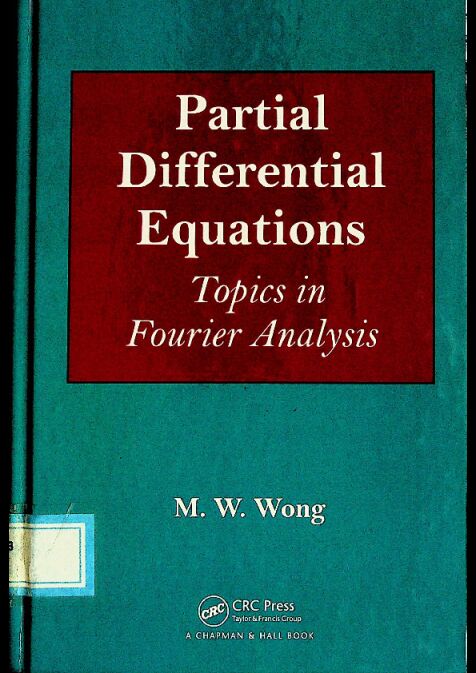
书名:Partial differential equations
责任者:M.W. Wong. | Wong, Man Wah,
ISBN\ISSN:9781466584013,1466584017
出版时间:2014
出版社:Boca Raton, FL,CRC Press,
前言
The motivation for writing this book comes from the desire and the need that there be a bridge between the standard undergraduate course in partial differential equations for students in science and engineering and the graduate course in partial differential equations for students in mathematics who are interested in a research career in analysis.
The literature on partial differential equations is huge. It covers a broad spectrum of topics from the very classical and applied to the very modern and pure. We have chosen to look at some linear partial differential equations in a setting that is somewhere between the very classical and the very modern. Listed in the bibliography is a very small sample of references that have shaped my vision on the subject.
The focus in this book is on the constructions of solutions of partial differential equations governed by first the Laplacian on ℝn, then the Hermite operator on ℝn, and finally the sub-Laplacian and its twisted Laplacians on the Heisenberg group ℍ1. The topics are chosen not only because of their fundamental importance, but also for coerciveness in the sense that the methods are largely based on Fourier analysis. It is hoped that this book may help toward an appreciation that partial differential equations can be studied as a subject with a beautiful structure in its own right and not just a bag of isolated ad-hoc techniques.
The emphasis in the book is not on complete mathematical rigor, but rather on how the Fourier transform and some heuristics can be used effectively to obtain significant insight into the solutions of the canonical models in partial differential equations. This approach is valuable for its magnificient power in getting plausible answers, which can then be justified by the norm of modern analysis.
The first part of the book consists of thirteen chapters. The first chapter is on the notation currently used in the practice of partial differential equations. Chapters 2-5 are on the gamma function, convolutions, Fourier analysis, and distribution theory, which provide the background material and the lingua franca of the book. Chapters 6-13 are on second-order equations that bear on the Laplacian on ℝn. The real study of partial differential equations begins in Chapter 6 in which the heat kernel is constructed. The construction of the free propagator given in Chapter 7 is similar to that of the heat kernel, but the technical details are more demanding. Chapter 8 on the constructions of the Newtonian potential is closely related to the heat kernel in the sense that the Newtonian potential is the integral from zero to infinity with respect to time of the heat kernel. The Poisson kernel is constructed in Chapter 11. Chapter 13 is devoted to the constructions of the wave kernels. The Bessel potential for the perturbed Laplacian, which is the analog of the Newtonian potential for the Laplacian, is constructed in two ways in Chapter 9. The Bessel-Poisson kernel for the heat equation when the Laplacian is replaced by the perturbed Laplacian is given in Chapter 12. It is clear from this overview that standard undergraduate courses in real analysis and complex analysis are sufficient for a good understanding of Chapters 1-13.
The second part of the book contains Chapters 14-16. These three chapters are devoted to the Hermite equation, which is a prototype of a partial differential equation with variable coefficients. The Hermite operator is the simplest and yet very important operator in quantum physics. This operator and the corresponding equation are studied in some detail after a recall of the basics on Hermite functions in Chapter 14. This module requires some knowledge of Hilbert spaces up to the basic properties of orthonormal bases, which are normally taught in a fourth-year undergraduate course in real analysis. Nothing more than the Fourier series expansions in Hilbert spaces is assumed and any one of the books [5, 23, 26, 44], among others, contains enough information on Hilbert spaces for a complete understanding of the book.
Chapters 17-23 in the last part of the book contain a detailed study of the sub-Laplacian on the Heisenberg group. For the sake of simplicity in notation, we are content with the complete analysis for the one-dimensional Heisenberg group of which the underlying manifold is ℝ3. The end is to construct the heat kernel and the Green function of the sub-Laplacian, and the means to this end is to reduce this operator to a family of operators, known as twisted Laplacians, on ℝ2 using the Fourier transform. Wigner transforms and Weyl transforms studied in Chapter 20 are the tools used in the constructions of the heat kernels and Green functions of the twisted Laplacians, which can then be transported back to the Heisenberg group in order to produce the heat kernel and Green function of the sub-Laplacian.
Mathematicians and physicists with names and contributions built into the text are highlighted in historical notes. Brevity notwithstanding, it is my hope that students can realize that mathematics is the culmination of efforts of many outstanding individuals over centuries. Exercises, intended to be done by students in order to better understand the material in the book, are appended at the end of every chapter.
查看更多
目录
Preface vii
1 The Multi-Index Notation 1
2 The Gamma Function 7
3 Convolutions 11
4 Fourier Transforms 21
5 Tempered Distributions 33
6 The Heat Kernel 43
7 The Free Propagator 53
8 The Newtonian Potential 63
9 The Bessel Potential 69
10 Global Hypoellipticity in the Schwartz Space 73
11 The Poisson Kernel 81
12 The Bessel-Poisson Kernel 87
13 Wave Kernels 93
14 The Heat Kernel of the Hermite Operator 103
15 The Green Function of the Hermite Operator 111
16 Global Regularity of the Hermite Operator 121
17 The Heisenberg Group 127
18 The Sub-Laplacian and the Twisted Laplacians 137
19 Convolutions on the Heisenberg Group 143
20 Wigner Transforms and Weyl Transforms 147
21 Spectral Analysis of Twisted Laplacians 153
22 Heat Kernels Related to the Heisenberg Group 159
23 Green Functions Related to the Heisenberg Group 165
Bibliography 169
Index 173
查看更多
馆藏单位
中科院文献情报中心