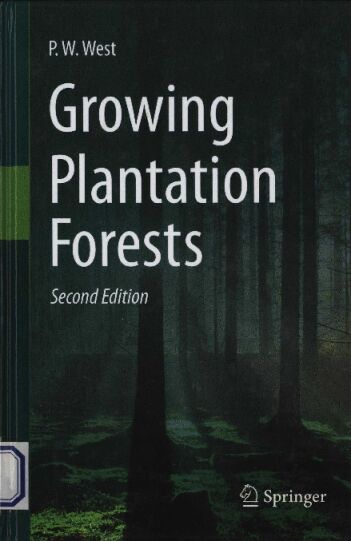
书名:Growing Plantation Forests
责任者: P. W. West. | West, P. W.
ISBN\ISSN:9783319018263,9788132211815
前言
The importance of plantation forests has increased steadily since the first edition of this book was published in 2006. Plantations supply increasing amounts of wood for human consumption as firewood, for paper production, as timber for building, or as energy through conversion to liquid fuel or by firing boilers to produce electricity. Also, their environmental benefits are being appreciated more fully for uses such as remediation of damaged sites, for disposal of indus¬trial and human wastes or by increasing floral and faunal biodiversity in regions where native forests have been cleared. Plantations act also as ‘sinks’ for the stor¬age of carbon dioxide, the greenhouse gas that is being emitted to the atmosphere in increasing amounts and is believed to be a major contributing factor to climate change.
Whatever the use being made of plantation forests, their owners want them to grow vigorously and to remain healthy so they can achieve their objectives as soon as possible. So varied are plantation forests around the world and so varied are the practices necessary to grow them successfully that it is impossible to consider them completely in a single volume. However, wherever successful plantation for¬ests are grown there is a set of scientific principles that underly what is done. It is those principles this book describes so that readers anywhere in the world might glean some idea as to how their plantations will behave and what problems they might face.
I have attempted to reach a wide range of readers, from those with no formal forestry education through to forest scientists involved in research. This has meant dealing with topics from basic plant biology through to advanced concepts of for¬estry science. To maintain the interest of all readers, I have tried wherever possi¬ble to illustrate the concepts with practical examples drawn from plantation forests throughout the world. The decisions as to which topics to include or exclude were not easy. In general, I have tried to cover as much as I feel can be taught reason¬ably in a one-semester undergraduate university course on plantation forestry.
Areas of plantation forestry that have developed significantly since the first edi¬tion include the relationship between silviculture and tree wood properties, the use of mixed-species plantations, genetic engineering of trees, and concern about the long-term sustainability of plantation forests. New material has been added about these topics in particular. In addition, research findings in other areas of plantation forestry have been updated. I thank again those colleagues who reviewed all or part of the original manuscript. Dr. Geoff Downes kindly offered useful comments on the new material that makes up Sect. 3.4 of this edition.
查看更多
目录
1 Plantation Forests 1
1.1 Plantation Forests Around the World 1
1.2 Purposes of Plantation Forests 3
1.3 About This Book 5
2 Biology of Plantation Growth 9
2.1 Basic Plant Biology 9
2.1.1 Tree Requirements and Characteristics 9
2.1.2 Photosynthesis and Water Use 11
2.1.3 Temperature 12
2.1.4 Nutrients 12
2.2 Principles of Plantation Growth 14
2.3 An Example of Plantation Growth 15
2.3.1 Leaf Development 17
2.3.2 Root, Branch and Stem Growth 19
2.3.3 Growth Variations and Leaf and Root Turnover 20
2.4 Growth of Individual Trees 22
3 Growth Rates and Wood Quality 25
3.1 Expressing Growth Rates of Plantations 26
3.2 How Fast Do Plantations Grow? 28
3.3 Wood Quality 32
3.3.1 Tracheid and Fibre Length 33
3.3.2 Microfibril Angle 34
3.3.3 Wood Density 35
3.3.4 Grain Angle 38
3.3.5 Sapwood and Heartwood 38
3.3.6 Reaction Wood 39
3.3.7 Growth Stresses 40
3.3.8 Knots 41
3.4 Silviculture and Wood Quality 41
4 Choosing the Species and Site 45
4.1 Land Availability 45
4.2 Selecting the Species 46
4.3 Site Productive Capacity 48
4.4 Predicting Site Productive Capacity 49
4.4.1 Site Classification Approach 49
4.4.2 Regression Approach 50
4.4.3 Process-Based Model Approach 52
5 Establishment 55
5.1 Cultivation 56
5.2 Seedlings 61
5.2.1 Nurseries 61
5.2.2 Factors Determining Seedling Survival and Growth 62
5.2.3 Achieving Seedling Specifications 64
5.3 Planting 69
5.4 Weed Control 72
5.4.1 Loss of Growth due to Weeds 72
5.4.2 Causes of Growth Losses 75
5.4.3 Controlling Weeds 77
5.5 Coppice 78
5.5.1 Wood Production by Coppice 79
5.5.2 Silviculture of Coppice 81
6 Nutrient Management 83
6.1 Early Growth in Relation to Nutrient Supply 84
6.1.1 Ingestad,s Theory 84
6.1.2 Conclusions for Fertilisation Practice 86
6.2 A Fertiliser Regime for Sweetgum in North America 88
6.2.1 Example Details 88
6.2.2 Growth Response to Fertilisation 89
6.2.3 Nutrient Budget 90
6.2.4 Fertiliser Regime 92
6.3 Long-Term and Later Age Fertilisation 92
6.4 Assessing the Need for Fertilisation 94
6.5 Sustaining Nutrients on the Site 96
7 Stand Density and Initial Spacing 99
7.1 Stand Density 99
7.1.1 Maximum Density 100
7.1.2 Measuring Density 102
7.1.3 Stand Development in Relation to Density 102
7.2 Initial Spacing 106
7.2.1 Effects on Stand Wood Yields and Tree Sizes 107
7.2.2 Effects on Branch Size 109
7.2.3 Effects of Rectangularity of Spacing on Trees and Stands 111
7.2.4 Initial Spacing in Practice 112
8 Thinning 115
8.1 Growth Following Thinning 116
8.2 Hazards of Thinning 119
8.3 Tree Selection 121
8.4 Developing Thinning Regimes 123
8.5 Thinning in Practice 127
9 Pruning 131
9.1 Natural Pruning 132
9.2 Knots and Wood Quality 133
9.3 Branch Development 134
9.4 Effects of Pruning 135
9.5 Pruning Regime 137
9.5.1 When to Prune 138
9.5.2 Height of Pruning 139
9.5.3 Trees to be Pruned 140
9.6 Pruning Method 141
9.7 Examples of Pruning Regimes 143
9.7.1 Eucalypts in Australia 143
9.7.2 Teak in Costa Rica 145
9.7.3 Western White Pine in Northwestern USA 145
9.7.4 Spanish Red Cedar in Costa Rica 146
10 Pests 147
10.1 Principles of Pest and Disease Management 147
10.1.1 Natural Occurrence of Pests and Diseases 148
10.1.2 Control Strategies 148
10.2 Insects 150
10.3 Examples of Insect Pests 152
10.3.1 Leaf Beetles in Eucalypts 153
10.3.2 Pine Weevil in Coniferous Plantations 154
10.3.3 Transmission of Disease of Douglas Fir by Beetles 157
10.4 Mammal Pests 158
10.4.1 Control Measures 162
10.4.2 Integrated Pest Management Approach 164
11 Diseases 169
11.1 Fungi 169
11.2 Fungal Diseases 170
11.3 Examples of Fungal Disease 171
11.3.1 Pine Needle Blight in Australasia 171
11.3.2 White Pine Blister Rust in North America 174
11.3.3 Chryphonectria Canker of Eucalypts in South Africa 176
11.3.4 Damping-Off in Nurseries 178
11.4 Other Diseases 179
12 Tree Breeding 183
12.1 Genetics 183
12.1.1 Genotype and Phenotype 184
12.1.2 Qualitative and Quantitative Traits 185
12.2 Breeding Programme Strategy 186
12.2.1 Principles 187
12.2.2 Provenance Selection and Testing 189
12.2.3 Selection 190
12.2.4 Mating 193
12.2.5 Gains 196
12.2.6 Genotype × Environment Interactions 199
12.2.7 Interspecific Hybrids 199
12.3 Propagation 200
12.3.1 Seed Orchards 201
12.3.2 Clonal Propagation 202
12.4 Genetic Engineering 206
13 Mixed-Species Plantations 211
13.1 Growth and Development of Mixed-Species Plantations 212
13.2 Examples of Mixed-Species Plantations 215
13.2.1 Sydney Blue Gmm-Falcataria in Hawaii 215
13.2.2 Black Alder-Poplar in Quebec 217
13.2.3 Cedrela~Cordia-Hyeronima in Costa Rica 219
13.2.4 Red Cedar-Silky Oak in Queensland 221
14 Silviculture and Sustainability 223
Appendix 1: Glossary 229
Appendix 2: Conversion Factors 239
About the Author 241
References 243
Index 317
查看PDF
查看更多
馆藏单位
中国农科院农业信息研究所