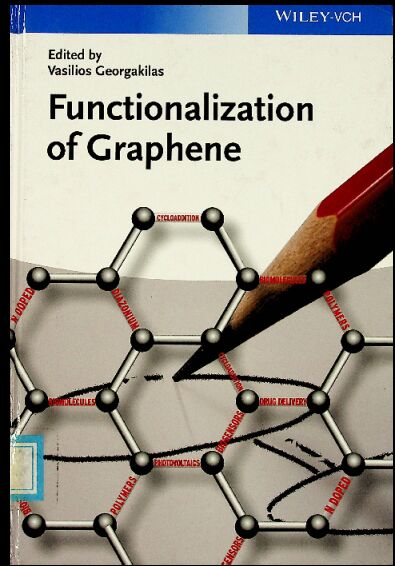
书名:Functionalization of graphene
责任者: Vasilios Georgakilas.
前言
All set to become the standard reference on the topic, this book covers the most important procedures for chemical functionalization, making it an indispensable resource for all chemists, physicists, materials scientists and engineers entering or already working in the field. Expert authors share their knowledge on a wide range of different functional groups, including organic functional groups, hydrogen, halogen, nanoparticles and polymers.
查看更多
目录
Preface XIII
List ofContributors XV
1 An Introduction to Graphene 1
Konstantinos Spyrou and Petra Rudolf
1.1 BriefHistory ofGraphite 1
1.2 Graphene and Graphene Oxide 2
1.2.1 Preparation ofGraphene from Graphene Oxide 3
1.2.2 Isolation ofPristine Graphene Monolayers 5
1.2.3 Large Scale Production ofGO by Langmuir-Blodgett Methods 6
1.2.4 Other Methods ofGraphene Production 6
1.3 Characterization ofGraphene 9
1.3.1 Microscopic Observation 9
1.3.2 Raman Spectroscopy 11
1.3.3 Thermogravimetric Analysis 12
1.3.4 Optical Properties ofGraphene 13
1.3.5 X-Ray Diffraction Pattern 17
References 18
2 Covalent Attachment ofOrganic Functional Groups on Pristine Graphene 21
Vasilios Georgakilas
2.1 Introduction 21
2.2 Cycloaddition Reactions 22
2.2.1 1,3-Dipolar Cycloaddition ofAzomethine Ylide 22
2.2.1.1 Through a Substituted Aldehyde Pathway 24
2.2.1.2 Through Substituted α Amino Acid Pathway 27
2.2.2 Cycloaddition by Zwitterionic Intermediate 28
2.2.3 Diels–Alder Cycloaddition 29
2.2.4 Nitrene Addition 30
2.2.5 Carbene Addition 35
2.2.6 Aryne Addition 36
2.2.7 Bingel Type Cycloaddition 37
2.3 Addition ofFree Radicals 39
2.3.1 Diazonium Salt Reaction 39
2.3.2 Other Radical Additions 42
2.4 Nucleophilic Addition 46
2.5 Electrophilic Addition on Graphene 46
2.6 Organometallic Chemistry ofGraphene 48
2.7 Post Functionalization Reactions 50
2.8 Conclusion 55
References 56
3 Addition ofOrganic Groups through Reactions with Oxygen Species ofGraphene Oxide 59
Vasilios Georgakilas
3.1 Introduction 59
3.1.1 Graphene/Polymer Nanocomposites 60
3.2 The Role ofCarboxylic Acids ofGO 61
3.2.1 Organic Functionalization through Amide Bond Formation 61
3.2.1.1 Lipophilic Derivatives 61
3.2.1.2 Hydrophilic – Biocompatible Derivatives 62
3.2.1.3 Addition ofChromophores 64
3.2.1.4 Polymer Graphene Composite 69
3.2.2 Esterification ofGO 71
3.2.3 Functionalization ofGO through Heterocyclic Ring Formation 75
3.3 The Role ofHydroxyl Groups ofGO 77
3.4 Miscellaneous Additions 78
3.4.1 Reaction ofCarboxylic Acid and Hydroxyl Groups with Isocyanate Derivatives 78
3.4.2 Reaction ofEpoxides with Carboxylic Acids or Hydroxyl Groups 78
3.4.3 Interaction ofAmmonia with Carboxylic Acids and Epoxides of GO 80
3.4.4 Enrichment ofGO in Carboxylic Acids 81
3.4.5 Addition ofGallium-Phthalocyanine (Ga-Pc) to GO through Ga–O Covalent Bond 82
3.5 The Role ofEpoxide Groups ofGO 83
3.5.1 Nucleophilic Addition ofAmine to Epoxides 83
3.5.2 Addition ofChromophores 85
3.5.3 Addition ofPolymers 86
3.6 Post Functionalization ofGO 87
3.6.1 Post Functionalization ofOrganically Modified GO via Click Chemistry 87
3.6.2 Counter Anion Exchange 89
3.7 Conclusions 90
References 92
4 Chemical Functionalization ofGraphene for Biomedical Applications 95
Cinzia Spinato, Cécilia Ménard-Moyon, and Alberto Bianco
4.1 Introduction 95
4.2 Covalent Functionalization ofGraphene Nanomaterials 97
4.2.1 Synthesis ofGO and rGO 99
4.2.1.1 Synthesis ofGraphene Oxide 99
4.2.1.2 Reduction ofGraphene Oxide 99
4.2.2 Functionalization ofGraphene Oxide with Polymers 100
4.2.2.1 PEGylated-GO Conjugates 100
4.2.2.2 Covalent Linkage ofBiopolymers 103
4.2.3 Tethering ofAntibodies 105
4.2.4 Attachment ofNucleic Acids 106
4.2.5 Grafting ofPeptides and Enzymes 108
4.2.6 Attachment ofOther Organic Molecules and Biomolecules 108
4.3 Non-covalent Functionalization ofGraphene 110
4.3.1 Adsorption via π-Stacking 110
4.3.1.1 Adsorption ofDrugs 111
4.3.1.2 Adsorption ofPyrene Derivatives 111
4.3.1.3 Non-covalent Interactions with Nucleic Acids and Aptamers 113
4.3.1.4 Immobilization ofEnzymes, Proteins, and Other Macromolecules 116
4.3.2 Electrostatic and Hydrophobic Interactions 116
4.3.2.1 Coating with Polymers and Biopolymers 116
4.3.2.2 Deposition ofNanoparticles 119
4.3.2.3 Adsorption ofQuantum Dots 121
4.4 Graphene-Based Conjugates Prepared by a Combination ofCovalent and Non-covalent Functionalization 121
4.4.1 Polymer- and Biopolymer-Grafted Graphene Nanomaterials Used as Nanocarriers 121
4.4.1.1 Polymer-Functionalized GO for Drug Delivery 122
4.4.1.2 Polymer-Functionalized GO for Gene Delivery 123
4.4.1.3 Chitosan-Functionalized GO 125
4.4.2 GO Functionalized with Targeting Ligands and Antibodies 125
4.4.2.1 Folic Acid-Conjugated GO 125
4.4.2.2 Antibody-Functionalized GO for Radioimaging and Biosensing 127
4.5 Conclusions 129
Acknowledgments 130
References 130
5 Immobilization ofEnzymes and other Biomolecules on Graphene 139
Ioannis V. Pavlidis, Michaela Patila, Angeliki C. Polydera, Dimitrios Gournis, and Haralampos Stamatis
5.1 Introduction 139
5.2 Immobilization Approaches 141
5.3 Applications ofImmobilized Biomolecules 145
5.3.1 Biosensors 145
5.3.1.1 Glucose Oxidase-Based Biosensors 146
5.3.1.2 Horseradish Peroxidase-Based Biosensors 150
5.3.1.3 Tyrosinase-Based Biosensors 151
5.3.1.4 Cytochrome c-Based Biosensors 152
5.3.1.5 Other Protein/Enzyme Biosensors 152
5.3.1.6 DNA Sensors 152
5.3.1.7 Immunosensors and Aptasensors 154
5.3.2 Biocatalysis 155
5.3.3 Biofuel Cells 159
5.3.4 Drug and Gene Delivery 161
5.4 Interactions between Enzymes and Nanomaterials 162
5.5 Conclusions 165
Abbreviations 165
References 166
6 Halogenated Graphenes: Emerging Family ofTwo-Dimensional Materials 173
Kasibhatta Kumara Ramanatha Datta and Radek Zboˇ ril
6.1 Introduction 173
6.2 Synthesis ofHalogenated Graphenes 174
6.2.1 Fluorographene 175
6.2.1.1 Mechanical or Chemical Exfoliation – from Graphite Fluoride to Fluorographene 175
6.2.1.2 Fluorination ofGraphene – from Graphene to Fluorographene 175
6.2.2 Nonstoichiometric Fluorinated Graphene and Fluorinated Graphene Oxide 175
6.2.3 Other Halogenated Graphenes 178
6.3 Characterization ofHalogenated Graphenes 179
6.3.1 Fluorographene 179
6.3.2 Partially Fluorinated and Halogenated Graphenes 183
6.4 Chemistry, Properties, and Applications ofFluorographene and Fluorinated Graphenes 184
6.5 Chemistry and Properties ofChlorinated and Brominated Graphenes 190
6.6 Other Interesting Properties ofHalogenated Graphenes and Their Applications 190
6.7 Halogenated Graphene–Graphene Heterostructures – Patterned Halogenation 193
6.8 Conclusion and Future Prospects 195
References 195
7 Noncovalent Functionalization ofGraphene 199
Kingsley Christian Kemp, Yeonchoo Cho, Vimlesh Chandra, and KwangSoo Kim
7.1 Noncovalent Functionalization ofGraphene – Theoretical Background 199
7.1.1 Insight into the π-Interaction ofBenzene 200
7.1.2 Adsorption on Graphene 201
7.2 Graphene–Ligand Noncovalent Interactions – Experiment 202
7.2.1 Polycyclic Molecules 202
7.2.2 Biomolecules 205
7.2.3 Polymers 207
7.2.4 Other Molecules 210
7.3 Conclusions 213
References 213
8 Immobilization ofMetal and Metal Oxide Nanoparticles on Graphene 219
Germán Y. Vélez, Armando Encinas, and Mildred Quintana
8.1 Introduction 219
8.2 Graphene Production 219
8.2.1 Graphene Oxide (GO) 220
8.2.2 Functionalized Graphene (f-Graphene) 220
8.2.3 Graphene Growth on Metal Surfaces 220
8.2.4 Micromechanical Cleavage ofGraphite 221
8.3 Graphene Functionalized with Metal Nanoparticles (M-NPs) 221
8.3.1 GO-Reducing Approach 221
8.3.1.1 Reduction Assisted by Sonication 222
8.3.2 Anchoring NPs on f-Graphene 223
8.3.2.1 Controlling Size ofNPs 226
8.3.3 Applications ofM-NPs/Graphene Nanohybrids 227
8.3.3.1 Optoelectronic Devices 227
8.3.3.2 Applications in Catalysis 229
8.3.3.3 Applications in Biology 232
8.4 Graphene Functionalized with Metal Oxide Nanoparticles 233
8.4.1 Lithium Batteries 233
8.4.2 Optical Properties 236
8.4.2.1 Water Splitting 237
8.4.2.2 f-Graphene-POM 238
8.4.3 Photocatalytic Reduction ofGO 238
8.5 Graphene Functionalized with Magnetic NPs 242
8.5.1 Magnetic Properties 243
8.5.2 Applications ofGO-Mag NPs 246
8.5.2.1 Magnetic Separation ofMetals and Pollutants with GO-Mag NPs 247
8.5.2.2 Biomedical Applications ofGO-Mag NPs 248
8.6 Conclusions 252
References 252
9 Functionalization ofGraphene by other Carbon Nanostructures 255
Vasilios Georgakilas
9.1 Introduction 255
9.2 Graphene–C 60 Nanocomposites 255
9.2.1 Covalent Bonding ofC 60 on GO 256
9.2.2 Deposition ofC 60 on Graphene 256
9.3 Graphene–CNT Hybrid Nanostructures 262
9.3.1 Graphene–CNT Composites by Simple Mixing 264
9.3.2 Graphene–CNTs Hybrid Nanostructures by Direct Development Of CNTs on Graphene Surface 272
9.4 Graphene–Carbon Nanospheres 274
9.5 Graphene–Carbon Nitride Dots Hybrid Nanocomposite 277
9.6 Conclusions 279
References 280
10 Doping ofGraphene by Nitrogen, Boron, and Other Elements 283
Achutharao Govindaraj and C.N.R. Rao
10.1 Introduction 283
10.2 Nitrogen-Doped Graphene 284
10.2.1 DC Arcing 284
10.2.2 Heating with Ammonia, Hydrazine, and Other Reagents 287
10.2.3 Chemical Functionalization Route 288
10.2.4 Solvothermal Synthesis 289
10.2.5 Chemical Vapor Deposition and Pyrolysis 293
10.2.6 Pyrolysis Methods 300
10.2.7 Other Methods 306
10.3 Boron Doping 320
10.3.1 Mechanical Exfoliation 321
10.3.2 Thermal Annealing 321
10.3.3 Chemical Vapor Deposition 323
10.3.4 Other Methods 326
10.4 BN Doping in Graphene 329
10.5 Doping with Other Elements 334
10.6 Properties and Applications 339
References 352
11 Layer-by-Layer Assembly ofGraphene-Based Hybrid Materials 359
Antonios Kouloumpis, Panagiota Zygouri, Konstantinos Dimos, and Dimitrios Gournis
11.1 Introduction 359
11.2 LbL Graphene-Based Hybrid Films 360
11.2.1 Hybrid Thin Films for Electronics 360
11.2.2 Hybrid Thin Films as Sensors 375
11.2.3 Hybrid Films for Other Applications 383
11.3 Graphene-Based Hybrids through the Langmuir–Blodgett
Approach 385
11.3.1 Monolayers ofGraphene Oxide 385
11.3.2 Nanocomposite Films 389
11.3.3 Applications and Properties ofLB Thin Films 390
11.4 Conclusions 397
References 397
Index 401
查看更多
作者简介
Vasilios Georgakilas received his BSc in Chemistry in 1989 and his Ph.D in Organic Chemistry in 1998 from the University of Ioannina (Greece). He worked as a Postdoctoral Fellow at the University of Trieste (Italy) with Professor Maurizio Prato (2000-2002), as Research Associate at the Institute of Materials Science of N.C.S.R. "Demokritos" in Greece (1999-2000 & 2003-2010) and as Chemist at the Institute of Food Hygiene (Ministry of Agriculture & Food Development-Greece) (2004-2012). In 2013 he was appointed as Assistant Professor in the Materials Science Department of the University of Patras (Greece). His research focuses on the functionalization of carbon nanostructured materials (fullerene, carbon nanotubes, graphene, C dots) for application in catalysis, bionanotechnology, nanoelectronics.
查看更多
馆藏单位
中科院文献情报中心