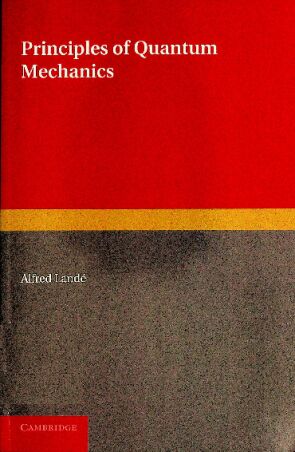
书名:Principles of quantum mechanics
ISBN\ISSN:9781107667839,1107667836
出版时间:1937
出版社:Cambridge University Press,
前言
Originally published in 1937, this book by renowned physicist Alfred Landé aims 'to develop the principles of quantum mechanics on the basis of a few standard observations'. Landé notes that, in contrast with classical mechanics, quantum mechanics is still a relatively young science with some way to go before it is internally consistent. This book will be of value to anyone with an interest in the history of physics and quantum mechanics.
查看更多
目录
Preface ix
Introduction
1. Observation and interpretation 1
2. Difficulties of the classical theories 2
3. The purpose of quantum theory 6
Part I. Elementary Theory of Observation (Principle of Complementarity)
4. Refraction in inhomogeneous media (force fields) 9
5. Scattering of charged rays 11
6. Refraction and reflection at a plane 12
7. Absolute values of momentum and wave length 13
8. Double ray of matter diffracting light waves 15
9. Double ray of matter diffracting photons 17
10. Microscopic observation of ρ (x) and σ (p) 19
11. Complementarity 20
12. Mathematical relation between ρ (x) and σ (p) for free particles 21
13. General relation between ρ (q) and σ (p) 25
14. Crystals 28
15. Transition density and transition probability 30
16. Resultant values of physical functions matrix elements 32
17. Pulsating density 33
18. General relation between ρ (t) and σ (є) 34
19. Transition density matrix elements 35
Part II. The Principle of Uncertainty
20. Optical observation of density in matter packets 37
21. Distribution of momenta in matter packets 39
22. Mathematical relation between ρ and σ 41
23. Causality 43
24. Uncertainty 46
25. Uncertainty due to optical observation 47
26. Dissipation of matter packets rays in Wilson Chamber 49
27. Density maximum in time 51
28. Uncertainty of energy and time 52
29. Compton effect 54
30. Bothe–Geiger and Compton–Simon experiments 56
31. Doppler effect Raman effect 57
32. Elementary bundles of rays 59
33. Jeans' number of degrees of freedom 61
34. Uncertainty of electromagnetic field components 62
Part III. The Principle of Interference and Schrödinger's equation
35. Physical functions 65
36. Interference of probabilities for p and q 66
37. General interference of probabilities 68
38. Differential equations for Ψp (q) and X_q (p) 70
39. Differential equation for фβ (q) 71
40. The general probability amplitude Φβ' (Q) 72
41. Point transformations 73
42. General theorem of interference 75
43. Conjugate variables 75
44. Schrödinger's equation for conservative systems 76
45. Schrödinger's equation for non-conservative systems 76
46. Pertubation theory 78
47. Orthogonality, normalization and Hermitian conjugacy 79
48. General matrix elements 80
Part IV. The Principle of Correspondence
49. Contact transformations in classical mechanics 83
50. Point transformations 83
51. Contact transformations in quantum mechanics 86
52. Constants of motion and angular co-ordinates 88
53. Periodic orbits 90
54. De Broglie and Schrödinger function correspondence to classical mechanics 91
55. Packets of probability 93
56. Correspondence to hydrodynamics 94
57. Motion and scattering of wave packets 97
58. Formal correspondence between classical and quantum mechanics 98
Part V. Mathematical Appendix: Principle of Invariance
59. The general theorem of transformation 100
60. Operator calculus 102
61. Exchange relations three criteria for conjugacy 103
62. First method of canonical transformation 104
63. Second method of canonical transformation 106
64. Proof of the transformation theorem 108
65. Invariance of the matrix elements against unitary transformations 110
66. Matrix mechanics 112
Index of literature 117
Index of names and subjects 119
查看更多
馆藏单位
中科院文献情报中心