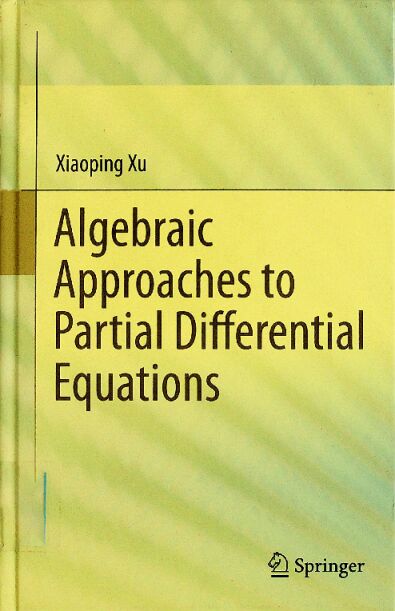
书名:Algebraic approaches to partial differential equations
前言
Partial differential equations are fundamental tools in mathematics,science,andengineering. For instance,electrodynamics is governed by the Maxwell equations, the two-dimensional cubic nonlinear Schrödinger equation is used to describe the propagation of an intense laser beam through a medium with Kerr nonlinearity,and the Navier-Stokes equations are the fundamental equations in fluid dynamics. There are three major ways of studying partial differential equations. The analytic way is to study the existence and uniqueness of certain solutions of partial differential equations and their mathematical properties, whereas the numerical way is to find certain numerical solutions of partial differential equations.In particular,physicists and engineers have developed their own computational methods of finding physical and practically useful numerical solutions, mostly motivated by experiments. The algebraic way is to study symmetries, conservation laws,exact solutions,and complete integrability of partial differential equations.
This book belongs to the third category.It is mainly an exposition of the vari- ous algebraic techniques of solving partial differential equations for exact solutions developed by the author in recent years, with an emphasis on physical equations. such as the Calogero-Sutherland model of quantum many-body systems in one dimension, the Maxwell equations, the free Dirac equations, the generalized acoustic system, the Korteweg and de Vries(KdV)equation, the Kadomtsev and Petviashvili (KP)equation, the equation of transonic gas flows, the short-wave equation, the Khokhlov and Zabolotskaya equation in nonlinear acoustics,the equation of geopotential forecast, the nonlinear Schrödinger equation and coupled nonlinear Schrödinger equations in optics, the Davey and Stewartson equations of three- dimensional packets of surface waves,the equation of dynamic convection in a sea, the Boussinesq equations in geophysics, the incompressible Navier-Stokes equations, and the classical boundary layer equations.
It is well known that most partial differential equations from geometry are treated as equations of elliptic type and most partial differential equations from fluid dynamics are treated as equations of hyperbolic type. Analytically,partial differential equations of elliptic type are easier to solve than those of hyperbolic type.Most of the nonlinear partial differential equations in this book are from fluid dynamics. Our results show that algebraically, partial differential equations of hyperbolic type are easier to solve than those of elliptic type in terms of exact solutions.The algebraic approach and the analytic approach have fundamental differences.
This book was written based on the author's lecture notes on partial differential equations taught at the Graduate University of the Chinese Academy of Sciences. It turned out that thecourse with the same title as the book was welcomed not only by mathematical graduate students but alsoby physical andengineering students.Some engineering faculty members also showed an interest in the course.The bookisselfcontained with a minimal prerequisite of calculus and linear algebra. It progresses according to the complexity of the equations and thesophisticationof the techniques involved. It includes the basic algebraictechniques in ordinary differential equations and a brief introduction to special functions as the preparation for the main context.
In linear partial differential equations, we focus on finding all the polynomial so- lutions and solving initial value problems. Intuitive derivations of easilyused symmetry transformations of nonlinear partial differential equations are given. These transformations generate sophisticated solutions with more parameters from relatively simple ones. They are also used to simplify our process of finding exact solutions. We have extensively used moving frames,asymmetric conditions, stable ranges of nonlinear terms, special functions,and linearizations in our approaches to nonlinear partial differential equations. The exact solutions that we have obtained usually contain multiple parameter functions, and most of them are not of the traveling-wave type.
The book can serve as a research reference book for mathematicians,scientists, and engineers.It can also be treated as a textbook after a proper selection of materials for training students'mathematical skills and enriching their knowledge.Xiaoping Xu Beijing, People's Republic of China 2013
查看更多
目录
Part I Ordinary Differential Equations
1 First-Order Ordinary Differential Equations 1
1.1 Basics 1
1.2 Special Equations 8
2 Higher Order Ordinary Differential Equations 17
2.1 Basics 17
2.2 Method of Undetermined Coefficients 21
2.3 Method of Variation of Parameters 25
2.4 Series Method and Bessel Functions 29
3 Special Functions 37
3.1 Gamma and Beta Functions 37
3.2 Gauss Hypergeometric Functions 43
3.3 Orthogonal Polynomials 47
3.4 Weierstrass’s Elliptic Functions 54
3.5 Jacobian Elliptic Functions 61
Part II Partial Differential Equations
4 First-Order or Linear Equations 67
4.1 Method of Characteristics 68
4.2 Characteristic Strip and Exact Equations 71
4.3 Polynomial Solutions of Flag Equations 74
4.4 Use of Fourier Expansion I 93
4.5 Use of Fourier Expansion II 100
4.6 Calogero–Sutherland Model 117
4.7 Maxwell Equations 126
4.8 Dirac Equation and Acoustic System 134
5 Nonlinear Scalar Equations 141
5.1 Korteweg and de Vries Equation 142
5.2 Kadomtsev and Petviashvili Equation 149
5.3 Equation of Transonic Gas Flows 155
5.4 Short-Wave Equation 161
5.5 Khokhlov and Zabolotskaya Equation 168
5.6 Equation of Geopotential Forecast 172
6 Nonlinear Schrödinger and Davey–Stewartson Equations 179
6.1 Nonlinear Schrödinger Equation 179
6.2 Coupled Schrödinger Equations 187
6.3 Davey and Stewartson Equations 201
7 Dynamic Convection in a Sea 213
7.1 Equations and Symmetries 213
7.2 Moving-Line Approach 216
7.3 Cylindrical Product Approach 219
7.4 Dimensional Reduction 223
8 Boussinesq Equations in Geophysics 231
8.1 Two-Dimensional Equations 231
8.2 Three-Dimensional Equations and Symmetry 247
8.3 Asymmetric Approach I 249
8.4 Asymmetric Approach II 255
8.5 Asymmetric Approach III 261
9 Navier–Stokes Equations 269
9.1 Background and Symmetry 269
9.2 Asymmetric Approaches 273
9.3 Moving-Frame Approach I 285
9.4 Moving-Frame Approach II 296
10 Classical Boundary Layer Problems 317
10.1 Two-Dimensional Problem 317
10.2 Three-Dimensional Problem: General 326
10.3 Uniform Exponential Approaches 332
10.4 Distinct Exponential Approaches 344
10.5 Trigonometric and Hyperbolic Approaches 350
10.6 Rational Approaches 362
References 385
Index 393
查看PDF
查看更多
馆藏单位
中科院文献情报中心