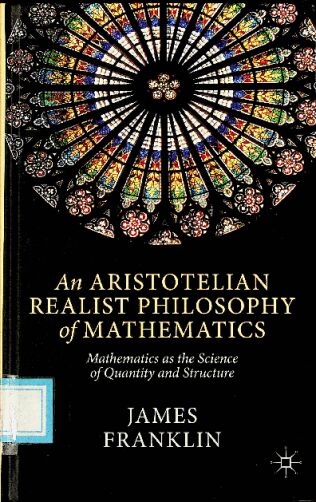
书名:An Aristotelian realist philosophy of mathematics
ISBN\ISSN:9781137400727,1137400722
出版时间:2014
出版社:Palgrave Macmillan,
摘要
Mathematics is as much a science of the real world as biology is. It is the science of the world's quantitative aspects (such as ratio) and structural or patterned aspects (such as symmetry). The book develops a complete philosophy of mathematics that contrasts with the usual Platonist and nominalist options.
查看更多
目录
List of Figures ix
List of Tables x
Introduction 1
Part I The Science of Quantity and Structure
1 The Aristotelian Realist Point of View 11
The reality of universals 11
Platonism and nominalism 12
The reality of relations and structure 15
'Unit-making' properties and sets 16
Causality 17
Aristotelian epistemology 18
2 Uninstantiated Universals and 'Semi-Platonist' Aristotelianism 21
Determinables and determinates 22
Uninstantiated shades of blue and huge numbers 23
Possibles by recombination? 25
Semi-Platonist Aristotelianism 26
3 Elementary Mathematics: The Science of Quantity 31
Two realist theories of mathematics: quantity versus structure 31
Continuous quantity and ratios 34
Discrete quantity and numbers 36
Discrete quantity and sets 38
Discrete and continuous quantity compared 44
Defining 'quantity' 45
4 Higher Mathematics: Science of the Purely Structural 48
The rise of structure in mathematics 48
Structuralism in recent philosophy of mathematics 49
Abstract algebra, groups, and modern pure mathematics 51
Structural commonality in applied mathematics 54
Defining 'structure' 56
The sufficiency of mereology and logic 59
Is quantity a kind of structure? 63
5 Necessary Truths about Reality 67
Examples of necessity 67
Objections and replies 71
6 The Formal Sciences Discover the Philosophers' Stone 82
A brief survey of the formal or mathematical sciences 83
The formal sciences search for a place in the sun 89
Real certainty: program verification 92
Real certainty: the other formal sciences 95
Experiment in the formal sciences 98
7 Comparisons and Objections 101
Frege's limited options 101
The Platonist/nominalist false dichotomy 104
Nominalism 106
Constructions in set theory 108
Avoiding the question: what are sets? 110
Overemphasis on the infinite 111
Measurement and the applicability of mathematics 113
The indispensability argument 114
Modal and Platonist structuralism 117
Epistemology and 'access' 121
Naturalism: non-Platonist realisms 122
8 Infinity 129
Infinity, who needs it? 130
Paradoxes of infinity? 134
'Potential' infinity? 136
Knowing the infinite 140
9 Geometry: Mathematics or Empirical Science? 141
What is geometry? Plan A: multidimensional quantities 143
What is geometry? Plan B: the shapes of possible spaces 146
The grit-or-gunk controversy: does space consist of points? 150
Real non-spatial 'spaces' with geometric structure 153
The space of colours 154
Spaces of vectors 155
The real space we live in 156
Non-Euclidean geometry: the 'loss of certainty' in mathematics? 160
Part II Knowing Mathematical Reality
10 Knowing Mathematics: Pattern Recognition and Perception of Quantity and Structure 165
The registering of mathematical properties by measurement devices and artificial intelligence 167
Babies and animals: the simplest mathematical perception 172
Animal and infant knowledge of quantity 173
Perceptual knowledge of pattern and structure 176
11 Knowing Mathematics: Visualization and Understanding 180
Imagination and the uninstantiated 180
Visualization for understanding structure 181
The return of visualization, and its neglect 185
Why visualization has been persona non grata in the philosophy of mathematics 185
The mind and structural properties: the mysteriousness of understanding 188
The chiliagon and the limits of visualization 191
12 Knowing Mathematics: Proof and Certainty 192
Proof: a chain of insights 192
Symbolic proof 'versus' visualization: their respective advantages 196
Proof: logicist, 'if-thenist' and formalist errors 197
Axioms, formalization and understanding 200
Counting 202
Knowing the infinite 203
13 Explanation in Mathematics 207
Explanation in pure mathematics 208
How do pure mathematical explanations fit into accounts of explanation? 212
Geometrical explanation in science 215
Non-geometrical mathematical explanation in science 217
Aristotelian realism for explanatory success 220
14 Idealization: An Aristotelian View 222
Applied mathematics without idealization 224
Approximation with simple structures, not idealization 225
Negative and complex numbers, ideal points, and other extensions of ontology 229
Zero 234
The empty set 238
15 Non-Deductive Logic in Mathematics 241
Estimating the probability of conjectures 242
Evidence for (and against) the Riemann Hypothesis 245
The classification of finite simple groups 250
Probabilistic relations between necessary truths? 254
The problem of induction in mathematics 257
Epilogue: Mathematics, Last Bastion of Reason 260
Notes 263
Select Bibliography 302
Index 305
查看PDF
查看更多
作者简介
James Franklin is Professor of Mathematics at the University of New South Wales, Australia and founder of the 'Sydney School' in the philosophy of mathematics. His books include The Science of Conjecture: Evidence and Probability Before Pascal; Corrupting the Youth: A History of Philosophy in Australia; and What Science Knows.
查看更多
馆藏单位
中科院文献情报中心