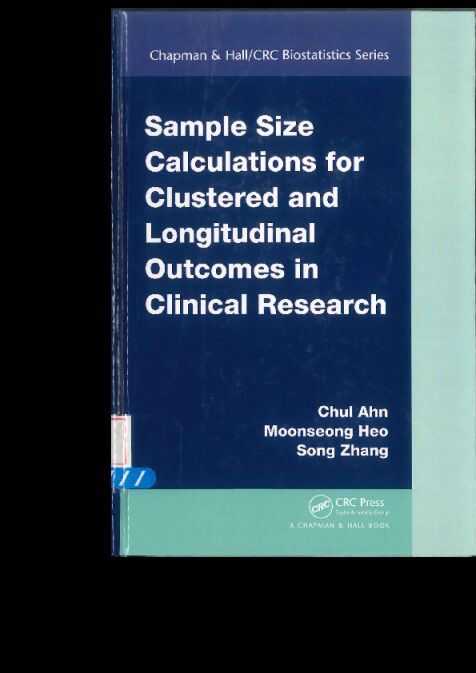
书名:Sample size calculations for clustered and longitudinal outcomes in clinical research
责任者:Chul Ahl | Moonseong Heo | Song Zhang.
ISBN\ISSN:9781466556263,1466556269
出版时间:2015
出版社:CRC Press, Taylor & Francis Group,
前言
One of the most common questions statisticians encounter during interaction with clinical investigators is "How many subjects do I need for this study?" Clinicians are often surprised to find out that the required sample size depends on a number of factors. Obtaining such information for sample size calculation is not trivial, and often involves preliminary studies, literature review, and, more than occasionally, educated guess. The validity of clinical research is judged not by the results but by how- it is designed and conducted. Accurate sample size calculation ensures that a study has adequate power to detect clinically meaningful effects and avoids the waste in resources and the risk of exposing excessive patients to experimental treatments caused by an overpowered study.A\In this book we focus on sample size determination for studies with correlated outcomes, which are widely implemented in medical, epidemiological, and behavioral studies. Correlated outcomes are usually categorized into two types: clustered and longitudinal. The former arises from trials where randomization is performed at the level of some aggregates (e.g., clinics) of research subjects (e.g., patients). The latter arises when the outcome is measured at multiple time points during follow-up from each subject. A key difference between these two types is that for a clustered design, subjects within a cluster are considered exchangeable, while for a longitudinal design, the multiple measurements from the each subject are distinguished by their unique time stamps.A\Designing a randomized trial with correlated outcomes poses special challenges and opportunities for researchers. Appropriately accounting for the correlation with different structures requires more sophisticated methodologies for analysis and sample size calculation. In practice it is also likely that researchers might encounter correlated outcomes with a hierarchical structure. For example, multiple levels of nested clustering (e.g., patients nested in clinics and clinics nested in hospital systems) can occur, and such designs can become more complicated if longitudinal measurements are obtained from each subject. Missing data leads to the challenge of "partially" observed data for clinical trials with correlated outcomes, and its impact on sample size requirement depends on many factors: the number of longitudinal measurements, the structure and strength of correlation, and the distribution of missing data. On the other hand, researchers enjoy some additional flexibility in designing randomized trials with correlated outcomes. When multiple levels of clustering are involved, the level at which to perform randomization actually becomes a design parameter, which can greatly impact trial administration, analysis, and sample size requirement. This issue is explored in Chapters 5 and 6. Another example is that in longitudinal studies, to certain extent, researchers can compensate the lack of unique subjects by increasing the number of measurements from each subject, and vice versa. This feature has profound implication for the design of clinical trials where the cost of recruiting an additional subject is drastically different from the cost of obtaining an additional measurement from an existing subject. It requires researchers to explore the trade-off between the number of subjects and the number of measurements per subject in order to achieve the optimal power under a given financial constraint. We explore this topic in Chapters 3 and 4.A\The outline of this book is as follows. In Chapter 1 we review sample size determination for independent outcomes. Advanced readers who are already familiar with sample size problems can skip this chapter. In Chapter 2 we explore sample size determination for variants of clustered trials, including one- and two-sample trials, continuous and binary outcomes, stratified cluster design, and nonparametric approaches. In Chapter 3 we review sample size methods based on summary statistics (such as individually estimated means or slopes) obtained from longitudinal outcomes. In Chapter 4 we present sample size determination based on GEE approaches for various types of correlated outcomes, including continuous, binary, and count. The impact of missing data, correlation structures, and financial constraints is investigated. In Chapter 5 we present sample size determination based on mixed-effects model approaches for randomized clinical trials with two level data structure. Longitudinal and cross-sectional factorial designs are explored. In Chapter 6 we further extend the mixed-effects model sample size approaches to scenarios where three level data structures are involved in randomized trials.A\We wish this book to serve as a useful resource for biostatisticians, clinical investigators, epidemiologists, and social scientists whose research involves randomized trials with correlated outcomes. While jointly addressing the overarching theme of sample size determination for correlated outcome under such settings, individual chapters are written in a self-contained manner so that readers can explore specific topics relevant to their research projects without having to refer to other chapters.A\We give special thanks to Dr. Mimi Y. Kim for her enthusiastic support by providing critical reviews and suggestions, examples, edits, and corrections throughout the chapters. Without her input, this book would have not been in the present form. We also thank Acquisitions Editor David Grubbs for providing the opportunity to work on this book, and Production Manager Suzanne Lassandro for her outstanding support in publishing this book. In addition, we thank the support of the University of Texas Southwestern Medical Center and the Albert Einstein College of Medicine.Chul Ahn, PhD; Moonseong Heo, PhD; Song Zhang, PhD
查看更多
目录
Preface ix
List of Figures xi
List of Tables xiii
1 Sample Size Determination for Independent Outcomes 1
1.1 Introduction 1
1.2 Precision Analysis 2
1.3 Power Analysis 5
1.4 Further Readings 18
2 Sample Size Determination for Clustered Outcomes 23
2.1 Introduction 23
2.2 One-Sample Clustered Continuous Outcomes 24
2.3 One-Sample Clustered Binary Outcomes 28
2.4 Two-Sample Clustered Continuous Outcomes 34
2.5 Two-Sample Clustered Binary Outcomes 38
2.6 Stratified Cluster Randomization for Binary Outcomes 42
2.7 Nonparametric Approach for One-Sample Clustered Binary Outcomes 45
2.8 Further Readings 51
3 Sample Size Determination for Repeated Measurement Outcomes Using Summary Statistics 61
3.1 Introduction 61
3.2 Information Needed for Sample Size Estimation 62
3.3 Summary Statistics 64
3.4 Further Readings 78
4 Sample Size Determination for Correlated Outcome Measurements Using GEE 83
4.1 Motivation 83
4.2 Review of GEE 85
4.3 Compare the Slope for a Continuous Outcome 90
4.4 Test the TAD for a Continuous Outcome 110
4.5 Compare the Slope for a Binary Outcome 119
4.6 Test the TAD for a Binary Outcome 123
4.7 Compare the Slope for a Count Outcome 126
4.8 Test the TAD for a Count Outcome 130
4.9 Further Readings 134
5 Sample Size Determination for Correlated Outcomes from Two-Level Randomized Clinical Trials 149
5.1 Introduction 149
5.2 Statistical Models for Continuous Outcomes 150
5.3 Testing Main Effects 151
5.4 Two-Level Longitudinal Designs: Testing Slope Differences 158
5.5 Cross-Sectional Factorial Designs: Interactions between Treatments 167
5.6 Longitudinal Factorial Designs: Treatment Effects on Slopes 172
5.7 Sample Sizes for Binary Outcomes 176
5.8 Further Readings 181
6 Sample Size Determination for Correlated Outcomes from Three-Level Randomized Clinical Trials 187
6.1 Introduction 187
6.2 Statistical Model for Continuous Outcomes 187
6.3 Testing Main Effects 189
6.4 Testing Slope Differences 200
6.5 Cross-Sectional Factorial Designs: Interactions between Treatments 211
6.6 Longitudinal Factorial Designs: Treatment Effects on Slopes 218
6.7 Sample Sizes for Binary Outcomes 223
6.8 Further Readings 230
Index 235
查看PDF
查看更多
馆藏单位
中国医科院医学信息研究所