书名:Statistical computing in nuclear imaging
摘要
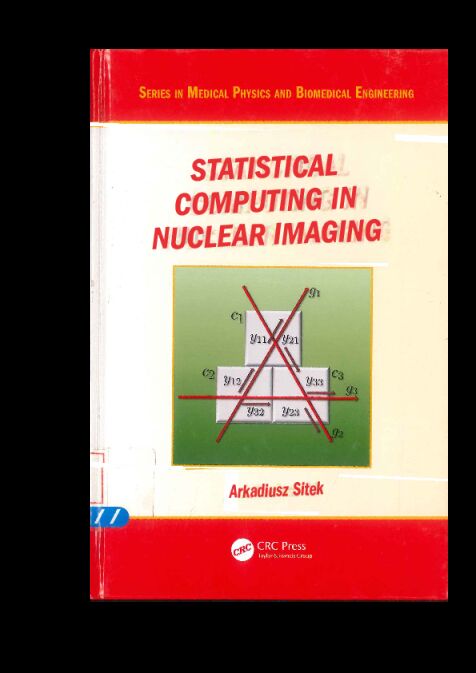
Statistical Computing in Nuclear Imaging introduces aspects of Bayesian computing in nuclear imaging. The book provides an introduction to Bayesian statistics and concepts and is highly focused on the computational aspects of Bayesian data analysis of photon-limited data acquired in tomographic measurements.
Basic statistical concepts, elements of decision theory, and counting statistics, including models of photon-limited data and Poisson approximations, are discussed in the first chapters. Monte Carlo methods and Markov chains in posterior analysis are discussed next along with an introduction to nuclear imaging and applications such as PET and SPECT.
The final chapter includes illustrative examples of statistical computing, based on Poisson-multinomial statistics. Examples include calculation of Bayes factors and risks as well as Bayesian decision making and hypothesis testing. Appendices cover probability distributions, elements of set theory, multinomial distribution of single-voxel imaging, and derivations of sampling distribution ratios. C++ code used in the final chapter is also provided.
The text can be used as a textbook that provides an introduction to Bayesian statistics and advanced computing in medical imaging for physicists, mathematicians, engineers, and computer scientists. It is also a valuable resource for a wide spectrum of practitioners of nuclear imaging data analysis, including seasoned scientists and researchers who have not been exposed to Bayesian paradigms.
查看更多
目录
List of Figures xi
List of Tables xvi
About the Series xviii
Preface xxi
About the Author xxiii
Chapter 1 Basic statistical concepts 1
1.1 Introduction 1
1.2 Before- and after-the-experiment concepts 2
1.3 Definition of probability 6
1.3.1 Countable and uncountable quantities 8
1.4 Joint and conditional probabilities 10
1.5 Statistical model 13
1.6 Likelihood 17
1.7 Pre-posterior and posterior 19
1.7.1 Reduction of pre-posterior to posterior 19
1.7.2 Posterior through Bayes theorem 19
1.7.3 Prior selection 20
1.7.4 Examples 22
1.7.5 Designs of experiments 23
1.8 Extension to multi-dimensions 25
1.8.1 Chain rule and marginalization 26
1.8.2 Nuisance quantities 27
1.9 Unconditional and conditional independence 29
1.10 Summary 34
Chapter 2 Elements of decision theory 37
2.1 Introduction 37
2.2 Loss function and expected loss 39
2.3 After-the-experirnent decision making 42
2.3.1 Point estimation 43
2.3.2 Interval estimation 48
2.3.3 Multiple-alternative decisions 50
2.3.4 Binary hypothesis testing/detection 52
2.4 Beforc-the-experiment decision making 56
2.4.1 Bayes risk 58
2.4.2 Other methods 62
2.5 Robustness of the analysis 64
Chapter 3 Counting statistics 67
3.1 Introduction to statistical models 67
3.2 Fundamental statistical law 69
3.3 General models of photon-limited data 71
3.3.1 Binomial statistics of nuclear decay 71
3.3.2 Multinomial statistics of detection 72
3.3.3 Statistics of complete data 77
3.3.4 Poisson-multinomial distribution of nuclear data 84
3.4 Poisson approximation 88
3.4.1 Poisson statistics of nuclear decay 88
3.4.2 Poisson approximation of nuclear data 90
3.5 Normal distribution approximation 93
3.5.1 Approximation of binomial law 94
3.5.2 Central limit theorem 95
Chapter 4 Monte Carlo methods in posterior analysis 99
4.1 Monte Carlo approximations of distributions 99
4.1.1 Continuous distributions 99
4.1.2 Discrete distributions 104
4.2 Monte Carlo integrations 107
4.3 Monte Carlo summations 110
4.4 Markov chains 111
4.4.1 Markov processes 113
4.4.2 Detailed balance 114
4.4.3 Design of Markov chain 116
4.4.4 Metropolis-Hastings sampler 118
4.4.5 Equilibrium 120
4.4.6 Resampling methods (bootstrap) 126
Chapter 5 Basics of nuclear imaging 129
5.1 Nuclear radiation 130
5.1.1 Basics of nuclear physics 130
5.1.1.1 Atoms and chemical reactions 130
5.1.1.2 Nucleus and nuclear reactions 131
5.1.1.3 Types of nuclear decay 133
5.1.2 Interaction of radiation with matter 136
5.1.2.1 Inelastic scattering 137
5.1.2.2 Photoelectric effect 138
5.1.2.3 Photon attenuation 138
5.2 Radiation detection in nuclear imaging 141
5.2.1 Semiconductor detectors 142
5.2.2 Scintillation detectors 143
5.2.2.1 Photomultiplier tubes 144
5.2.2.2 Solid-state photomultipliers 145
5.3 Nuclear imaging 147
5.3.1 Photon-limited data 150
5.3.2 Region of response (ROR) 152
5.3.3 Imaging with gamma camera 153
5.3.3.1 Gamma camera 153
5.3.3.2 SPECT 157
5.3.4 Positron emission tomography (PET) 159
5.3.4.1 PET nuclear imaging scanner 159
5.3.4.2 Coincidence detection 161
5.3.4.3 ROR for PET and TOF-PET 162
5.3.4.4 Quantitation of PET 165
5.3.5 Compton imaging 166
5.4 Dynamic imaging and kinetic modeling 168
5.4.1 Compartmental model 169
5.4.2 Dynamic measurements 171
5.5 Applications of nuclear imaging 173
5.5.1 Clinical applications 173
5.5.2 Other applications 174
Chapter 6 Statistical computing 179
6.1 Computing using Poisson-multinomial distribution (PMD) 179
6.1.1 Sampling the posterior 180
6.1.2 Computationally efficient priors 182
6.1.3 Generation of Markov chain 186
6.1.4 Metropolis-Hastings algorithm 187
6.1.5 Origin ensemble algorithms 190
6.2 Examples of statistical computing 193
6.2.1 Simple tomographic system (STS) 194
6.2.2 Image reconstruction 195
6.2.3 Bayes factors 198
6.2.4 Evaluation of data quality 200
6.2.5 Detection—Bayesian decision making 203
6.2.6 Bayes risk 205
Appendix A Probability distributions 209
A.1 Univariate distributions 209
A.1.1 Binomial distribution 209
A.1.2 Gamma distribution 209
A.1.3 Negative binomial distribution 209
A.1.4 Poisson-binomial distribution 210
A.1.5 Poisson distribution 210
A.1.6 Uniform distribution 210
A.1.7 Univariate normal distribution 210
A.2 Multivariate distributions 211
A.2.1 Multinomial distribution 211
A.2.2 Multivariate normal distribution 211
A.2.3 Poisson-multinoraial distribution 211
Appendix B Elements of set theory 213
Appendix C Multinomial distribution of single-voxel imaging 217
Appendix D Derivations of sampling distribution ratios 221
Appendix E Equation (6.11) 223
Appendix F C++ OE code for STS 225
References 231
Index 239
查看PDF
查看更多
馆藏单位
中国医科院医学信息研究所