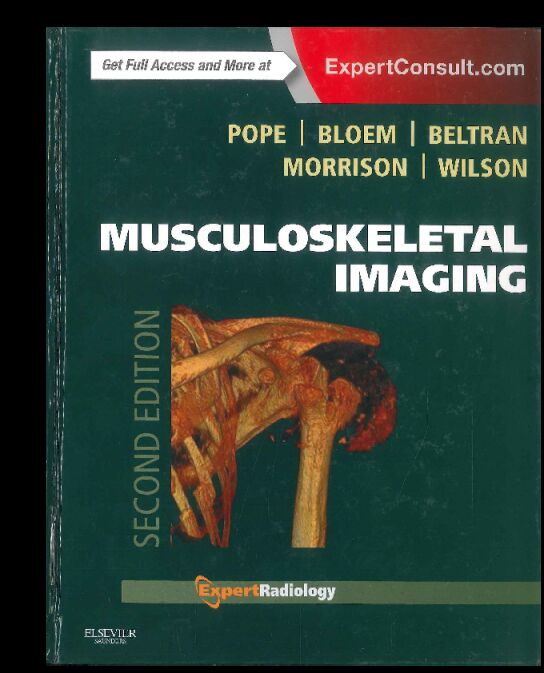
书名:Musculoskeletal imaging
责任者:Thomas L. Pope ... [et al.]. | Bloem, Hans L. | Beltran, Javier | Morrison, William B. | Wilson, David J.
出版时间:2015
出版社:Elsevier/Saunders,
前言
The publishing business is in the midst of a revolution. It's a brave new world! Authors, readers, and publishers are caught in the torrents of this transformation. All are confronted by the impact of the Internet and other electronic communications on traditional paper publications. Newspapers and magazines were the first to be affected, but fiction and non-fiction literature was soon to follow. None is spared. Even standard scientific textbooks are affected.
Only dauntless souls take on new ventures in this environment. What should the author write? In what electronic and paper formats should a publisher publish? And what is the reader likely to buy? At this time there are no commonly accepted or recognized standards. It's a dilemma. You're on your own.
In the case of the authors and publishers of the second edition of Musculoskeletal Imaging, the problem is compounded. In 2008 they produced and published the initial edition of what has become a highly regarded and genuinely useful text devoted to the entire field of musculoskeletal imaging. The two-volume first edition was immediately recognized as an instant classic. Since then, however, significant advances in musculoskeletal imaging—particularly in MRI and CT—have occurred, and the authors realized that revisions in the original text incorporating the new developments in the field would be necessary to ke epthe book up to date and in line with current practice.
The authors and publishers further appreciated the rapidly developing role that electronic and online sources have begun to play in the everyday educational and working environments of radiologists. Therefore they decided to develop an electronic, online resource to complement the print edition.
The principal advantages of print are permanence and portability. Once printed, there can be no changes in the text or illustrations. The disadvantages are cost to produce and purchase the print edition and limitations as to the amount of material, illustrations, and text that print books may contain; the more material included, the more expensive the book. A distinct disadvantage for radiology is the limitation on the number, size, and quality of images that may be included in the printed text; the larger the images and the higher their quality, the greater the costs involved.
The electronic format has been shown to have at least three distinct advantages. First among them is a lower cost to produce and purchase the material, as well as the potential to include much more content at a given cost. Second, there is the advantage of the convenience of immediate online access at the reading desk or wherever you might be at home or away while interpreting clinical studies. Finally, electronic formats allow images that are of the highest quality and are significantly larger than is possible in print.
What is the best way to combine and accommodate an electronic, online resource with a newly revised print edition? The authors devised a specific and separate vision for both the print and the electronic versions of the book.
The printed textbook is focused on core material; it is a quick, go-to reference for the clinical radiologist and contains the book's most essential information in a condensed, abbreviated form, emphasizing the clinical features of disease, the appropriate imaging to be obtained, and the particular imaging characteristics of each disease or condition.
查看更多
目录
1 General Imaging Principles 1
PART 1 INJURY
SECTION ONE AXIAL SKELETON
2 General Principles of Osseous Injury 13
3 Imaging of Facial and Skull Trauma 21
4 Cervical Spine Injuries 32
5 Injury of the Thoracic Cage and Thoracolumbar Spine 60
SECTION TWO APPENDICULAR SKELETON Upper Extremities
6 Normal Shoulder 70
7 Osseous Injuries of the Shoulder Girdle 87
8 Shoulder Impingement Syndromes 99
9 Glenohumeral Instability 119
10 Normal Elbow 134
11 Acute Osseous Injury of the Elbow and Forearm 148
12 Soft Tissue Injury to the Elbow 157
13 Normal Wrist 169
14 Acute Osseous Injury to the Wrist 183
15 Internal Derangement of the Wrist 189
16 Acute Osseous Trauma to the Hand 207
17 Compressive and Entrapment Neuropathies of the Upper Extremities 214
18 Soft Tissue Injuries of the Hand and Wrist 224
Lower Extremities
19 Normal Pelvis and Hip 244
20 Acute Osseous Injury to the Pelvis and Acetabulum 254
21 Athletic Pubalgja 275
22 Acute Osseous Injury to the Hip and Proximal Femur 284
23 Internal Derangement of the Hip and Proximal Femur 307
24 Normal Knee 324
25 Acute Osseous Injury to the Knee 333
26 Internal Derangement of the Knee: Meniscal Injuries 350
27 Internal Derangement of the Knee: Ligament Injuries 364
28 Internal Derangement of the Knee: Tendon Injuries 379
29 Internal Derangement of the Knee: Cartilage and Osteochondral Injuries 400
30 Normal Ankle and Foot 414
31 Acute Osseous Injury to the Ankle and Foot 431
32 Soft Tissue Injury to the Ankle: Ligament Injuries 455
33 Soft Tissue Injury to the Ankle: Tendon Injuries 474
34 Soft Tissue Injury to the Ankle: Osteochondral Injuries and Impingement 493
35 Compressive and Entrapment Neuropathies of the Lower Extremity 507
36 Imaging of the Forefoot 522
SECTION THREE PEDIATRIC INJURIES
37 Lower Extremity Injuries in Children 534
38 Upper Extremity Injuries in Children 554
39 Skeletal Manifestations of Pediatric Nonaccidental Injury 579
SECTION FOUR OTHER MUSCULOSKELETAL INJURIES
40 Stress Injury 590
41 Radiation Effects in the Musculoskeletal System 602
42 Complications of Osseous Trauma 610
43 Muscle Injury and Sequelae 616
44 Complex Regional Pain Syndrome 628
PART 2 ARTHROPATHIES AND NEUROLOGIC/MUSCULAR DISORDERS AND CONNECTIVE TISSUE DISEASE
45 Degenerative Disorders of the Spine 634
46 Aging 649
47 Degenerative Disease: Physiology and Advanced Imaging 655
48 Rheumatoid Arthritis 666
49 Psoriatic Arthritis and Psoriatic Spondyloarthropathy 675
50 Reactive Arthritis 684
51 Ankylosing Spondylitis 691
52 Progressive Scleroderma 700
53 Systemic Lupus Erythematosus 703
54 Mixed Connective Tissue Disease 707
55 Juvenile Idiopathic Arthritis 711
56 Idiopathic Inflammatory Myopathy 716
57 Hemochromatosis 721
58 Ochronosis 724
59 Diffuse Idiopathic Skeletal Hyperostosis and Ossification of the Posterior Longitudinal Ligament 727
60 Gout 730
61 Crystal-Related Arthritis 746
62 Neuropathic Osteoarthropathy 761
PART 3 INFECTION
63 Noninflammatory Intraarticular Pathology 766
64 Soft Tissue Infection: Cellulitis, Pyomyositis, Abscess, Septic Arthritis 772
65 Appendicular Infection 779
66 Spinal Infection 791
67 Diabetic Pedal Infection 805
68 Pediatric Infections 815
69 HIV Infection and AIDS 823
70 Atypical Mycobacterial Infection 833
PART 4 HEMATOLOGIC AND VASCULAR DISEASES
71 General Principles of MR I of the Bone Marrow 868
72 Ischemic Bone Lesions 869
73 Hemophilia and Related Disorders 870
74 Sickle Cell Anemia 871
75 Thalassemia 872
76 Myelofibrosis 873
PART 5 METABOLIC, HORMONAL, AND SYSTEMIC DISEASE
77 Osteoporosis 874
78 Hyperparathyroidism, Renal Osteodystrophy, Osteomalacia, and Rickets 889
79 Amyloidosis 890
80 Pituitary and Thyroid Disorders 891
81 Gaucher Disease 892
82 Storage Diseases 893
83 Osteogenesis Imperfecta 894
84 Marfan Syndrome 895
85 Paget Disease 896
86 Hypertrophic Osteoarthropathy 897
87 Sarcoidosis 898
88 Tuberous Sclerosis 899
89 Drug-Related Bone and Soft Tissue Disorders 900
PART 6 MUSCULOSKELETAL TUMORS AND TUMOR-LIKE LESIONS
90 The Patient with a Tumor or a Tumor-Like Lesion of Bone 901
91 The Patient with a Soft Tissue Lump 917
92 Primary Bone Tumors 924
93 Myeloma 944
94 Tumor-Like Lesions of Bone 959
95 Soft Tissue Tumors 970
96 Tumor-Like Soft Tissue Lesions 996
97 Metastatic Disease 1016
98 Treatment Strategies for Musculoskeletal Tumors and Tumor-Like Lesions 1033
99 Staging Bone and Soft Tissue Tumors 1046
100 Monitoring Therapy in Bone and Soft Tissue Tumors 1054
PART 7 CLINICALLY RELEVANT DEVELOPMENT DYSPLASIAS
101 Focal Growth Disturbances 1070
102 Developmental Dysplasia of the Hip 1074
103 Coalitions 1080
104 Dysplasias 1087
105 Spinal Deformity 1102
PART 8 POSTSURGICAL IMAGING AND COMPLICATIONS
106 Principles and Complications of Orthopedic Hardware 1107
107 Postoperative Shoulder 1123
108 Postoperative Elbow, Wrist, and Hand 1136
109 Postoperative Hip 1162
110 Postoperative Knee 1171
111 Postoperative Ankle and Foot 1194
112 Imaging of the Residual Limb after Amputation 1206
113 Postoperative Infections 1211
PART 9 MISCELLANEOUS
114 Temporomandibular Joint 1217
115 Dental Imaging 1218
116 Normal Variants 1219
PART 10 MUSCULO5KELETAL PROCEDURES
117 Biopsy: Soft Tissue 1220
118 Percutaneous Biopsy of the Appendicular Skeleton 1221
119 Percutaneous Biopsy of the Spine 1222
120 Tumor Ablation 1223
121 Spinal Injections 1224
122 Discography 1225
123 Vertebroplasty and Kyphoplasty 1226
124 Percutaneous Intradiskal Therapies 1227
125 Ultrasound Procedures 1228
APPENDICES
Appendix 1 Measurements Most Frequently Used in Orthopedic Imaging 1229
Appendix 2 Orthopedic Devices 1231
Appendix 3 Fractures with Names 1232
Appendix 4 Diseases with Names 1233
Appendix 5 Classic Signs and Findings in Musculoskeletal Radiology 1234
查看PDF
查看更多
馆藏单位
中国医科院医学信息研究所