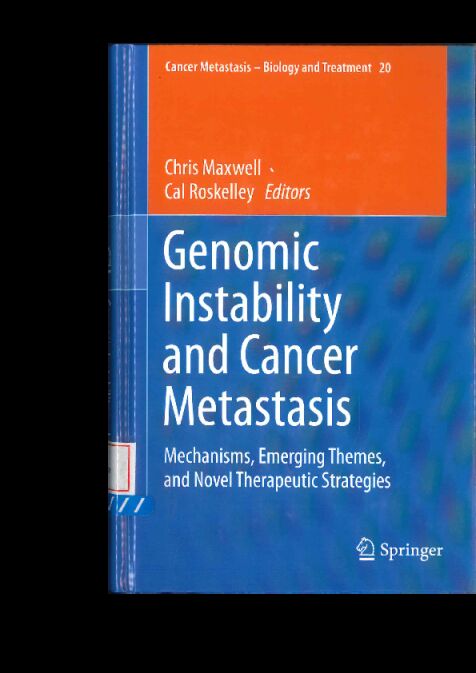
书名:Genomic instability and cancer metastasis
责任者:Chris Maxwell | Cal Roskelley
前言
In 1975, the mortality rate for all cancers in the United States was 199 deaths per 100,000 people in the population. The most recent statistics available (2006-2010) indicate that the current mortality rate is 176.4 deaths per 100,000 people, which represents a modest 11 % reduction in the past 35 years. It has been estimated that approximately 90% of cancer deaths arise from the metastatic spread of primary tumors, Thus, any future improvement in the overall cancer mortality rate will depend upon a more thorough understanding of the properties that enable the metastatic process.A\Cancers are diverse and complex tissues. Conceptually, it is proposed that cancers possess shared hallmarks, but it may be more correct to consider cancer as an evolving, heterogeneous, and dynamic entity that is responsive to a plethora of selective events, both intrinsic to the tumor (e.g., hypoxia) and extrinsic (e.g., combination chemotherapy). Within the framework of an evolving tissue, it is clear that the extent of heterogeneity may provide selective advantages. Moreover, scientists have long known that cancer cells display significant intra-tumoral heterogeneity at the genetic level, which falls under the umbrella term of genomic instability. Therefore, it is reasonable to propose the interplay between tumor heterogeneity, which may be enabled by genomic instability, and an enhanced ability to withstand the selection pressures applied throughout the metastatic process.A\This book connects cancer metastasis with genomic instability in a comprehensive manner through four sections. Section 1 outlines the fundamental mechanisms that occur at tissue, cellular and molecular levels and regulate the processes of cancer metastasis, genomic stability, and DNA damage response, respectively. Section 2 discusses the model systems that will enable our better understanding of the metastatic process and genomic instability through experimentation performed in silico, in vitro, and in vivo. Section 3 reviews emerging themes and frameworks for the understanding of the contributions of non-tumor cells to the metastatic process (ex., tumor microenvironment, mechanotransduction, and immunomodulation). Finally, Section 4 discusses new therapeutic approaches designed to overcome the unique challenges presented by the heterogeneous and metastatic tumor.A\Section 1 takes a reductionist approach to describe the mechanisms responsible for the maintenance of tissue and cellular integrity starting with an examination of the tumor tissue, followed by a discussion of processes that prevent instability at the genome level, and ending with a discussion of molecular pathways that act at the base-pair level to maintain integrity. Drs. Rodenhiser and Chambers (London Regional Cancer Clinic, Canada) introduce the metastatic tumor as an evolving tissue that presents many challenges, including diversity and dynamic heterogeneity, which must be interrogated in the clinic if novel treatments are to be successful. Dr. Connell and colleagues (University of British Columbia, Canada) outline the pathways in the normal cell, or the malignant tumor cell, that are responsible for the prevention of genomic instability and, when compromised, the promotion of heterogeneity. Dr. El-Khamisy and colleagues (University of Sheffield, UK and Helmy Institute, Egypt) review the diverse molecular pathways that fall under the umbrella term of the DNA damage response, and discuss the intimate relationship between loss of function in each of these pathways and cancer predisposition.A\More complete knowledge of cancer metastasis, and the complex interplay between regulators that are found in the cancer cell, the tumor tissue and within the organism inflicted with cancer, will be born from studies that encompass in sili- co, in vitro, and in vivo model systems, each of which are reviewed in Section 2. Dr. Costes and colleagues (Lawrence Berkeley National Laboratories, USA) utilize 3D automated foci detection and computational modeling to understand and track the properties and kinetics for repair of DNA double strand breaks. Chapter 4 outlines how integration of mathematical models with irradiation data, a highly quantitative and reproducible manner to induce DNA damage, enables the synthesis of new knowledge in the fields of cancer initiation, detection and progression. In Chapter 5, Dr. Bennewith and colleagues (BC Cancer Agency and Dalhousie University, Canada) discuss a variety of animal models and the strengths and considerations when using these models to a dress specific research questions, which span from high-throughput analysis of novel compounds to dissection of the relative contributions of individual gene products during defined stages of cancer metastasis, from local invasion to distal entrenchment and expansion.A\In 2000, Hanahan and Weinberg outlined six hallmarks of cancer; only one of the six original hallmarks of cancer (i.e., they stimulate the growth of blood vessels to supply nutrients to the tumor) identified a property that was extrinsic to the tumor cell. It is increasing clear, however, that non-tumor cells, in the cancer tissue and the patient afflicted with cancer, are critical to cancer progression and metastasis, including, but not limited to, the role of tumor-stroma interactions and the tumor microenvironment, mechanical cues provided from the environment to the tumor, and immunomodulation. Section 3 reviews these emerging themes in the field of tumor microenvironment and cancer metastasis. In Chapter 6, Dr. Calvin Roskelley (University of British Columbia, Canada) provides an overview of microenviron-mental control of cancer metastasis while recent advances in the fields of mechano-transduction in the tumor and immunosurveillance are detailed by Dr. Nelson and colleagues (Princeton University, USA) and Dr. Gregor Reid (University of British Columbia, Canada) in Chapters. 7 and 8, respectively.A\Prevention and treatment of metastatic tumor spread may represent the most significant challenge of medical oncology. In Chapter 8, Dr. Reid reviews the cross-talk between immune cells and cancer cells; the controlled regulation of these dynamic processes through chemical or cell-based therapies may allow for improved im- munosurveillance of metastatic cells. While tumor heterogeneity enabled through genome instability likely provides the tumor advantages against conventional che- motherapeutic and irradiation treatments, it is hoped that molecular-targeted therapies can turn the table by targeting pathways that are non-essential in normal tissue but, due to the loss of parallel pathways, are essential to tumor cells. In Chapter 9, Dr.McManus and colleagues (University of Manitoba, Canada) utilize colorectal cancer as the framework within which to introduce the concept of synthetic lethality and review the recent therapeutic advances gained through the targeting of deficient DNA repair pathways. Finally, a significant hurdle to the success of any systemic therapy, including those that may eventually be used to combat metastatic disease, is the efficient and specific delivery of the therapeutic agent to the target cell or tumor. In Chapter 10, Drs. Hauser-Kawaguchi and Luyt (University of Western Ontario, Canada) review the emerging field of nanomedicine and the utility of nanoparticles for improved cancer imaging and drug delivery.
查看更多
目录
1 Cancer Metastasis: Tracking and Attacking a Moving Target 1
2 The Generation, Detection, and Prevention of Genomic Instability During Cancer Progression and Metastasis 15
3 DNA Damage Response Pathways in Cancer Predisposition and Progression 39
4 Mathematical Modeling for DNA Repair, Carcinogenesis and Cancer Detection 75
5 Animal Models of Metastasis 95
6 Microenvironmental Control of Metastatic Progression 125
7 Mechanotransduction, Metastasis and Genomic Instability 139
8 Immunomodulation and Genomic Instability 159
9 Synthetic Genetic Approaches in Colorectal Cancer: Exploiting and Targeting Genome Instability 179
10 Nanomedicine-Nanoparticles in Cancer Imaging and Therapy 205
Index 245
查看PDF
查看更多
馆藏单位
中国医科院医学信息研究所