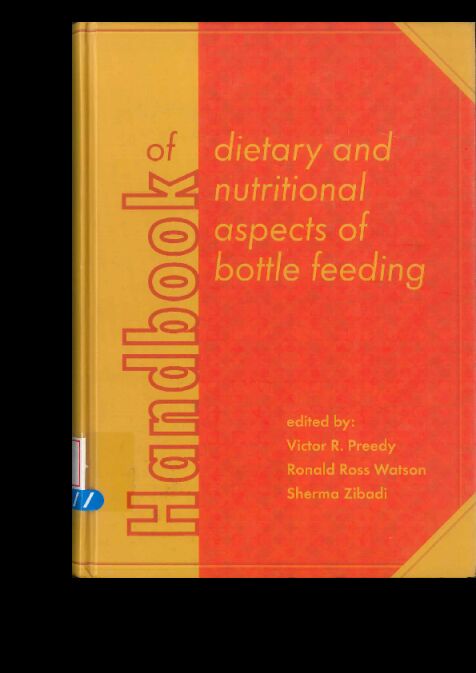
书名:Handbook of dietary and nutritional aspects of bottle feeding
责任者:Victor R. Preedy | Ronald Ross Watson | Sherma Zibadi.
ISBN\ISSN:9086862233,9789086862238
出版时间:2014
出版社:Wageningen Academic Publishers,
前言
Newborn babies are usually fed via the breast which ensures optimal development and emotional mother-child bonding. Indeed the World Health Organization has characterized features of normative growth in children who are exclusively breast fed. However, in some circumstances breast feeding may be either inadequate or impractical. Breast feeding rates and duration are dependent upon the support of families and communities and there are also socio-geographical variations in breast feeding rates and duration. Historically, deficiencies in the provision of breast milk were addressed by wet-nurse feeding but this was superseded by the introduction of artificial milk feeds, i.e. formula or bottle feeds. Infants may also be fed exclusively on bottle feeds or part breast-part bottle when feeding practices are in transition. The formula of the artificial milk will also vary depending on the stage of development. However, seeking knowledge about the uses, disadvantages, and future of formula feeds has been problematically as there are numerous bibliographic sources each with different focal points. The 'Handbook of dietary and nutritional aspects of bottle feeding' addresses these limitations by covering formula feeds in the most comprehensive way. Preclinical studies are also reported to advance the understanding of how the milk formulas work or behave at fundamental levels.A\The 'Handbook of dietary and nutritional aspects of bottle feeding' is divided in six parts:1.Introductory text, prevalence and situations.2.Formulations, composition and features of formula feeding.3.Microbiological and chemical contaminants in infant formulas.4.Allergy and immunology.5.Effects on physical development and metabolic responses.6.Effects on psychological and neurological development.A\It is important to point out that this book is not an endorsement for artificial feeding in place of breast feeding. All authors are required to sign a declaration so that any sources of funding and commercial involvement are fully transparent.A\Coverage in Part 1 covers historical and international aspects (South American, African and Chinese perspectives), sensory features, flavour learning and satiation, appetite, effects of caesarean deliveries, emergencies, powdered and liquid formulas and growth curves. In Part 2 there are chapters on composition, soy protein, effect of sterilization, lipid peroxidation, polyamines, vitamin D, parathormone, milk fortifiers, prebiotics, probiotics and symbiotics, thickening agents and meconium. Part 3 includes material on Staphylococcus aureus, Cronobacter spp., Salmonella, Nosocomial diarrhea, advanced glycation end products, melamine and the characterization of infant formula quality. Part 4 includes chapters on allergic enterocolitis, rotavirus-induced diarrhoea and immunoglobulin A and M antibodies. Part 5 has material on dentition, diabetes risk, mTORCl-programming, intestinal barrier function and necrotizing enterocolitis. Finally, Part 6 has chapters on neurodevelopment and ADHD.A\The contributors are authors of international and national standing, leaders in the field and trendsetters. Emerging fields of science and important discoveries relating dietary and nutritional aspects of formula feeding are also incorporated. The 'Handbook of dietary and nutritional aspects of bottle feeding' will be essential reading for nutritionists, dieticians, paediatricians, midwives, pharmacologists, health care professionals, general practitioners and those interested in babies health in general.
查看更多
目录
Preface 13
Introduction, prevalence and situations
1.Historical aspects of formula feeding 17
2.Bottle Feeding: South American perspectives 33
3.Bottle feeding: African perspectives 45
4.The relationship between bottle feeding and breastfeeding in China 63
5.Sucking in bottle feeding 81
6.The sensory world of formula-fed infants: differences among artificial milk feedings in flavor learning and satiation 95
7.Appetite regulation and bottle feeding 117
8.Effects of caesarean deliveries on formula adoption 133
9.Formula Feeding in emergencies 143
10.Powdered and liquid infant formulas: clinical and nutritional aspects 163
11.Growth curves and bottle feeding 177
Formulations, composition and features of formula feeding
12.An overview of the composition of bottle feeds 191
13.Soy protein infant formula in infant nutrition 209
14.Effect of sterilization of bottled infant milk: impact on lipid oxidation and locopherols 221
15.Lipid peroxidation of infant milk formula 239
16.Infant formula and polyamines 257
17.Vitamin D, parathormone and formula feeding 269
18.Human milk fortifiers and the premature infant 285
19.Prebiotic, probiotic and symbiotic use in infant formulae 305
20.Thickening of infant formula 321
21.Formula feeds and meconium 341
Microbiological and chemical contaminants in infant formulas
22.Infant formulas and feeding: risks associated with Staphylococcus aureus and its enterotoxins 357
23. Cronobacter spp. and infant formula 373
24.Powdered infant formula and Salmonella 393
25.Nosocoaial diarrhea and formula feeds: Iraqi perspectives 407
26.Advanced glycation end products in infant Formulas 421
27.Melamine: adulteration of inFant Formula, health impacts and regulatory response 441
28.Potential of the FAST index to characterize infant formula quality 457
Allergy and immunology
29.Allergic enterocolitis in preterm neonates due to formula feeds 479
30.Whey protein is beneficial for rotavirus-induced diarrhoea in preclinical studies 491
31.Immunoglobulin A and M antibodies in breastfed and formula-fed infants 507
Effects on physical development and metabolic responses
32.Bottle feeding and dentition 519
33.Formula feeding and diabetes risk 531
34.Formula feeding promotes adipogenic, diabetogenic, hypertonic and allergic mTORCl-programming 545
35.Milk formula and intestinal barrier function 569
36.Cytotoxicity From digested formula and how it may contribute to necrofizing enlerocolitis 587
Effects on psychological and neurological development
37.Formula feeding and neurodevelopment 609
38.Soy-based infant formula associated with increased risk For ADHD 627
Index
Index 647
About the editors 661
查看PDF
查看更多
馆藏单位
中国医科院医学信息研究所