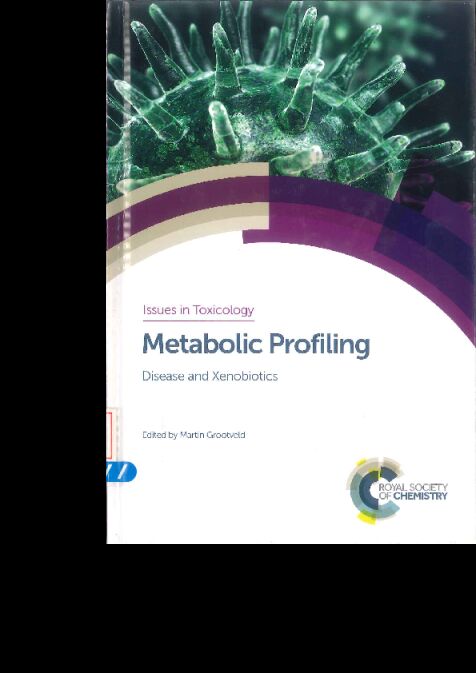
书名:Metabolic profiling
ISBN\ISSN:9781849731638,1849731632
出版时间:2015
出版社:Royal Society of Chemistry,
摘要
Multivariate analysis of the multi-component analytical profiles of carefully collected biofluid and/or tissue biopsy specimens can provide a 'fingerprint' of their biomolecular/metabolic status. Therefore, if applied correctly, valuable information regarding disease indicators, disease strata and sub-strata and disease activities can be obtained.
This exemplary new book highlights applications of these techniques in the areas of drug therapy and toxicology, cancer, obesity and diabetes, as well as outlining applications to cardiovascular, infectious, inflammatory and oral diseases in detail. The book gives particular reference to cautionary measures that must be applied to the diagnosis and classification of these conditions or physiological criteria. Comprehensively covering a wide range of topics, of particular interest is the focus on experimental design and 'rights and wrongs' of the techniques commonly applied by researchers, and the very recent development of powerful 'Pattern Recognition' techniques.
The book provides a detailed introduction to the area, applications and common pitfalls of the techniques discussed before moving into detailed coverage of specific disease areas, each highlighted in individual chapters. This title will provide an invaluable resource to Medicinal chemists, Biochemists and toxicologists working in industry and academia.
查看更多
目录
Chapter 1 Introduction to the Applications of Chemometric Techniques in 'Omics' Research: Common Pitfalls, Misconceptions and 'Rights and Wrongs' 1
Martin Grootveld
1.1 Introduction 1
1.2 Principal Component Analysis (PCA) 2
1.2.1 Critical Assumptions Underlying PCA 4
1.2.2 Number and Significance of Explanatory Variables Loading on a PC 9
1.2.3 Number of Extractable PCs and Their Characteristics 9
1.2.4 Total Variance of the Dataset 10
1.2.5 What is an Adequate Sample Size for PCA and Further Forms of MV Analysis? 10
1.2.6 Interpretability Criteria of PCs 11
1.2.7 Varimax Rotation 12
1.2.8 Example Case Study 13
1.2.9 Examination of a Wider Range of Components 15
1.2.10 Consideration of Type I (False-Positive) Errors 16
1.2.11 Determinations of the Suitability of MV Datasets for Analysis with PCA and FA 17
1.3 Partial Least Squares-Discriminatory Analysis (PLS-DA) 18
1.3.1 Case Study Describing an Example of PLS-DA 'Overfitting' 20
1.3.2 Permutation Testing 22
1.3.3 Procedures for the Validation and Cross-validation of PLS-DA Models 24
1.3.4 Attainment of the Final Calibration Model 28
1.3.5 Quality Evaluation Processes 28
1.3.6 Cost-Benefit Analysis [CBA) 30
Appendix I 31
Appendix II 33
Acknowledgements 33
References 33
Chapter 2 Experimental Design: Sample Collection, Sample Size, Power Calculations, Essential Assumptions and Univariate Approaches to Metabolomics Analysis 35
Martin Grootveld and Victor Ruiz Rodado
2.1 Introduction 35
2.2 Essential Considerations for Sample Collection 36
2.3 Raw Data Preprocessing Steps 39
2.4 Data Normalisation, Scaling and Dimensionality Reduction 42
2.5 Assumption of Normality 44
2.6 Analysis-of-Variance (ANOVA): Experimental Design and Analysis 50
2.6.1 Model I: Fixed Effects 50
2.6.2 Model II: Random Effects 53
2.6.3 Hierarchical or 'Nested' Models 54
2.6.4 Factorial/Multifactorial Models 54
2.6.5 ANOVA-Simultaneous Component Analysis 57
2.6.6 Further Considerations of Interaction Components of Variance in MV Modeling 57
2.7 Outline of the Applications of Univariate Approaches to the Analysis of Metabolomics Datasets 58
2.7.1 More on Essential Assumptions Required 60
2.7.2 Bonferroni Correction for Multiple Comparisons of Mean Values 62
2.8 Power (Sample Size) Computations for Untargeted, Univariate Investigations of Metabolomics Datasets 64
2.9 Sample Size Requirements and Statistical Power Computations for High-Dimensional, Metabolomic Datasets 67
2.10 Error Analysis 69
Acknowledgements 69
References 70
Chapter 3 Recent Developments in Exploratory Data Analysis and Pattern Recognition Techniques 74
Martin Grootveld
3.1 Introduction 74
3.2 Canonical Correlation Analysis (CCorA) 75
3.2.1 CCorA Case Study 76
3.3 Classification and Regression Tree (CART) Analysis 80
3.4 Moderated t-Statistic Methods 81
3.4.1 Significance Analysis of Microarrays (SAM) 81
3.4.2 Empirical Bayesian Approach Modelling (EBAM) 82
3.5 Machine Learning Techniques 83
3.5.1 Self-Organising Maps (SOMs) 83
3.5.2 Support Vector Machines (SVMs) 85
3.5.3 Random Forests (RFs) 86
3.6 Cluster Analysis 86
3.6.1 Agglomerative Hierarchal Clustering (AHC) Methods 89
3.6.2 Clustering Analysis Case Study 91
3.7 Novel Approaches to the Analysis of High-throughput Metabolomics Datasets 92
3.7.1 Genetic Algorithms 95
3.7.2 Gaussian Graphical Models 96
3.7.3 Independent Component Analysis (ICA) 98
3.8 Multidimensional Data (P>n) Problems Encountered in MV Regression Modelling 101
3.8.1 Regression Regularisation 102
3.8.2 Model Tuning and Optimisation via an M-Fold Cross-Validation Process 102
3.8.3 Principal Component Regression (PCR) 103
3.8.4 Partial Least Squares Regression (PLS-R) 104
3.8.5 Correlated Component Regression (CCR) 104
References 110
Chapter 4 Analysis of High-dimensional Data from Designed Metabolomics Studies 117
Johan A. Westerhuis, Ewoud J. J. van Velzen, Jeroen J. Jansen, Huub C. J. Hoefsloot and Age K. Smilde
4.1 Introduction 117
4.2 Case Study 1: The Effect of Jasmonic Acid on the Production of Glucosinolates in Brassicaceae oleracea 119
4.2.1 The ANOVA Model 121
4.2.2 The ASCA Model 121
4.2.3 Concluding the Glucosinolate Study 125
4.3 Case study 2; Metabolic Modifications Following Polyphenolic Intervention in Humans 125
4.3.1 Multivariate Consequence 126
4.3.2 The Multilevel PLSDA Model 128
4.3.3 The Study Setup 130
4.3.4 Analysis of Pooled Samples 130
4.3.5 Dynamic Non-linear Analysis of the Urinary ~1H NMR Data 133
4.3.6 Short Conclusion on Case Study 2 133
4.4 Conclusion 134
Acknowledgement 135
References 135
Chapter 5 Current Trends in Multivariate Biomarker Discovery 137
Darius M. Dziuda
5.1 Introduction 137
5.2 Common Misconceptions in Biomarker Discovery based on p»N Datasets 138
5.2.1 Univariate [Rather than Multivariate) Analysis 139
5.2.2 Using Unsupervised (Rather than Supervised) Learning Algorithms 140
5.3 Feature Selection 142
5.3.1 Search Models 143
5.3.2 Search Strategies 143
5.3.3 Stability of Results 144
5.4 Supervised Learning Algorithms 145
5.4.1 Linear Discriminant Analysis 145
5.4.2 Support Vector Machines 150
5.4.3 Random Forests 155
5.5 Searching for Multivariate Biomarkers that are Robust and Biologically Interpretable 156
5.5.1 Informative Set of Genes 157
5.5.2 Modified Bagging Schema 158
5.5.3 Identification of Parsimonious Biomarkers that are Robust and Interpretable 159
References 160
Chapter 6 Discovery-based Studies of Mammalian Metabolomes with the Application of Mass Spectrometry Platforms 162
Warwick B. Dunn, Catherine L Winder and Kathleen M. Carroll
6.1 Introduction 162
6.2 Mass Spectrometry Instrumentation 168
6.2.1 Sample Introduction 169
6.2.2 Ion Formation 170
6.2.3 Mass Ion Separation According to Mass-to-charge Ratio 170
6.2.4 Ion Detection and Data Acquisition 172
6.2.5 Instrument Control and Data Processing 174
6.2.6 Other Considerations 175
6.3 Sample Introduction Systems 176
6.3.1 Direct Infusion Mass Spectrometry (DIMS) 176
6.3.2 Gas Chromatography-Mass Spectrometry 177
6.3.3 Comprehensive GCxGC-MS 180
6.3.4 High Performance Liquid Chromatography-Mass Spectrometry 181
6.3.5 Capillary Electrophoresis-Mass Spectrometry 184
6.4 Moving from Small-scale to Large-scale Metabolomic Studies 185
6.5 Concluding Remarks 188
Acknowledgements 188
References 188
Chapter 7 Recent Advances in the Multivariate Chemometric Analysis of Cancer Metabolic Profiling 199
Kenichi Yoshida and Martin Grootveld
7.1 Introduction 199
7.2 MV Chemometric Analysis of Cancer 202
7.2.1 Infrared Spectroscopy 202
7.2.2 Nuclear Magnetic Resonance Spectroscopy 203
7.2.3 Mass Spectrometry 206
7.2.4 Other Methods 207
7.2.5 Further Considerations 208
7.3 Summary 208
References 209
Chapter 8 Group-specific Internal Standard Technology (GSIST) for Mass Spectrometry-based Metabolite Profiling 220
Jiri Adamec
8.1 Introduction 220
8.2 Basic Principles of GSIST 221
8.3 Application of GSIST 223
8.3.1 Absolute Quantification Targeting Specific Functional Groups: Determination of Estrogens 223
8.3.2 Absolute Quantification Targeting Multiple Functional Groups: Analysis of Central Carbon and Energy Metabolism 227
8.3.3 Relative Quantification of Unknown Metabolites in Complex Samples: Determination of Triterpenoid Metabolomic Fingerprints 234
8.3.4 Discovery of Novel Metabolites 240
8.4 Conclusion 247
Acknowledgements 247
References 248
Chapter 9 ~18O-assisted ~31P NMR and Mass Spectrometry for Phosphometabolomic Fingerprinting and Metabolic Monitoring 255
Emirhan Nemutlu, Song Zhang, Andre Terzic and Petras Dzeja
9.1 Introduction 255
9.2 Methodology 259
9.2.1 Phosphometabolomic Platforms 259
9.2.2 ~18O Metabolic Labelling Procedure 261
9.2.3 GC/MS Analysis of ~18O-labelling of Metabolite Phosphoryls 262
9.2.4 ~31P NMR Analysis of ~18O Incorporation into Phosphoryl Metabolites 265
9.2.5 Phosphometabolite Analysis by ~1H-NMR 267
9.2.6 Data Analysis and Calculations of Phosphoryl Turnover and Phosphotransfer Fluxes 267
9.2.7 Multivariate Statistical Analysis 269
9.3 Results 270
9.3.1 Phosphometabolomic Profiling of Transgenic Animal Models 270
9.4 Conclusions 277
Abbreviations 278
Acknowledgments 278
References 279
Chapter 10 Investigations of the Mechanisms of Action of Oral Healthcare Products using ~1H NMR-based Chemometric Techniques 287
C. J. L. Silwood and Martin Grootveld
10.1 Introduction 287
10.1.1 High-resolution NMR Analysis of Human Saliva 288
10.1.2 Applications of Multivariate (MV) Statistical Techniques to the Interpretation of Salivary ~1H NMR Profiles 290
10.2 Case Study: ~1H NMR-based Multivariate Statistical Analyses of Human Saliva Samples before and after Treatment with an Oxyhalogen Oxidant-containing Oral Rinse Product 293
10.2.1 Materials and Methods 294
10.2.2 Results 303
10.2.3 Discussion 314
10.3 Conclusions 316
References 317
Chapter 11 Metabolomics Investigations of Drug-induced Hepatotoxicity 323
Wei Tang and Qiuwei Xu
11.1 Introduction 323
11.2 Drug-Induced Liver Injury (DILI) 324
11.3 Possible Mechanisms Underlying DILI 326
11.3.1 Drug Metabolism and Elimination 326
11.3.2 Direct Cytotoxicity and Immune-mediated Reactions 329
11.3.3 Ambiguous Nature of Current Understandings of DILI 333
11.4 Metabolomics 336
11.5 Application of Metabolomics in Studies of DILI 339
11.5.1 Mechanistic Investigation 339
11.5.2 Searching for Biomarkers 342
11.6 Summary and Closing Remarks 345
Acknowledgements 347
References 347
Chapter 12 Chemogenomics 357
Virendra S. Gomase, Akshay N. Parundekar and Archana B. Khade
12.1 Introduction 357
12.2 Privileged Structures 358
12.3 Drugs Arising from the Side-effects - SOSA Approach 359
12.4 Classification of Chemogenomics 360
12.5 Chemogenomics Screens 361
12.6 Haploinsufficiency Profiling 362
12.7 High-content Screening 363
12.8 Mode of Action by Network Identification 364
12.9 Current Research in Chemogenomics 364
12.10 Bioinformatics 365
12.11 Kinase Activity 365
12.12 Oncology 366
12.13 Ligand-binding Study 367
12.14 Metabolomics 367
12.15 Pharmacophore 367
12.16 Cheminformatics 368
12.17 Pharmacogenomics 368
12.18 Drug Safety 369
12.19 Evaluating Complex Signalling Networks 369
12.20 Current Trends in Chemogenomics 370
12.20.1 Stem Cells 370
12.20.2 Schistosomiasis 370
12.20.3 Ligand-Enzyme Interaction 370
12.20.4 Cytoscape Plug-ins 370
12.20.5 Novel Screening Technologies 371
12.20.6 Anti-HIV Drugs 371
12.21 Discussion 371
12.22 Conclusion 372
References 373
Subject Index 379
查看PDF
查看更多
馆藏单位
中国医科院医学信息研究所